




[Editor’s Note: The following is excerpted from David Stringer’s upcoming book, Speaking for Myself, scheduled for release following the November 2026 election.]
The Republican Men’s Forum in Prescott, Arizona, is one of the oldest and most distinguished political clubs in the state. Membership is open to any Republican in good standing. But those regularly attending the monthly luncheons are heavily skewed towards a local elite of business and professional figures, elected officials and candidates for office. Over the years, top state and local Republican leaders from the Governor on down have appeared as guest speakers.
My turn came in June of 2018 as I finished my first term in the state legislature. By tradition, after sine die–the end of the legislative session– usually in May or June, the Men’s Forum would invite the LD1 delegation to give a wrap-up of the session and what they had accomplished for the District.
At the June 2018 luncheon in the ballroom of the St Michaels Hotel, I was joined by my colleagues Sen Karen Fann and Rep Noel Campbell. As the youngest in seniority, I spoke last. As I thought about what I might say in the days leading up to the event, I was a little nervous. The fact is, I hadn’t accomplished much. I’d been the conservative legislator I’d promised to be. I’d supported some good Republican legislation, including tax relief and an expansion of the ESAs. And in the narrowly divided House I’d blocked some bad legislation, including Governor Ducey’s Red Flag bill which made a mockery of due process. But my interest in criminal justice reform hadn’t really caught on. The Republican brand is ‘tough on crime’. Criminal Justice Reform turned out to be a tougher sell than I expected. Notwithstanding Arizona’s high incarceration rate and exploding prison costs, few of my Republican colleagues were willing to stick their necks out for even the most basic, common-sense reforms.


Luckily, the day before the luncheon I received my legislative score card listing the bills I had either sponsored or co-sponsored. As a small government conservative, I was surprised at how many bills I’d signed on to—over sixty as I recall. I found enough to cobble together a few remarks for the Men’s Forum.
But I needed a closer. I’d spent my career as a trial attorney, arguing cases before juries. I understood the importance of a strong close—something fresh and unexpected, something with a little dramatic flair. My colleagues may have had more legislative accomplishments. But I had the power of ideas. I’d been an early Trumper. I understood why the slogan Make America Great Again and his America First rhetoric resonated so deeply with voters. Trump was the first national candidate in my lifetime to talk about the negative impact of too much immigration and openly champion the interests of the White working class.
As a member of the House Education Committee, I studied Arizona’s public school system. I learned about the changing demographics of public education and the challenges this presented to academic performance. Every report we saw on the academic performance of Arizona students noted the marked disparities among racial and ethnic groups. The disparities invariably showed Asians and Whites at the top and Hispanics, Native Americans and Blacks at the bottom. Arizona’s schools became majority nonwhite in 2010. By the time I spoke in June 2018, sixty percent of the state’s public school students were classified as nonwhite. In 2026—a short eight years later– White kids have declined to 33.9% (1) of the state’s public school population. That percentage continues to go down with every yearly census.
The 1954 Supreme Court decision in Brown v Board of Education, which mandated the racial integration of America’s public schools, was handed down when the composition of the United States looked very different. The 1950 US Census placed the White percentage of the US population at 89%. It could reasonably be expected that racially integrated schools would be majority White and that children of African descent—then America’s largest minority group—would benefit from the stronger academic standards in majority White schools. It never quite worked out that way. But by 2018 in Arizona, White kids had become a racial minority.
In the 2016 Presidential election, Donald Trump made building a wall to keep out illegal immigrants a signature issue. By the time I spoke at the Men’s Forum, Trump was a year and a half into his first term and had made good on his promise. Trump closed the border to illegals, but it was obvious that the millions of third world immigrants who had gained legal status since the 1965 Immigration Reform Act were changing the demographic makeup and culture of the United States.



I decided to make this the ‘closer’ for my remarks. A lot of Yavapai County Republicans, living in a predominantly White county, didn’t seem to know that Arizona’s school population had tipped to majority nonwhite. The changing demographics of the state meant that our future work force, our police and military, our media and cultural institutions would be majority nonwhite within a generation. And so would be the voters in future elections. There is no precedent for demographic change of this magnitude in the history of nations. Although I did not use denigrating or racially charged language, there was clearly a racial theme to my remarks. At the time, many people considered race to be the ‘third rail’ of American politics. Political opponents denounced me as a racist. Many others who wished me well thought I had been overly frank and politically stupid.
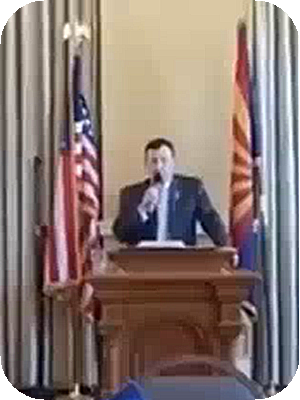
Fortunately—and unknown to me as I spoke—a campaign assistant recorded my remarks on a cell phone. The video of my remarks were live streamed on Facebook and went viral. What they show is that after a few rambling opening remarks about my first term in the legislature, I segued to the issue of immigration and demographic change, which I described as an “existential threat” to the United States. Some people thought my remarks were extemporaneous and that I had inadvertently gone too far. The truth is there was nothing unplanned about what I said. From the video you can see me at the podium turning the pages of prepared remarks.
I pointed out the obvious fact that immigration was changing the demographics of the state. Remembering Brown, I noted that the change in the student population to majority nonwhite, “complicated school integration because there weren’t enough White kids to go around.” I meant every word of it.
The response from the media and political establishment was outrage. Within a day I got a text from a couple of young campaign workers who were driving to the East Coast. They told me that my remarks were being reported on national news. I was told that Governor Ducey (he never contacted me personally) had publicly denounced me as a racist and demanded that I resign from the legislature and drop my campaign for re-election [2]
Jonathan Lines, then head of the State Republican Party, did call me personally to say that my remarks were ‘going viral’ and could hurt other Republicans across the state. He asked me to quit the legislature and drop my campaign for re-election. When I refused, he said the state party would support my primary opponent and abruptly hung up. As a result of this attitude, money that might have saved other Republican candidates around the state flowed into Yavapai County to defeat me.
It was a waste of money. I went on to win my contested primary by fifteen points. In the November general election, I had the second highest vote tally in the state for a seat in the House of Representatives. But powerful figures in Republican politics had gone so far to the dark side, they couldn’t walk it back. Despite an endorsement from LD1 voters, my standing as a state political figure never recovered.
Fast forward eight years to 2026. Trump is back and pushing an America First agenda. He’s built the Wall, closed the border and is repatriating illegals. The only asylum seekers allowed in at the moment are White South Africans fleeing racial discrimination in a majority Black country. In retrospect, my remarks from 2018 that caused such an uproar, sound like prophecy. If I accomplish nothing else in politics, I can honestly say that I used my few minutes on the public stage to speak the truth on behalf of my people. In the short run, I’ve taken a beating. But my political faith is that in the fullness of time, truth tellers with the best ideas will prevail.
Endnotes:


[1] CoPilot AI
[2] Twitter, June 14, 2018 from Gov. Ducey’s spokesman, @DanielScarpinato





5 thoughts on “The Speech That Changed Yavapai County Politics – David Stringer, Publisher”
Mr. Stringer, there was nothing racist about your comments. Its never wrong to speak the truth.
I remember the brouhaha in the media. It was a ‘the Emperor has no clothes’ moment in Arizona politics. Yavapai County stood behind you in 2018. Looking forward to your book.
David, you left out the Executive Board of the Yavapai County Republican Party was quick to condemn your comments (5-2). Funny since most were at the St. Michaels hotel the previous meeting of the Republican Men’s forum and heard your comments without a whisper of disapproval.
Just proves politics is an emotional matter with people that have a thin understanding of conservatism and telling the truth.
Shamefully, the media and ‘White Toady’ politicians misquoted Stringer at the time. But the video shows what he actually said. Pretty tame by today’s standards.
Republican Rhino’s like to pretend that race doesn’t matter. But they only win elections in Arizona when there is a big turnout in the White precincts and the rural counties like Yavapai.
Stringer’s book comes out after the November election. It looks like he’s going to get the last word.
David’s article shows how often Republicans turn on their own in the face of overblown media outrage. We can only hope the Trump has taught them the lesson, that no matter what one says or does, someone, somewhere, will be offended and complain. The key is to respond with facts and truth. The result will be that the media hyped controversy dies on the vine.
I think a lot of Americans totally agree that immigration is changing this country and want it to stop but they are afraid to speak out. They are afraid they will be labeled as racist . I’m not. Mass deportation is needed NOW!
Comments are closed.