




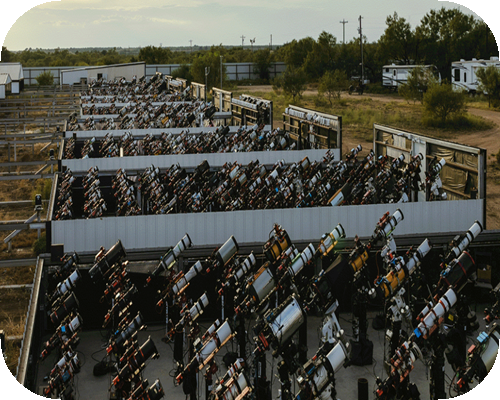
Starfront Observatories in Rockwood, Texas, opens a window on the heavens for stargazers around the world. Jenna Diaz for The Epoch Times
Deep in Texas’s dark sky country near dusk, roofs slide back like cigar box lids to reveal a sea of telescopes lifting their gaze to the heavens.
Starfront Observatories is a telescope ranch with 18 buildings and 1,000 telescopes on 35-acres in the middle of nowhere. There, the Edwards Plateau gives way to the rolling plains of West Texas.
1K TELESCOPES
1,000 telescopes at Starfront Observatories make stargazing possible for viewers around the world.
It’s a lonely spot at the end of a stark stretch of Highway 83 near Rockwood, where coyotes and deer far outnumber about 80 residents.
A couple of donkeys on the neighboring ranch are the observatory’s only frequent visitors.
Bray Falls, a 28-year-old aerospace engineering graduate turned astrophotographer, helped found Starfront Observatories. He has discovered 10 planetary nebulae and several supernova remnants, making him a rock star in the literal sense.
He specializes in deep-sky astrophotography and shares image-processing techniques and scientific discoveries on social media. On YouTube and Instagram alone, he has about 700,000 followers.
For Falls, being in the dark is the point.
The telescope ranch’s isolated location is rated a Bortle One dark-sky site, which is the best dark-sky rating, based on sky brightness and observable celestial features. The lack of light pollution, combined with predominantly dry, clear weather, makes it ideal.
Falls has been living on-site with fellow techies in RVs to staff the remote viewing observatory. There, astronomers and astrophotographers can pay to install their own telescopes or rent the equipment from Starfront.
Telescope Ranch
Falls worked as an engineer for Honeywell for about a year, but it wasn’t for him. So he and three other co-founders—Dustin Gibson, Josh Kim, and Nathan Hanks—launched the operation in April 2024 and funded it themselves.
“I thought it was a great idea, and someone was going to do it eventually. So I was like, just do it,” Falls told The Epoch Times.
According to the website, Starfront is “the largest remote observatory in the world by number of telescopes.”
Falls said that while a few similar but smaller “backyard” businesses exist in California, Nevada, Utah, and New Mexico, they serve a different purpose or operate at a different scale than Starfront.
Remote observing isn’t new, but Starfront is making astrophotography and astronomy affordable for the masses, he said.
So far, business is booming with 150 people on the waitlist for the $99 monthly rental of an entry-level telescope pier with a Seestar smart telescope. More telescope buildings are under construction.
Renters can log in through the Seestar app to view a live camera feed of the sky on their device. The app allows them to control pointing and imaging.
Those with their own equipment use different apps and software, but viewing operates similarly.
The setup lets people access dark skies even if light pollution or weather makes stargazing difficult where they live.
Starfront’s business model offers rental opportunities that eliminate the cost of buying expensive equipment. For those who already own their own telescopes, it costs far less than the thousands of dollars traditionally charged for hosting, he said.
Clients can ship their gear or drop it off in person at the observatory for installation on a rented pier.
Remote viewing offers advantages to stargazers in cities like New York and London, who may have the money to buy big telescopes but might only get to use them 15 nights a year because of weather and geography, he said.
If customers want to buy their own equipment, Falls said good entry-level telescopes can cost around $600. As technology has improved, smart telescopes like the Seestar S30 now do what a $3,000 scope could do a decade ago.

The Milky Way, as seen by telescopes at Starfront Observatories in Rockwood, Texas. Courtesy of Starfront Observatories
240 NIGHTS PER YEAR
At Starfront, star viewing is available 220 to 240 nights per year.
The ranch has fiber internet to support remote control and image transfers. The team also sets up and maintains customers’ equipment and provides technical support.
The observatory is adding more smart telescopes for rent. They are smaller, require minimal setup, have all-in-one astrophotography systems, and include built-in computers.
Unlike traditional telescopes, they don’t require manual alignment or separate cameras, and customers can control them via an app.
Rain, Rain, Go Away
At Starfront, viewing is available 220 to 240 nights a year. If skies are clear, the tops automatically roll back around sunset. Falls said someone monitors the weather 24 hours a day for rain and storms.
Some of the high-end models at Starfront are in the $150,000 range. Falls doesn’t take any chances with the weather.
As autumn approached in West Central Texas, anvil-shaped thunderheads lurked on the horizon, and the smell of yesterday’s rain clung to the air.
On a hot September evening, Falls said the telescopes would likely remain covered that night. Cumulus clouds with bruised flat bottoms threw hard shadows across the plains, and even a slight chance of rain was too risky.
The observatory also acts as a hub for astrophotography projects. People collaborate on a single object, “stacking” hundreds of frames until the space noise falls away.
Long exposure photos pick up random grain, static, and heat interference along with starlight. By taking dozens or hundreds of short, identical photos of the same galaxies or stars, software can recognize the noise and remove it.
“It’s way more fun,” Falls said, because teamwork allows stargazers to see objects they couldn’t see before.
“If you’re just doing it yourself, it would take years and years of your scope on one thing, which is no fun. But when you do it together, you can get it done in a couple of weeks,” he said.
A Kid With Binoculars
For Falls, his fascination with celestial objects began as a kid and led him into the observatory business.
When he was 13, he saw Jupiter’s moons for the first time while living in Phoenix.
“I just used my dad’s binoculars out in the backyard, and then I was like, ‘Oh, there’s a whole bunch of stuff that is over my head that I’ve never seen before,’” he said.
While other teens played sports, Falls was looking up. His fascination with the heavens guided him as he began photographing far-flung galaxies.
Falls pulls up photos on his phone demonstrating some of his discoveries, including a probable supernova remnant in Virgo he named the Crown of Thorns Nebula. The honor of suggesting names for astronomical objects belongs to those who find them.
“Oftentimes you may see something that hasn’t been seen before or something weird,” he said.
“I try to not get excited until I’m done with my photo and can share it with the world if there’s something new.”
Reaching for the Stars
Starfront is expanding into Australia with a second observatory. That move will let customers in the United States view the night sky remotely during daytime hours.
Viewing the skies in the Southern Hemisphere has advantages because it offers a direct view of the Milky Way, which appears bigger and brighter there than in the northern half of the sky. Australia also offers a clear view of the Magellanic Clouds—the largest and most well-known dwarf galaxies in the Milky Way’s orbit—along with the famous star cluster Omega Centauri and the Southern Cross constellation.
Starfront is exploring a partnership with the Library Telescope Program once the Australian observatory is running.
The program lets public libraries, schools, and community organizations lend telescopes to the public, like checking out a book. It currently has more than 1,200 participating libraries and organizations.
The program uses modified, lightweight tabletop telescopes such as the Apertura Library Telescope that require no prior astronomy experience. The loaner telescopes operate with a simple zoom eyepiece.
Starfront is also considering a free online public viewing program. “ I would eventually like to give away logins for limited-time events, “ he said.
For Falls, expanding public access gives him the chance to share the love.
“It’s very inspirational, and I think it’s important,” he said.
Starry skies above Starfront Observatories in Rockwood, Texas, in this undated photo. The telescope ranch’s isolated location is rated a Bortle 1 dark-sky site. Courtesy of Starfront Observatories



Darlene McCormick Sanchez | THE EPOCH TIMES
Recent Articles
Freaky Foot Tours Presents the Prescott Haunted History Tour
November Voter Publicity Pamphlet has Error in it
CAFMA and Prescott Fire Department Invite Community to Help Shape Wildfire Protection Plan
City of Prescott Invites Community Members to Learn More About Long-Term Water Management Plan