




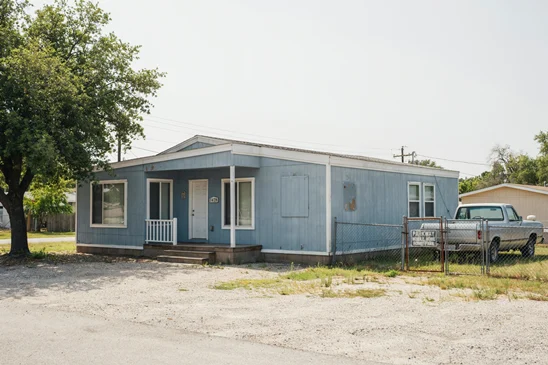
Manufactured housing may become an important part of solving today’s housing crisis.
At the MBA Annual Convention and Expo in Chicago last week, leaders from the U.S. Department of Housing and Urban Development and Ginnie Mae spoke to attendees about what they are expecting for the future of manufactured housing now that the 21st Century ROAD to Housing Act is law.
The federal chassis mandate was eliminated with the law’s passage, clearing the way for more production of manufactured homes, which are cheaper to build and more affordable than existing homes on the market.
Matt Jones, deputy assistant secretary for Single Family Housing at HUD and President Donald Trump’s nominee to serve as the commissioner of the Federal Housing Administration, told the crowd at Tuesday’s “HUD Update” session that he thinks the removal of the chassis mandate is one of the most impactful measures in the sweeping bipartisan bill.
Jones explained that with the federal law changing, today’s modular builders will be able to claim federal preemption and there will be pressure on states to update their codes to align with the national standard.
“At a 30,000-foot view, what this means is we think there will be a significant acceleration of factory-built, non-site-built housing,” Jones said.
He added that modern manufactured homes, similar to the ones seen on the National Mall in Washington, D.C., last month during HUD’s Innovative Housing Showcase, are very different than manufactured homes built decades ago.
“I think for most people they wouldn’t even be able to tell the difference between a site-built home and a factory-built home,” Jones said.
Jones said they were talking with conference attendees about financing and investing in manufactured housing.
“A lot of it is about destigmatization, but it certainly helps to have the actual product that’s coming to market look so much like any other home,” Jones said.
Ginnie Mae’s President Joseph Gormley, who is currently overseeing FHA and the Office of Housing, agreed with Jones that the money to finance loans for manufactured homes can be found.
“From the financing and investment side, one of the things we have found is investors are actually willing to pay up for manufactured housing loans because they tend to have a longer duration,” Gormley said.
Gormley said that it is hard to describe the current excitement about the possibilities for manufactured homes, and although they won’t provide a complete solution to supply issues, they can be a key component in bringing more supply online.
Gormley told MBA attendees at the session that HUD Secretary Scott Turner has made manufactured housing a priority. During Turner’s confirmation hearing, he said he would work to eliminate costly delays and undue regulatory burdens.
Turner also committed to meeting with the builders who run factories across the country that produce manufactured housing.
At the Innovative Housing Showcase, Champion Homes unveiled a two-story, three-bedroom, 2.5-bathroom, 1,700-square-foot manufactured home that is designed as an urban infill solution.
Cavco Industries unveiled Grande Arbor, the first HUD-code manufactured home built without a permanent steel chassis frame.
MBA’s Annual Convention and Expo wrapped up on Oct. 14. Next year’s convention will be held in Nashville.



KIMBERLEY HAAS | The Mortgage Note
Recent Articles
Freaky Foot Tours Presents the Prescott Haunted History Tour
November Voter Publicity Pamphlet has Error in it
CAFMA and Prescott Fire Department Invite Community to Help Shape Wildfire Protection Plan
City of Prescott Invites Community Members to Learn More About Long-Term Water Management Plan