




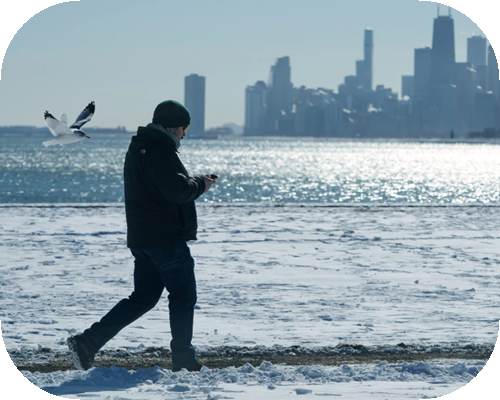
A person walks near the snow-covered sand at Lake Michigan in Chicago, Jan. 28, 2026. (AP Photo/Nam Y. Huh, File)
Winter in the United States looks like it will generally be wetter and warmer, but not necessarily snowier, according to the federal government’s seasonal outlook and other meteorologists’ forecasts. You can thank or blame El Niño.
El Niño is likely to shift weather patterns to bring more moisture, but with it higher temperatures. That should help erase persistent Western drought, but it won’t likely make Northern snow-lovers happy, the National Oceanic and Atmospheric Administration said Thursday.
“This is going to be a winter that’s really difficult for them to find what they’re looking for,” said James Belanger, vice president of meteorology for the Weather Company.
El Niño, the natural but temporary warming in parts of the Pacific, generally warms the globe. Although it disrupts weather conditions around the world in dramatically different ways, its effects tend to follow predictable regional patterns, especially when El Niño is strong like it is right now. That gives forecasters greater confidence in what lies ahead.





All this is on top of a U.S. winter that has warmed about 4 degrees (2.2 degrees Celsius) in the past 50 years, predominantly from human-caused climate change, according to NOAA.
The best chance of snow could actually shift south
“Listen, even in the winter months, it doesn’t mean you’re not going to have snow. It doesn’t mean you might not have a snowstorm,” National Weather Service Director Ken Graham said in a media briefing presenting the three-month winter outlook. “So it doesn’t erase the risk.”
The Northern snow shrinkage is also predicted by private meteorology firms. Salt Lake City is the only big metro area where AccuWeather expects above-normal winter snow amounts. Chicago, Boston, New York and Philadelphia are forecast to get about half or less of their normal winter snow, the firm said.
And a White Christmas? Consider a plane ride to the Southern Rockies, Belanger said. Otherwise, “Santa’s gonna find a barren landscape when he returns in late December.”
A warmer winter can still pack a punch


Part or all of 41 of the Lower 48 states are forecast to be warmer than normal. No states — or even parts of states — are forecast to be cooler than average. Florida, Louisiana, southern Georgia, Alabama and Mississippi are forecast to be near normal. There’s equal chance of warm, cold or normal in Texas, New Mexico, Arizona, Utah, Southern California, Nevada, Wyoming, western Oklahoma, Kansas and Nebraska.
And the dreaded polar vortex with its icy blast of Arctic air escaping into the United States? That shouldn’t happen as much as most winters, but that doesn’t mean it won’t happen at all, said National Weather Service meteorologist and branch chief Jon Gottschalck.
“It only takes one storm to flip the script, especially for the East Coast cities,” said AccuWeather lead long-range forecaster Paul Pastelok, who said to especially watch for Eastern snowstorms in late January and February.
AccuWeather is more bullish than NOAA for snow in the Rockies regions, calling for Denver to have 10 to 18 days with at least 2 inches (5 centimeters) of snow, which is more than the historical average of 9 inches (23 centimeters). The company’s overall snow forecast for Denver is still around average, but considerably more than last winter.
Drought relief comes with a downside
NOAA is forecasting that parts of all of 39 states will see a wetter-than-usual winter, with much of Montana and parts of Oregon, Idaho, Wisconsin and Michigan being drier.
“We anticipate drought conditions to improve or end for western portions of Oregon and western Washington state, the Southwest, the central and southern Rockies, the southern Great Plains, the lower Mississippi Valley, and areas in the East,” Gottschalck said.

Mike Bettes, a meteorologist at The Weather Channel, said it will likely be too much rain for California: “We’d anticipate numerous, high-impact atmospheric rivers that could bring extensive flooding and landslides this winter.”
Atmospheric rivers are long and relatively narrow bands of water vapor. They take water from oceans and flow through the sky, dumping rain in prodigious amounts.
Florida and parts of the Southeast should also be on guard for more tornadoes this winter and early spring because of El Niño, Gottschalck said.


A record El Niño puts forecasters in uncharted territory
Forecasters across the globe expect the current El Niño to reach record levels this fall or winter. Graham, the weather service chief, noted that a strong El Niño doesn’t mean its impacts are stronger, but it does make the weather easier to predict.
Winter weather expert Judah Cohen, an MIT research scientist, is waiting a couple more weeks before making his forecast. He says an unprecedented El Niño is “a reason not be more confident, but less confident.”
“We have no real historical analog or precedent,” Cohen said. “When every meteorologist on the planet is on the same side, I get nervous. We’re not that good.”
___
The Associated Press’ climate and environmental coverage receives financial support from multiple private foundations. AP is solely responsible for all content. Find AP’s standards for working with philanthropies, a list of supporters and funded coverage areas at AP.org.


SETH BORENSTEIN
Recent Articles
CAFMA and Prescott Fire Department Invite Community to Help Shape Wildfire Protection Plan
City of Prescott Invites Community Members to Learn More About Long-Term Water Management Plan
October Gardening Classes Every Saturday at Watters Garden Center
City of Prescott to Host Public Meeting on Willow Lake Management Plan