



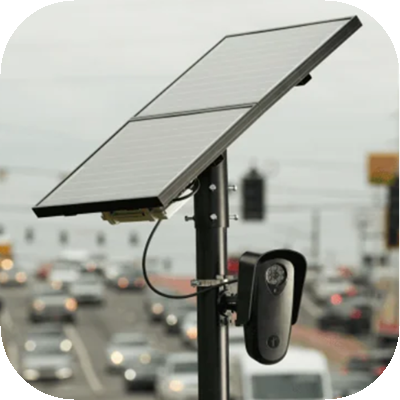
Recent scrutiny of Flock has raised concerns about who can access the information these cameras collect, how it’s used, and what safeguards exist to prevent abuse. D.C. officials have asked important questions about how the Metropolitan Police Department uses Flock Safety’s automated license plate readers, but they should not stop there.
D.C. residents move daily through a network of technologies that collect information about where we drive, where we walk, who we associate with, what we post online, and, in some circumstances, where our phones are located. Most residents have little idea how extensive that network has become. The scrutiny of Flock should spark a broader conversation about how D.C. tracks its residents, who has access to that information, and whether these technologies are actually making us safer.
The Metropolitan Police Department uses gunshot-detection technology, an extensive network of public and privately connected CCTV cameras, automated license plate readers, social-media monitoring, drones and other surveillance tools. Police also use cell-site simulators, sometimes called Stingrays, that mimic cell towers to locate a targeted phone while also collecting information from other devices nearby.
In 2024, D.C. opened its Real-Time Crime Center, which brings together information from cameras, gunshot detection and other sources. The police department has said the center draws on more than 1,500 publicly and privately owned cameras, along with other monitoring technologies.
Surveillance affects more than people suspected of crimes. A license plate reader does not know whether the person driving past it is under investigation. A cell-site simulator can collect information from devices belonging to people who happen to be nearby. Cameras record thousands of people simply moving through public spaces. Records obtained by the Brennan Center show that the Metropolitan Police Department has used social media surveillance to monitor racial justice protests and collect information about people in predominantly Black communities, including individuals who were not suspected of crimes.





Surveillance is not experienced equally across the District. ShotSpotter offers one example: 43 percent of D.C. alerts originate in Ward 8 and an additional 32 percent in Ward 7. The Investigative Workshop reported in 2025 that “there were virtually no sensors listed in the majority-White Wards 2 and 3. Most of the sensors on the list were installed in Wards 7 and 8, where the highest proportion of the District’s Black residents reside.” This means that residents in some of D.C.’s predominantly Black communities live under substantially more police surveillance than residents in whiter, wealthier parts of the city.
Many residents and advocates are calling for Flock cameras to be removed, arguing that technology capable of tracking people’s movements at this scale has no place in D.C. While the City Council should listen and respond to community concerns around Flock by removing this harmful piece of technology, the issues it has exposed extend far beyond one company or technology.
The council should use this moment to require transparency, establish meaningful oversight, and ensure accountability across D.C.’s entire surveillance system. Rather than responding technology by technology as concerns emerge, Council members should require transparency about what tools are being used, accountability for how they are used, and evidence that they actually make D.C. safer.
First, the police department should publish a complete inventory of every surveillance technology it uses, the legal authority and policies governing each tool, what information each collects, how long it retains that information, and which outside agencies can access it.
Second, the District should disclose its data-sharing arrangements. That question has become especially urgent as federal law enforcement activity in D.C. has expanded. Residents deserve to know when federal agencies can access information collected by their local government and under what circumstances.


Third, these systems need independent oversight and audits to examine compliance, misuse, racial and geographic disparities, and whether safeguards actually work. It cannot be up to the agency operating surveillance technology to determine whether that technology is being used appropriately.
Finally, the City Council should demand evidence on the cost and effect of each technology, including its effect on residents’ privacy.
D.C. has shown that greater transparency around policing is possible. The District requires substantial reporting around body-worn cameras, for example, including information about their use, failures and role in investigations. The scrutiny of Flock is an important start. Residents deserve to know when their government is watching them. Our government must always require transparency and accountability, and demonstrate that its actions are worthy of the public’s trust.



Ashlei Anderson | INSIDE SOURCES
Recent Articles
Handel’s Ice Cream Brings Fresh, Handmade Ice Cream to Historic Downtown Prescott
Chino Valley Police Dept. Awarded $22,408 in Governor’s Office of Highway Safety Grants
Upcoming Community Meeting for the Effluent and Wastewater Pipelines & State Route 89 Improvements Project – City of Prescott
The Pine Ridge Prowl is Coming on October 24