




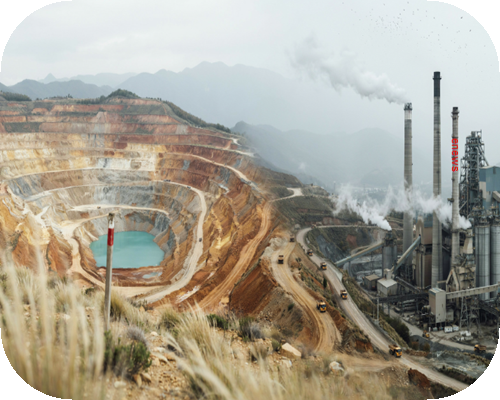
The United States is investing billions of dollars to rebuild a rare-earth supply chain that China largely controls — a dependence that threatens America’s ability to manufacture advanced weapons, compete in emerging technologies and keep factories running during a confrontation with Beijing.
The vulnerability became unmistakable in 2025, when Chinese export restrictions disrupted supplies of powerful magnets used in vehicles and other equipment. Some automakers reduced production or temporarily shut down operations, according to the International Energy Agency.
The Trump administration’s response combines domestic mining and manufacturing investments, overseas partnerships, stockpiling and research into recycling and alternative materials. The aim is to give American industry reliable sources for essential components whose availability can otherwise depend on Chinese export licenses.
“We are running fast, but China has a big lead and is running faster,” said Conor Bernstein, vice president of communications for the National Mining Association.
China’s advantage extends well beyond what it digs out of the ground. In 2024, it accounted for 60% of global mined production of the rare earths used in magnets, but 91% of refined output and 94% of sintered permanent magnet production, according to the IEA.





Those figures explain why new American mines alone cannot resolve the problem. The United States and its partners also need the facilities and expertise to separate the elements, turn them into metals and alloys, and manufacture finished magnets.
Rare earths are a group of 17 elements. Some are used to make compact, powerful magnets that help manufacturers build lighter, more efficient electric vehicles, wind turbines and military equipment. Despite their name, the elements are relatively plentiful in the Earth’s crust. Economically viable deposits and the ability to process them are harder to come by.
“Thirty years ago the US was a leader in rare earth mining,” said Ian Lange of the Colorado School of Mines. “But it’s a very low-margin business, there wasn’t so much demand for them, and these deposits are often found near radioactive material, so there were environmental concerns.”
Trump signed an executive order in March 2025 directing federal agencies to accelerate mineral project reviews, identify federal land for development and expand financial support. His administration has also pursued agreements with countries including Australia and Japan to build supply chains outside China.
One major investment involves MP Materials, which operates the Mountain Pass rare-earth mine in California. In July 2025, the Pentagon agreed to purchase $400 million in convertible preferred stock, provide a $150 million loan to expand processing and establish a 10-year price floor for the company’s neodymium-praseodymium products.


The $110-per-kilogram guarantee is designed to protect the investment against depressed prices that can make alternative suppliers uneconomic. The Pentagon also agreed to ensure purchases of all magnets produced by MP’s planned 10X factory for 10 years.
MP selected Northlake, Texas, for that factory in February. It plans to invest more than $1.25 billion and create more than 1,500 jobs, with commissioning expected to begin in 2028.
The company is already increasing domestic processing. It reported producing 2,599 metric tons of neodymium-praseodymium oxide in 2025, more than double its output the previous year.
Private customers are helping create demand for the new supply. Apple announced a $500 million commitment in July 2025 to purchase magnets from MP. The companies also plan a California recycling operation to recover rare earths from used material.
Another company, USA Rare Earth, finalized agreements with the Commerce Department in June providing access to up to $1.6 billion in funding and loan capacity, with disbursements tied to project milestones. Its projects include a Texas mineral deposit, magnet manufacturing in Oklahoma and a planned metals and magnet facility in South Carolina.
In September, it completed its acquisition of Brazil’s Serra Verde Group, adding an existing mine and processing operation to a network that includes assets in the United States and Europe.
Energy Fuels is addressing another vulnerability: heavy rare earths such as dysprosium and terbium, which help magnets perform at high temperatures. In July, the company announced that construction had begun on an expansion of its White Mesa Mill in Utah to produce these materials commercially. It targets completion of those processing circuits by the end of 2027.
Washington is also trying to protect manufacturers while new capacity develops. In February, the Export-Import Bank approved a loan of up to $10 billion for Project Vault, a public-private strategic reserve intended to cushion U.S. manufacturers against supply disruptions. It covers critical minerals broadly, including rare earths.


Other investments seek to recover valuable materials from industrial waste. In June, the Energy Department selected two projects for negotiations over $134 million in funding, including a Colorado School of Mines project to recover rare earths from alumina-refining waste. In July, it selected five projects for negotiations over $75 million to recover critical minerals from coal and coal-based feedstocks.
The department cautions that selection for negotiations does not guarantee an award or funding.
Some efforts could reduce the need for rare earths altogether. In August, the White House announced a $150 million defense investment in Minnesota-based Niron Magnetics, which is developing and producing permanent magnets without rare earths.
The administration also announced more than $180 million in mining school investments to train workers and support technology development. Rebuilding the workforce matters because processing rare earths and making specialized materials require expertise that new facilities cannot acquire simply by purchasing equipment.
“We need a symphony of efforts to get us back where we need to be,” said Bernstein.
The effort builds on earlier federal investments, including a $35 million Pentagon contract awarded to MP Materials in 2022, during the Biden administration, for heavy rare-earth processing.
But the scale of the current commitments does not eliminate the challenges. Plants must operate reliably, products must meet customers’ specifications, and emerging processing technologies must prove commercially viable. Projects outside China also face disadvantages in scale, costs and access to specialized equipment, according to the IEA.
In an April report, critical minerals researchers Gracelin Baskaran and Meredith Schwartz of the Center for Strategic and International Studies argued that reducing dependence on China is essential to strengthening America’s defense industry and its ability to respond to geopolitical crises.
“The United States has traveled a considerable distance to bolster rare earth and permanent magnet security,” they wrote.
“However, mining and processing are industries defined by long lead times.”
Maintaining that effort through changing market conditions and administrations will be crucial, they warned.
“Durable resilience will require a consistent long-term policy approach instead of the historical pattern of ramping up during crises only to scale back in periods of calm.”



Randall Bloomquist | INSIDE SOURCES
Recent Articles
October Gardening Classes Every Saturday at Watters Garden Center
City of Prescott to Host Public Meeting on Willow Lake Management Plan
Prescott Fine Art Launches Monthly Art Auctions at Pine Ridge Marketplace
Town of Chino Valley Selected for Community Beautification Project as APS Celebrates 140 Years in Arizona