


Most businesses try to win customers by adding more. More features, more claims, more pages, more proof. But that is usually not how real buying decisions happen. Most people do not make careful, spreadsheet style comparisons every time they need a product or service. They use shortcuts.
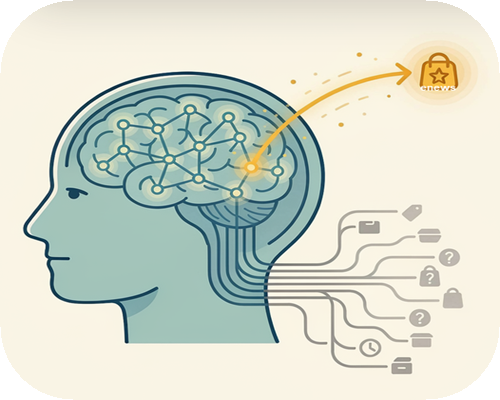
That is not laziness. It is survival. Modern buyers are flooded with options, ads, reviews, and tabs open in their browser. Their brains are trying to save energy. So instead of asking, “Which option is objectively best?” they often ask faster questions. “Which one feels familiar?” “Which one seems safe?” “Which one looks easiest to deal with?”
That is why even practical steps, like running a New Jersey business search, matter more than many brands realize. Customers are not always hunting for deep insight. Often, they are looking for the quickest sign that a company is real, established, and easy to trust. If your business helps answer that question quickly, you are already moving closer to becoming the default choice.
The real competition is mental effort
A lot of business advice frames competition as a battle over price or quality. Those things matter, of course. But there is another layer that gets overlooked. You are also competing against confusion, hesitation, and decision fatigue.





When a customer has to work too hard to understand what you do, compare your options, or verify that you are legitimate, your business stops feeling easy. And easy is powerful. In many cases, the winner is not the company with the most impressive offer. It is the one that feels simplest to choose.
This is where mental shortcuts, also called heuristics, come in. People rely on them because they reduce friction. Familiar names feel safer. Clear pricing feels less risky. Consistent branding feels more credible. A straightforward process feels more manageable. These cues are not small details. They become the signals customers use when they do not want to investigate every option from scratch.
Recognition beats explanation
One of the most useful ways to think about customer choice is this: recognition usually wins before explanation gets a chance.
Usability research has long shown that people find it easier to recognize something than to recall it from memory, which is why visible, familiar cues are so effective in decision making. Recognition over recall in user interfaces is not just a design principle. It is a buying principle too.


If your company name, message, visuals, and offer are instantly recognizable, customers do not have to pause and decode what they are seeing. That pause is dangerous. It creates room for distraction, doubt, or a competitor that feels clearer.
Think about the brands you choose automatically. Usually, they have built a pattern in your mind. You know what they are, what they promise, and what kind of experience to expect. That mental pattern becomes a shortcut. The next time you need that category, your brain reaches for the familiar answer first.
Trust is often a shortcut, not a conclusion
Here is the less discussed angle: trust is not always the final result of a long evaluation. Often, trust acts as the shortcut that allows the evaluation to end.
Customers rarely say it this way, but many decisions come down to “I saw enough to stop worrying.” That is a huge threshold. Your goal is not always to make people obsessed with your brand. Sometimes your goal is simply to remove enough uncertainty that choosing you feels low risk.
That can come from simple signals. A professional website. Clear contact information. Real reviews. Transparent policies. Consistent messaging across platforms. Proof that the business exists and operates responsibly. The Federal Trade Commission also advises consumers to evaluate reviews carefully, check multiple sources, and think critically about seller credibility, which shows how closely trust and verification are tied in online decisions.
In other words, customers are not just buying the product. They are buying relief from the fear of making a bad choice.
Friction hides in small places


Many companies assume friction only appears in major failures, like a broken checkout page or a confusing contract. But friction often starts much earlier.
It shows up when a headline is vague. When service descriptions are full of jargon. When visitors cannot tell who the business is for. When the next step is unclear. When the brand voice changes from page to page. When a business looks polished on social media but neglected everywhere else.
None of these issues seem dramatic on their own. Together, they create a subtle feeling that this choice may require work. Once that feeling appears, the customer starts scanning for an easier option.
How to become the default choice
If you want your brand to become the option customers reach for first, stop asking only how to impress them. Ask how to reduce the effort of choosing you.
- Start with clarity. Can someone understand what you do in seconds?
- Then move to consistency. Do your website, listings, messaging, and customer experience all point to the same promise?
- Next, strengthen proof. Are there visible signals that show you are established, dependable, and real?
- Finally, simplify action. Is the next step obvious, comfortable, and low pressure?
The best brands do not just provide value. They package that value in a form the brain can accept quickly.
Winning the shortcut is winning the sale
Customers do not always reward the business that says the most. They often reward the one that feels easiest to trust, easiest to understand, and easiest to choose.
That is the real opportunity. When your business becomes part of a customer’s decision making shortcut, you stop relying only on persuasion in the moment. You become the familiar, low friction answer their brain pulls forward before the harder comparison even begins.
And in a crowded market, that kind of mental availability can be more valuable than any single marketing tactic.