




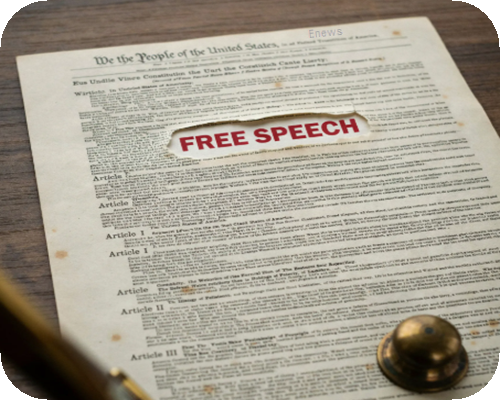
Governments rarely need to jail critics to quiet them. Demanding their files often does the job.
That playbook is spreading among Republican attorneys general. Texas used consumer-protection law to demand records from Media Matters over its reporting. Florida used its deceptive trade practices law to subpoena the Environmental Law Institute, which educates judges on climate science, demanding its funding sources and communications with judges.
The newest example is West Virginia, where Attorney General John “JB” McCuskey has subpoenaed at least six environmental groups for a decade of records on their “climate claims,” fundraising and internal deliberations. His tool is the state’s consumer protection law, written to stop businesses from cheating customers. Two targets, the West Virginia Rivers Coalition and 350.org, sell little beyond a trickle of branded merchandise. They sued, and a federal judge temporarily blocked the subpoenas, writing that “the First Amendment forbids a State from using its investigative power that way.”
The stakes are national. The question is whether state attorneys general can turn fraud statutes into tools for interrogating political opponents. A growing number of Republican attorneys general are betting they can.
McCuskey’s defense is blunt: “The First Amendment is not a license to lie.” He says the groups leaned on an old worst-case climate forecast — one that scientists formally retired after years of it being treated as the likely future. In his view, that exaggerated the harm from fossil fuels, the backbone of West Virginia’s economy. He even concedes that the groups’ political advocacy is protected.




He has a fair point that some advocates relied on that outdated forecast too long. Scientists settle such disputes in journals, not through a prosecutor’s subpoena. And look at his evidence. One example is a set of comments the Rivers Coalition endorsed and sent to the Federal Emergency Management Agency. Telling a federal agency what you think isn’t consumer fraud. It’s petitioning the government, a right the First Amendment names explicitly.
The timing matters. AI data centers are driving a historic surge in electricity demand, and communities everywhere are fighting over the gas plants, pipelines and power lines needed to feed them. Those fights get settled through public comment, petitions and organizing — by environmentalists and industry alike. Chill one side’s voice, and the energy transition gets decided by whoever holds the subpoena pen.
The overreach shows elsewhere. McCuskey dropped a demand for donor identities once the groups’ lawyers raised constitutional objections. Wise move, since the U.S. Supreme Court struck down California’s donor-disclosure rule in 2021. The West Virginia AG withdrew the Sierra Club’s subpoena after the group threatened to sue. Still, the damage is done: 350.org says it has stopped taking on new work in West Virginia. That’s what a chilling effect looks like.
The courts have pushed back before. A federal appeals court kept Texas Attorney General Ken Paxton’s demand on Media Matters on hold, finding the group would likely prove he targeted it as payback for its reporting, which the First Amendment forbids.
Didn’t Democrats use similar tactics? In a sense, yes. In 2016, Democratic attorneys general aimed fraud subpoenas at ExxonMobil over what it knew about climate change. Republicans cried foul. Paxton and Alabama’s Luther Strange intervened on Exxon’s behalf, and 13 Republican attorneys general signed a letter warning that their Democratic counterparts were using subpoenas to police the climate debate.


They were right then. Turnabout doesn’t make it right now. Consider Paxton: In 2016, he called these subpoenas an attack on free speech. In 2023, he used one on Media Matters.
Some conservatives remember. Jason Huffman, who leads Americans for Prosperity in West Virginia, wrote that he disagrees with the environmental left’s rhetoric but defends its right to voice it. The answer to speech you dislike, he argued, is “more speech, not less.”
Every tool one side forges, the other side eventually picks up. If a Republican attorney general can treat climate activism as consumer fraud, a Democratic one can treat gun-rights advocacy or pro-life fundraising the same way. Each side may win a few skirmishes. However, the price is a First Amendment that protects only whoever holds power at the moment, and that isn’t worth any legal victory. Free speech protects everyone, or it protects no one.



Ken Silverstein | INSIDE SOURCES
Recent Articles
Handel’s Ice Cream Brings Fresh, Handmade Ice Cream to Historic Downtown Prescott
Chino Valley Police Dept. Awarded $22,408 in Governor’s Office of Highway Safety Grants
Upcoming Community Meeting for the Effluent and Wastewater Pipelines & State Route 89 Improvements Project – City of Prescott
The Pine Ridge Prowl is Coming on October 24