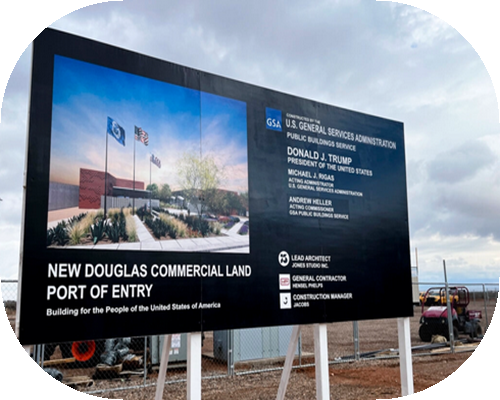
A sign marks the 80-acre site of the new Douglas Commercial Land Port of Entry in Douglas, Ariz., which is currently under construction, on Jan. 22, 2026. Allan Stein/The Epoch Times
Construction is underway on a new commercial Port of Entry in Douglas, Arizona, to link commerce between Mexico and the United States.
The port of entry will be the centerpiece in a sweeping, multibillion-dollar security initiative along the border with Mexico.
The plan calls for a cutting-edge commercial land port of entry to rise 4.5 miles west of Douglas, while the existing Raul H. Castro Port of Entry will be expanded to better serve pedestrians.
Construction began last fall and is expected to be substantially complete by May 2029.


Extensive work is also underway with Mexican federal agencies to ensure a “coordinated binational approach to the port-of-entry” project, according to Douglas’s official website.
The port is one of six in Arizona, where construction is underway along the state’s 372.5-mile southern border to plug gaps in security barriers left over from the Biden administration.
It is part of a bipartisan infrastructure package signed into law on Nov. 15, 2022, which allocated $400 million for the Douglas Two-Port Solution.
The Castro land point-of-entry has served the region since 1933.
In 2019, a study by the U.S. General Services Administration (GSA) found that the facility could not keep up with traffic or meet the needs of U.S. Customs and Border Protection.



“The two-port solution was selected because the Castro facility has a very constrained footprint, which has led to increasing operational conflicts and delays between commercial trucks, passenger vehicles, and pedestrians,” Christine McLachlan, director of Cochise County’s Development Services Department, told The Epoch Times.
In 2022, the Castro port served 1.55 million vehicles and 3.47 million people. It handled $4 billion in imports and exports.
Once the facility is complete, Customs and Border Protection will move business operations from the current Castro port to the new one, according to GSA.
The new port will include four inspection lanes for northbound trucks, up from one, and two lanes for southbound trucks.
It will also have 36 inspection docks instead of 12 and can handle large mining equipment too big for Castro.
The port will include safe storage areas, new inspection tools, and designated areas for hazardous materials. The site is set to feature a SENTRI enrollment center and dedicated employee parking.
McLachlan said the Douglas port will cover more than 80 acres and include 176,000 square feet of office space, kennels for service dogs, new training areas, and vehicle safety checks.
The existing Castro port will also be expanded and modernized.


McLachlin said that once commercial operations shift to the new port, Castro will become the hub for pedestrian, passenger vehicles, and bus traffic.
Stantec, a project engineer, said the all-electric port will meet the Federal Building Performance Standard.
The port will include solar panels, water-saving equipment, energy-saving systems, and building materials like concrete and steel that produce less carbon.
“Major commercial ports of entry are vital infrastructure projects that support freight and traveler movement as well as local and cross-border economic growth,” said Gary Johnston, Stantec’s president and CEO, in a statement.
He said the project shows how federal funding aids important infrastructure projects across the United States.
Stantec said the new facility would help improve border security and support economic growth in the region.
The port’s new inspection facilities, increased capacity, and advanced technology will make it an important gateway for trade, the company added.
GSA said the Bipartisan Infrastructure Law includes $3.4 billion to build and modernize land ports of entry at the country’s northern and southern borders.
The agency also said that this money will help businesses and trade, make the borders safer, create good jobs, and use eco-friendly features.
A view of the U.S.-Mexico border fence in southern Arizona from a high vantage point at the Coronado National Monument area on Jan. 22, 2026. Allan Stein/The Epoch Times
Since President Donald Trump took office in January 2025, illegal border crossings have plummeted by more than 94 percent, according to Customs and Border Protection.
“In less than a year, President Trump has delivered some of the most historic and consequential achievements in presidential history—and this administration is just getting started,” Department of Homeland Security (DHS) Secretary Kristi Noem said in a statement.
“In record time, we have secured the border, taken the fight to cartels, and arrested thousands upon thousands of criminal illegal aliens. Though 2025 was historic, we won’t rest until the job is done.”
According to DHS, more than 2.5 million illegal immigrants have left the country during Trump’s second term so far. This figure includes approximately 1.9 million who departed voluntarily and more than 622,000 who were deported.
Since Trump assumed office, fentanyl smuggling at the southern border has decreased by 50 percent compared to the same period in 2024.
In addition, the U.S. Coast Guard has seized quantities of cocaine sufficient to be lethal to more than 177 million Americans, DHS noted.
Although DHS oversees construction decisions, the National Park Service says it remains focused on keeping visitors safe on public lands near construction sites.
“Visitor safety remains a top priority. During periods of heightened migration in prior years, the NPS posted safety signage to ensure visitors were aware of potential risks in remote border areas,” the National Park Service told The Epoch Times in an email.
“Those signs remain in place as a standard safety measure. At this time, the National Park Service does not have current, elevated safety concerns related to migration activity in these areas, and ongoing coordination with DHS and CBP continues to support safe conditions for visitors and employees.”
DHS also reported that the Trump administration has saved taxpayers more than $13.2 billion and has enabled key agencies such as the Federal Emergency Management Agency, the Cyersecurity Infrastructure Security Agency, and the Secret Service to refocus on their primary missions.
In February 2025, the U.S. Border Patrol announced it apprehended 8,347 illegal immigrants across the southern border, a 94-percent drop from the previous year.
In Arizona, CBP apprehended 65,813 illegal border crossers between Oct. 1, 2024, and Sept. 30, 2025.
About 535 miles of the U.S.-Mexico border without a barrier will be monitored with new detection technology because the terrain is difficult to cross, or the area is remote.
CBP is also installing about 549 miles of technology in areas where barriers have already been built.
DHS is building or planning hundreds of miles of smart border wall in Texas, New Mexico, Arizona, and California.
In September 2025, $4.5 billion in construction contracts were awarded for these projects.
These improvements will include steel posts, floating barriers, patrol roads, bright lights, cameras, and new detection tools to support Border Patrol.
In total, these projects will add 230 miles of smart wall and nearly 400 miles of new technology, DHS said.
The technology additions will further secure the existing wall in areas where the Biden administration’s policies canceled contracts.
The U.S.–Mexico border fence ends with a gap east of Sasabe, Ariz., on Jan. 20, 2025. (John Moore/Getty Images)
The U.S.–Mexico border fence ends with a gap east of Sasabe, Ariz., on Jan. 20, 2025. John Moore/Getty Images
The new contracts are part of Trump’s One Big Beautiful Bill Act, which includes funding from fiscal year 2021 for wall fortifications that were suspended under the Biden administration.
To speed up smart wall construction and avoid delays, Noem approved exceptions for about nine miles in the San Diego Sector and about 30 miles in the El Paso Sector to include New Mexico.
About 483.5 million will fund nine miles of new smart wall and 52 miles of upgrades in the San Diego Sector.
Fisher Sand & Gravel Co. received a contract to build eight miles of main smart wall and 63 miles of improvements in the El Centro and San Diego Sectors.
The Yuma 1 Project, with a $199.5 million contract, was awarded to Barnard Spencer Joint Venture to build 60 miles of system features in the Yuma Sector in Arizona and California.
The Tucson 1 Project, awarded to BCCG, includes nearly $607 million to build 23 miles of secondary border wall and improve 66 miles in the Tucson and Yuma sectors of Arizona.
DHS said the El Paso 1 Project involves major border wall construction totaling $155.1 million.
BCCG will replace about seven miles of old barrier in the Santa Teresa Area of Responsibility and build a new smart wall with 22 miles of system attributes in the Border Patrol’s El Paso Sector in New Mexico.
The El Paso 2 Project in New Mexico sets aside $578.9 million for 23 miles of new smart wall and 81 miles of system features.
The El Paso 3 Project includes $850.36 million to build 42 miles of smart wall and six miles of secondary border wall, and to complete 46 miles of upgrades in the El Paso Sector in Texas.
Remnants of older border wall construction in Douglas, Ariz., on Jan. 22, 2026. (Allan Stein/The Epoch Times)
Remnants of older border wall construction in Douglas, Ariz., on Jan. 22, 2026. Allan Stein/The Epoch Times
Texas will also receive $565 million for 22 miles of main border wall construction and 40 miles of water barriers in the Del Rio Sector in the Eagle Pass area.
The Rio Grande Valley Waterborne Barrier Project will add 17 miles of new water barriers in the Rio Grande, south of Brownsville, at a cost of more than $93 million.
Residents Respond
Jeff, 57, from Benson, Arizona, says many of the people he knows are divided over the new border wall construction and its effectiveness.
Still, he supports stronger border security and the use of smart technology.
“I think our technology is way beyond what either one of us knows. Yeah, so what they can do with the drones and all the oter stuff is absolutely amazing,” Jeff told The Epoch Times, and asked that his last name not be used.
He remains skeptical that, despite major upgrades and towering 30-foot posts planned along 27 miles of border in the San Rafael Valley, determined border crossers and cartel members will still slip through.
“The way I feel is, even if there are gaps, it doesn’t matter. You can build it 100 feet tall, you can build it this wide, there’s going to be underground tunnels,” he said.
“We’ve got to close the borders. And I think [Trump] has done that. And it all works. Let’s make America first.”
A Huachuca City resident, choosing to remain anonymous, shared her belief in the border wall in concept, but has “mixed feelings” about its eventual completion.
Security fencing measuring 18 feet in height merges with 30-foot steel fencing built during President Donald Trump’s first term in Douglas, Ariz., on Jan. 22, 2026. Allan Stein/The Epoch Times
“I’m not quite sure what [the entire construction project] entails, but I guess it’s a lot of high-tech surveillance. I think the whole thing needs to be revamped,” she told The Epoch Times.
“The wall, I can understand—the idea of it, I’m on the fence. A lot of people’s political views split after the whole ICE thing. Even people who voted for Trump are upset.”
“The biggest result I’ve noticed since the whole administration change, or that I’d like to see, is that the border checkpoints are open,“ she said. ”They are open.”