





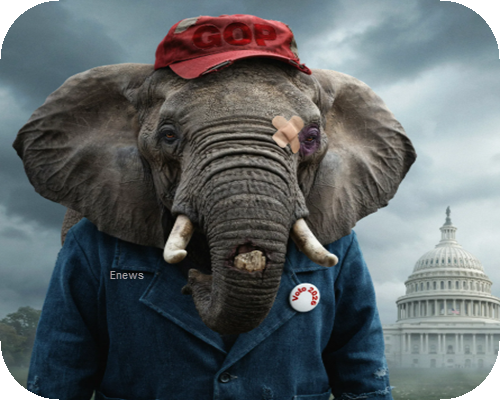
“It appears the voters are so angry at Trump they decided to shoot the hostages,” said one defeated Republican state legislator. “A generation of conservative reform is in peril as Democrats sweep down ballot,” notes the Wall Street Journal.
State-level Republicans are facing an apocalypse not of their making. What can they do about it?
Trump administration failures drove the Republican Party’s historic shellacking up and down the ballot. Commentators debate the roles of the Iran war (and its effect on gas prices), tariffs, corruption, ICE overreach and more, but the most accurate diagnosis has come from RealClearPolitics analyst Sean Trende: “It was all the things.”
Trump’s approval rating has gone virtually straight down since February 2025, with the only up-ticks coming during brief moments of comparative normality, such as the suspension of the Liberation Day tariffs and the first Iran ceasefire.
Young people, Latinos, and noncollege voters moved especially sharply away from Republicans this year. These demographic groups tend to be less anchored in partisan and ideological identities, making them more willing to “swing” between parties based on national conditions.






So why did the wave sweep away state legislators, regardless of whether they supported or opposed Trump? Because state legislative elections are “second-order elections.” Strange as it may seem, voters vote in state legislative elections based on their attitudes toward the party in power in Washington.
Gubernatorial elections are less second-order. Voters can refocus on state-level issues when they vote for governor, just not for the legislature.
Consider New Hampshire. Incumbent Republican governor Kelly Ayotte narrowly won re-election despite a worst-ever Republican performance in the state house. There was a 7.1-point swing to the Democrats in state house races and a 7.4-point swing to the Democrats in state senate races compared to 2024, considering only districts where both parties ran a full slate (the state has some multi-member districts). The Republican two-party share of the state legislative vote (43 percent) fell to just above their two-party share of the U.S. House vote (41.4 percent). (Ayotte got 52.2 percent.)
Voters punished Republican state legislators and congressional candidates for Trump, but spared the governor.
And it’s not just New Hampshire. Political science has repeatedly confirmed that voters punish state officials for the sins of their federal co-partisans.






This is a problem for democratic accountability. It means that it doesn’t matter whether state legislators do a good job; their political fate is out of their hands.
In fact, while Trump ignored the key issue of affordability, several Republican-led legislatures addressed the issue with major free-market reforms, including Texas, Idaho, Montana and New Hampshire. But on Election Day, the rain fell on the just and the unjust alike.
The most effective Republican solution is to adopt laws permitting something like Canada’s party system. In Canada, federal and provincial parties are independent and often even have different names. Nova Scotia has a “Progressive Conservative Party” that does not exist at the federal level, and the “Saskatchewan Party” is the main center-right party in that province.
In the United States, most states forbid parties from controlling who gets their nominations. This is a free-speech issue, not just a question of democracy, because it means parties must endorse candidates who may completely reject their ideology, simply because they won a primary or filed to run with no competition. In 2018, a neo-Nazi named Arthur Jones got the Republican nomination in Illinois’ District 3 because nobody else filed. Even though the party denounced him, it could not remove the nomination.
States should reform their laws to let parties choose whether to be state-only or federal-only, or even give their governing boards the right to reject candidate nominations. A state Republican party could split into two parties: one would run only federal candidates and affiliate with the Republican National Committee, and the other would run only state candidates and perhaps even change its name to further signal its independence from the national party.
State-level Democrats should be willing to go along. After all, they will remember the nationwide anti-Obamacare wave they suffered in 2010 that ushered in dramatically more conservative governance in Wisconsin and North Carolina, and it could easily happen again in 2030 if they hold the White House. They, too, would benefit from some independence from their national co-partisans.
Even if state Republicans attempt nothing so dramatic as a revolution in the party system, they must refuse to be hostages any longer. The voters Trump once brought into the party have left. Since voters don’t notice individual state legislators, state Republicans must collectively and loudly reject the Trump era and move forward with their positive agenda of free-market reform. If they don’t, more pain awaits in 2028.





Jason Sorens | INSIDE SOURCES
Recent Articles
Prescott Regional Communications Center Earns Third Place Nationwide in T-Mobile Innovation in Community Competition
‘Art for Everyone’ Returns to Prescott
Prescott Valley Voters Shoot Down Local Propositions – Bill Williams
Arizona’s #1 Farmers Market Opens Its 13th Winter Season November 7