




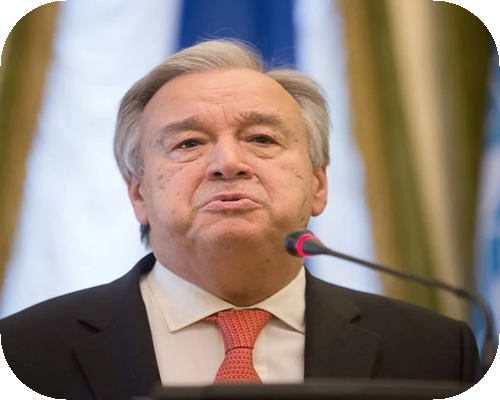
UN Secretary-General Antonio Guterres
The United Nations’ 81st session is underway, and as the Wall Street Journal put it, “Every annual (U.N. high-level) week comes with two certainties: traffic for New Yorkers and abuse for Israel.”
The problem is broader than the ritual of General Assembly week. The United Nations’ persistent hostility toward Israel has become a year-round feature of the institution, one that undermines its credibility and weakens its ability to contribute to Middle East peace.
Central to this pattern in recent years has been Secretary-General António Guterres. At the opening of this latest U.N. General Assembly session, Guterres wasted little time in condemning Israel, accusing it of “bulldozing the path to peace and raising the specter of ethnic cleansing.”
That rhetoric is not an isolated lapse. It reflects a recurring pattern during Guterres’ tenure: heavy-handed criticism of Israel and an unwillingness to confront the institutional bias that has long distorted the U.N.’s approach to the Israeli-Palestinian conflict.


Guterres is nearing the end of his second and final term, and the process of selecting his successor, who will take over in 2027, is underway. The United States and other responsible member states should insist that the next secretary-general apply balance, credibility and seriousness to the U.N.’s treatment of Israel and the broader Middle East.
By treating Israel as a uniquely culpable actor while too often minimizing the responsibility of terrorist organizations and rejectionist regimes, the U.N. reinforces a political narrative that fuels hostility, isolation and violence rather than compromise.
Guterres’ record is especially disappointing because he initially seemed different. When he became secretary-general in 2017, he struck a warm and constructive tone in meetings with Israeli and Jewish leaders. He expressed sympathy for Israel, acknowledged concerns about unequal treatment at the United Nations, and stated that Israel should not be subjected to a double standard by the international community.
That promise did not last. As secretary-general, Guterres has repeatedly lent legitimacy to U.N. bodies and practices that have entrenched the institution’s imbalance. He has praised and participated in meetings of the Committee on the Exercise of the Inalienable Rights of the Palestinian People (CEIRPP), an entity that emerged from the discredited 1975 U.N. resolution declaring that “Zionism is racism.”
He has also continued to defend the U.N. Relief and Works Agency for Palestine, despite longstanding concerns about governance failures, incitement in educational materials, and links to terrorists. These controversies should have prompted greater scrutiny from the secretary-general, not reflexive institutional defense.



The most egregious example came after the Hamas massacres of October 7, 2023. Guterres said, “It is important to also recognize the attacks by Hamas did not happen in a vacuum.” Whatever he intended, the line seemed to contextualize mass murder at the very moment when moral clarity was required.
This matters because the secretary-general’s words do more than express personal views. They signal what the international system is prepared to tolerate, condemn, excuse or ignore. When the U.N. appears more eager to censure Israel than to confront those who reject its existence or celebrate violence against civilians, it encourages maximalism and makes compromise harder.
Some of Guterres’ predecessors, at least belatedly, recognized the danger of this bias. In his 2006 valedictory speech at the United Nations, Kofi Annan warned that “some of the rhetoric used in connection with the issue implies a refusal to concede the very legitimacy of Israel’s existence, let alone the validity of its security concerns.” He added: “We must never forget that Jews have very good historical reasons for taking seriously any threat to Israel’s existence.”
Ban Ki-moon made a similar point as he prepared to leave office in December 2016: “We must never accept bias against Israel within U.N. bodies … decades of political maneuverings have created a disproportionate volume of resolutions, reports and conferences criticizing Israel.”
Guterres may yet acknowledge the damage caused by the U.N.’s imbalance. The larger lesson should not wait for a farewell speech. The next secretary-general should be judged by a concrete measure: whether he or she treats Israel by the same standard applied to other countries; condemns terrorism without qualification; demands accountability from U.N. agencies; resists politicized bodies that exist chiefly to isolate one member state; and supports serious efforts toward peace, security and prosperity for Israelis, Palestinians and the wider Middle East.
Anything less will make the United Nations not a vehicle for peace, but an obstacle to it.


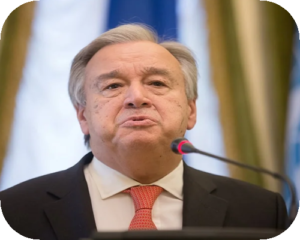
Gil Kapen and Richard P. Schifter
Recent Articles
The Pine Ridge Prowl is Coming on October 24
New 4-way stop at Granite Street and Willis Street
Freaky Foot Tours Presents the Prescott Haunted History Tour
November Voter Publicity Pamphlet has Error in it