




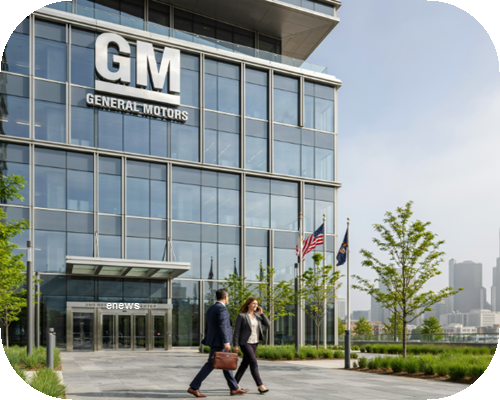
The GM logo is displayed at the new location of the General Motors Headquarters in Detroit, Mich
Combined market share of the Detroit Three—Ford Motor, General Motors, and Stellantis—is expected to fall in the third quarter, according to industry research firm Cox Automotive.
Researchers say that Asian carmakers will dominate the U.S. auto market going forward, especially as consumers shift toward hybrid cars and passenger vehicles—two areas in which Asian automakers are dominant.
“The market share of the Detroit 3 is expected to be the lowest in history,” Charlie Chesbrough, senior economist at Cox Automotive, said in the report.
Asian brands—Hyundai and Toyota—are projected to account for more than half of new vehicle sales for the second consecutive quarter, approaching all-time highs.




Both companies maintain a sizable footprint in the United States. Hyundai’s American manufacturing operations are concentrated in the South, mainly in Alabama and Georgia. Toyota’s U.S. presence is across 10 states, including Indiana, Kentucky, and Texas.
Data released on Oct. 1 show that General Motors was the top U.S. auto seller in the July–September period. The automaker sold almost 671,000 units.
But GM is showing weakness heading into the final three months of the year, as the quarter’s decline—deliveries fell more than 5 percent—outpaced the national average.
Toyota ranked second, with sales climbing 2 percent to more than 633,000 cars.
As consumers sought budget-friendly and efficient options, the Toyota Corolla compact car logged a 5 percent increase in sales. Electric vehicles, including hybrids, also surged by about 40 percent.


Ford logged a 6.6 percent decrease in the third quarter—more than 507,000 light-duty vehicles—and maintained its third position in US sales.
The company has endured various struggles in recent years, particularly in producing its F-Series pickup trucks after two supplier fires last year disrupted production and sales.
Hyundai’s quarterly sales jumped 6 percent year over year. The South Korean automaker delivered more than 506,000 vehicles in the quarter.
Cox forecasts September new-vehicle sales at close to 16.3 million, down from 16.6 million the previous year. This would also be below August’s solid 16.8 million seasonally adjusted annual rate.
Overall, demand in the U.S. auto market should continue at its current pace, which dates back to March, Chesbrough notes.
“Strong fleet sales, wealthier vehicle buyers, and more access to credit are all keeping this market relatively strong in the face of many headwinds,” he said in a statement on Sept. 24.
“High inflation and historically low consumer confidence have not discouraged buyers as much as might be expected.”
Additionally, many of today’s new-vehicle buyers are wealthier, so they are less likely to bear the burden of renewed inflationary pressures, the Cox economist said.


What About Tesla?
Electric vehicle giant Tesla Motors reported its third-quarter earnings on Oct. 2, and investors cheered the numbers.
Tesla said third-quarter vehicle deliveries totaled 486,532, and production exceeded 464,000. These figures easily surpassed economists’ expectations.
Shares of Tesla advanced almost 5 percent, paring their year-to-date decline to below 16 percent.
The Elon Musk-led company has come under tremendous pressure from Asian rivals, including China’s BYD and Xiaomi, due to more features at lower prices.
Wall Street analysts are still optimistic about Tesla stock, with a consensus “hold” rating, according to MarketBeat. Shares also enjoy a 12-month upside target of about 11 percent.
But Tesla’s share price suggests it needs to achieve many of its targets “more quickly than any company ever has,” says market analyst James Kostohryz.
“We are quite bullish on Tesla’s eventual success and its various lines of business, and we think the synergies across them are underestimated,” he said in an Oct. 2 note.
“However, our base case is that Tesla cannot achieve these successes quickly enough to justify its current valuation.”
Others say that Tesla regaining market share in the United States is a positive sign for the company.
Despite its stock struggling this year, financial markets may want to “pay attention here,” says Nancy Tengler, CEO and CIO at Laffer Tengler Investments.
“There’s a merger in our future, I think, with Tesla,” she said in a note emailed to The Epoch Times.
For months, there have been hints that Tesla would merge with rocket-and-satellite company SpaceX.




Andrew Moran | THE EPOCH TIMES
Recent Articles
Freaky Foot Tours Presents the Prescott Haunted History Tour
November Voter Publicity Pamphlet has Error in it
CAFMA and Prescott Fire Department Invite Community to Help Shape Wildfire Protection Plan
City of Prescott Invites Community Members to Learn More About Long-Term Water Management Plan