


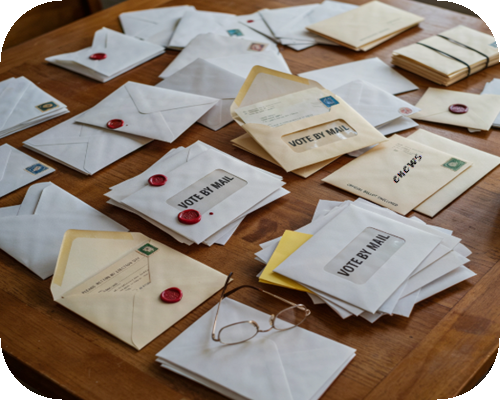
The Supreme Court’s latest decision in Donald Trump’s assault on voting rights should alarm anyone who cares about democracy. By a 6-3 vote, the court recently stayed a lower-court injunction that had blocked key parts of Trump’s executive order attempting to limit mail-in voting.
The decision didn’t rule that Trump’s order is constitutional or legal, as the court itself said: This “does not mean that any measure taken by the Government to implement the Order will necessarily be lawful. On that score, time will tell.”
But voters and election officials do not have time.
This decision is dangerous, not because of what the court is allowing the administration to do but because of what it has left unresolved and the chaos it could insert into the 2026 midterm elections.
At issue is the administration’s March executive order on voting, which seeks to significantly expand federal control over elections. It directs the Department of Homeland Security to create federal lists of citizens eligible to vote and orders the Postal Service to develop rules governing the delivery and handling of federal mail ballots. It directs the Department of Justice to prioritize potential criminal action against mail carriers, election officials, citizen election volunteers and others simply doing their jobs.





The Brennan Center for Justice explains that the creation of these “state citizenship lists” is not only not based on any federal law but could also use unreliable federal data not meant for the purposes of identifying the legal status of citizens. Such lists could function to disenfranchise voters who are legal and eligible to vote.
The Supreme Court’s ruling says the states challenged these measures too soon — when they filed their lawsuit, the Postal Service had not yet finalized the rule implementing the administration’s order, so the states couldn’t show they had suffered a concrete injury from the eventual rule.
The court majority concluded that the alleged harms were not yet sufficiently “concrete and imminent” to give the states standing to sue. If the administration’s eventual actions actually harm the states, the court said, they can challenge those actions later.
Later when? After the election? What kind of chaos will that create?
The court’s ruling threatens to inject more chaos into an environment where Trump’s allies have tried to crack down on voting ahead of midterm elections that could set his agenda back.






Nineteen states have enacted 44 restrictive voting laws since January 2025, including 12 more in the first part of 2026. More than 40 states have considered more than 300 voter-restriction bills so far in 2026.
The restrictions include proof-of-citizenship requirements, voter-ID requirements, tighter registration rules, restrictions on mail voting, and other barriers that could disenfranchise perfectly eligible voters. Trump is also trying to pass similar restrictions through the SAVE America Act, which could disenfranchise tens of millions of eligible voters. The legislation has passed the GOP-controlled House, although it doesn’t yet have enough support to pass the Senate.
All of this is meant to address a trumped-up problem that doesn’t exist: noncitizen voters stealing federal elections.
The American Immigration Council analyzed the Trump-aligned Heritage Foundation’s analysis of noncitizen voting and found just 89 alleged cases of noncitizens voting dating back to 2000. “Even if every one of these noncitizens had voted in the same election, it would still represent less than 0.0001 percent of total votes,” they write.
Meanwhile, the Supreme Court’s 2026 decision in Louisiana v. Callais has further weakened representation of Black and other minority voters at the local, state and federal levels by sharply restricting the use of Section 2 of the Voting Rights Act to challenge racial vote dilution in redistricting. And unprecedented mid-decade redistricting ahead of the 2026 midterm elections has potentially made voting less representative and more partisan.
A functioning democracy requires rules voters and states understand before ballots are cast, not legal ambiguity that keeps results tied up in legal battles after the election. Making the process so chaotic and intimidating that voters don’t trust their votes will be counted fairly is voter suppression, plain and simple.
That’s not establishing voting integrity. It’s deliberately inserting uncertainty into one of the foundational acts of our democracy. We can fix it by voting.