



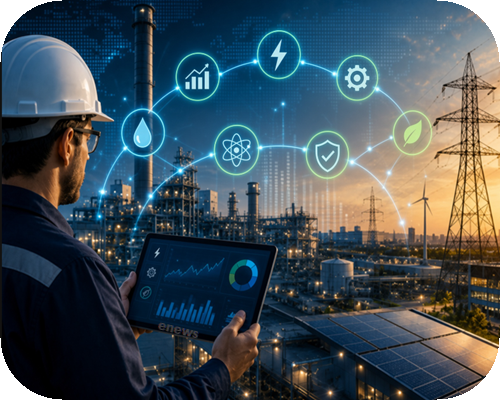
When people talk about the global energy transition, the conversation usually revolves around power generation. Wind farms, solar installations, battery storage projects, electric vehicles, and decarbonization strategies dominate the headlines. Those developments are undoubtedly reshaping the energy sector, but they tell only part of the story.
Away from public attention, another transition is taking place inside industrial facilities, commercial buildings, and critical infrastructure across North America. It is changing how organizations plan investments, manage assets, evaluate operational performance, and prepare for future growth. Unlike the transition toward cleaner electricity generation, this transformation is not driven primarily by new energy sources. It is driven by the way businesses themselves are adapting to an increasingly electrified economy.
That distinction matters.
Replacing one source of electricity with another is largely a utility challenge. Changing how an organization operates requires something entirely different. It involves production planning, engineering, automation, maintenance, digital infrastructure, capital investment, and executive decision-making working together in ways they rarely have before.
The businesses making the greatest progress are beginning to recognize that these disciplines are becoming inseparable.


Consider how dramatically industrial operations have evolved over the past twenty years.
Manufacturing plants now rely on robotics, machine vision systems, and sophisticated process automation. Distribution centres process thousands of orders using automated storage and retrieval equipment. Commercial buildings have become intelligent environments where heating, cooling, lighting, security, and occupancy systems communicate continuously. Hospitals depend on increasingly advanced medical technologies, while data centres supporting cloud computing and artificial intelligence have become critical infrastructure supporting almost every sector of the economy.
Every one of these systems depends upon electricity.
More importantly, every one of them produces operational information.
That information has become one of the most valuable resources available to organizations because it provides insight into how facilities actually perform rather than how managers assume they perform. Instead of waiting for monthly reports, engineering teams can evaluate electrical demand, equipment utilization, maintenance history, environmental conditions, and production activity in near real time.



The objective is no longer simply reducing electricity consumption.
It is understanding how energy influences operational performance.
Organizations are discovering that changes in electrical demand frequently reveal much broader operational trends. A production line drawing additional current may indicate declining mechanical efficiency. Building systems operating longer than expected may reflect changing occupancy patterns. Equipment consuming more electricity while producing identical output often suggests maintenance opportunities that would otherwise remain hidden.
These insights become considerably more valuable when viewed alongside external information.
Businesses operating in Ontario increasingly monitor ieso market data to better understand changing electricity demand, market conditions, and system activity. Internal operational information explains how facilities perform. External market intelligence provides context that helps organizations understand how broader electricity markets continue evolving around them.
That combination is becoming increasingly important because businesses are planning for an economy expected to consume significantly more electricity over the coming decades.
Artificial intelligence, industrial electrification, advanced manufacturing, and transportation continue increasing demand while creating new opportunities for organizations capable of adapting more quickly than competitors.
The transition therefore becomes operational rather than simply environmental.


Success depends less on purchasing new technologies than on understanding how existing operations support long-term business objectives.
Many organizations are investing in an energy management system that consolidates operational information from production equipment, electrical infrastructure, building automation, and maintenance systems into a unified operational platform. These technologies provide far more than historical reporting. They allow organizations to evaluate how energy influences productivity, asset performance, infrastructure utilization, and future investment planning, giving leadership teams considerably greater confidence when making long-term strategic decisions.
Perhaps that is the most significant shift taking place today.
The energy transition is no longer occurring only on the electrical grid.
It is taking place inside the businesses that depend on it.
The organizations adapting most successfully to this transition are not necessarily those making the largest investments. More often, they are the businesses developing a clearer understanding of how energy influences every aspect of their operations. They recognize that electrical infrastructure is no longer simply a support system operating in the background. It has become part of the operational framework that determines how efficiently facilities perform, how confidently expansion can be planned, and how effectively organizations respond to changing market conditions.
This broader perspective is reshaping long-term planning.
For many years, infrastructure decisions were made independently. Production managers focused on manufacturing capacity, maintenance departments managed equipment reliability, finance teams allocated capital, and engineering groups addressed electrical requirements as individual projects emerged. While this approach was appropriate for a less connected industrial environment, it has become increasingly difficult to sustain as facilities continue integrating automation, digital technologies, and advanced operational systems.
Today’s industrial operations are far more interconnected.
A production schedule affects electricity demand. Electrical demand influences equipment loading. Equipment performance impacts maintenance planning, while maintenance decisions affect production reliability and long-term capital investment. Every one of these activities influences the others, creating a business environment where isolated decision-making becomes less effective over time.
The companies gaining the greatest advantage are therefore taking a systems-based approach.
Instead of optimizing individual departments independently, they evaluate how the entire operation functions as a connected ecosystem. Engineering, operations, maintenance, finance, and executive leadership increasingly work from the same operational information, allowing decisions to reflect the broader objectives of the business rather than the priorities of a single department.
Technology has made this level of coordination possible.
Connected equipment now generates continuous operational information throughout industrial facilities. Intelligent electrical infrastructure measures consumption across production lines, environmental systems adjust automatically to changing occupancy, and automation platforms provide detailed visibility into equipment performance. Rather than relying on isolated reports generated once a month, organizations can evaluate operating conditions continuously and identify developing trends while there is still time to respond proactively.
Artificial intelligence is strengthening these capabilities even further.
Modern facilities generate millions of operational measurements every day. Human expertise remains indispensable, but manually interpreting every dataset is no longer practical. Advanced analytics help organizations identify patterns, compare historical performance, recognize emerging issues, and prioritize operational improvements based on measurable evidence rather than assumptions.
Importantly, the goal is not simply to consume less electricity.
The objective is to ensure that every unit of energy contributes as much value as possible to the operation.
That philosophy often leads to improvements extending well beyond energy performance itself. Equipment reliability improves because maintenance teams identify developing issues earlier. Production becomes more consistent because operating conditions are better understood. Capital investment decisions become more confident because infrastructure performance is measured rather than estimated. Sustainability initiatives also become more effective because organizations can demonstrate measurable improvements instead of relying primarily on projections.
This evolution is changing expectations throughout industry.
Customers increasingly evaluate suppliers according to operational resilience as well as product quality. Investors examine long-term infrastructure planning alongside financial performance. Governments continue encouraging industrial modernization through electrification and digital technologies, while executive leadership recognizes that operational intelligence has become an important competitive asset rather than simply another engineering tool.
Utilities are evolving alongside these changes.
Electricity providers increasingly collaborate with industrial customers to understand future infrastructure requirements before major expansion projects begin. Rather than responding only after demand increases, utilities and businesses work together to evaluate long-term capacity, modernization opportunities, and infrastructure planning. Better communication improves investment decisions for both parties while helping ensure future economic development is supported by reliable electrical systems.
This collaborative approach has also expanded the role of specialized expertise.
The modern energy transition requires considerably more than engineering alone. Organizations must understand automation, infrastructure planning, electrical systems, operational analytics, capital investment, sustainability objectives, regulatory considerations, and long-term business strategy. Bringing these disciplines together allows businesses to evaluate opportunities from a much broader perspective than would have been possible only a decade ago.
For that reason, many organizations partner with an experienced energy services company to help connect these disciplines into a coherent long-term strategy. Rather than approaching electrical infrastructure as a collection of isolated projects, these partnerships focus on understanding how energy influences production, operational resilience, asset performance, business continuity, and future growth. The objective is not simply to improve efficiency today but to ensure infrastructure investments continue supporting the organization as technologies, markets, and operational requirements evolve over time.
Looking ahead, the distinction between energy strategy and business strategy will continue narrowing.
Artificial intelligence will require additional computing infrastructure. Manufacturing will continue adopting automation. Transportation will become increasingly electrified, while commercial buildings evolve into intelligent operational environments supported by connected technologies. Every one of these developments increases dependence on reliable electricity, but more importantly, they increase the importance of understanding how electricity supports the business itself.
That may ultimately become one of the defining characteristics of the next industrial economy.
The organizations leading this transition will not simply be those investing in cleaner energy or newer technology. They will be the businesses that understand their operations most completely, use operational information to guide strategic decisions, and recognize that energy is no longer just something consumed in the background. It has become an operational asset capable of improving productivity, strengthening resilience, supporting investment decisions, and creating measurable competitive advantage.
For many years, the energy transition was viewed primarily through the lens of generation and environmental policy. Those issues remain critically important, but they represent only part of the story. The other part is unfolding inside factories, commercial buildings, logistics centres, hospitals, and industrial facilities where organizations are quietly redesigning the way they operate. That operational transition may receive fewer headlines, but it is likely to have an equally profound influence on the future of business because it changes not only how electricity is produced, but how economic value is created from every unit of energy consumed.