

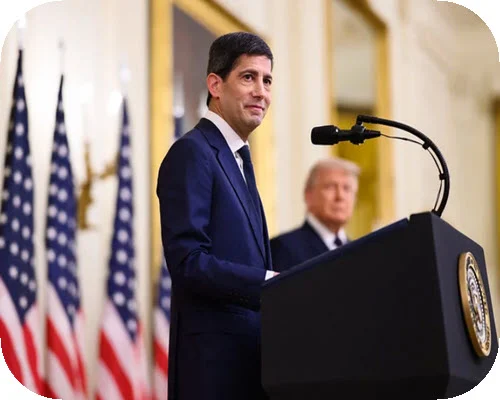
Federal Reserve Chair Kevin Warsh delivers remarks at his swearing-in ceremony in the East Room of the White House, Friday, May 22, 2026. (Official White House Photo by Daniel Torok)
Throughout the last few presidential administrations, Americans have seen inflation significantly rise and fall. In simple terms, inflation means your money buys less than it did before. A significant amount of the time, Americans look toward gas and grocery prices as benchmarks for how well the economy is performing. It is important to note that inflation does not simply mean that prices are currently high. Even when inflation itself falls, it often means not that prices are coming down, but that prices are increasing more slowly.
Inflation usually results from one of three factors. Demand-pull inflation, cost-push inflation and supply shocks are all contributing factors. Demand-pull inflation refers to consumers spending money faster than businesses can produce goods or services. This results in demand exceeding supply, often leading to higher prices. On the other hand, cost-push inflation refers to businesses paying higher costs to produce or acquire goods and services. This often results in those businesses passing those increased costs on to consumers. Moreover, supply shocks are unexpected events that disrupt the steady supply of goods. These disruptions are often caused by major events such as the COVID-19 pandemic, wars and trade restrictions.
The Federal Reserve, often referred to as the “Fed,” is America’s central bank. The Fed has been granted the responsibility of maintaining price stability and promoting maximum employment.
These two goals don’t always go hand in hand. If the economy grows too quickly, inflation rises. Conversely, unemployment may grow too high if the Fed slows the economy too much. Finding the right balance is the constant challenge facing the Federal Reserve.


On a deeper level, the Federal Funds Rate is the interest rate banks charge one another for very short-term loans. This is not to be confused with the interest rate at which you’re able to finance a new car or mortgage. Consumers never borrow directly at the Federal Funds Rate, yet it directly affects mortgage rates, auto loans, APRs on credit cards, business loans and savings accounts.
“Cutting rates,” as we often hear, is the action of the Fed lowering its benchmark interest rate. This, in turn, makes it easier for typical Americans to borrow money at a lower cost. This is when many Americans choose to take out a new mortgage, finance a car, or when small businesses are able to expand more affordably. In terms of economic stimulation, lower interest rates often allow for greater spending, therefore stimulating the economy.
On the other hand, the Fed doesn’t want to keep rates low all the time. Doing so can create excessive demand, which may contribute to higher inflation. During the COVID-19 pandemic, Congress approved several rounds of stimulus payments to the majority of Americans. This occurred during the Trump and Biden administrations. At the same time, the Fed lowered interest rates to nearly zero to help stabilize and stimulate the economy.
During the pandemic, industries struggled to meet consumer demand. Stimulus payments often increased spending power, which, in turn, allowed the economy to be stimulated through more money being pumped through the supply chain.
Following the pandemic, the economy gradually began recovering. Controversies surrounding the 2021–2023 period grew as shipping costs surged, global supply chains remained strained, and the war in Ukraine contributed to higher energy prices and shortages of certain goods and materials. Inflation rose to levels not seen in four decades.



Conservatives, on the other hand, often argued that multiple stimulus packages contributed to inflation. Most economists and experts think several combinations of factors, including government spending and disrupted supply chains, led to inflation. Labor shortages and rising energy costs also played a small role in this.
Fast forward, inflation has since fallen substantially from its peak, as President Trump campaigned heavily on reducing common household costs and expanding domestic business development. Of course, much criticism has surrounded Trump’s approach to international trade, with the administration’s use of tariffs being at the center of the debate.
Tariffs, which are taxes imposed by a government on imported goods, have become a commonly used economic tool by Trump.
Depending on the product and the industry, tariffs can temporarily increase prices on certain imported goods because businesses importing those products must pay the additional tax. Trump expanded this concept as part of a broader effort to encourage domestic manufacturing and respond to what his administration considers unfair trade practices by other countries.
For the Federal Reserve, tariffs add another layer of complexity. They can temporarily make inflation more persistent by increasing the cost of some imported goods. At the same time, tariffs also have the potential to slow economic activity. This brings us back to the often impossible balance the Fed must maintain: balancing inflation risks while trying to avoid slowing the economy even more.
Ultimately, the economy has been a leading issue among voters, particularly those between the ages of 25 and 45.
On one hand, President Biden and Democratic officials have proposed economic ideas such as expanding social safety net programs, raising taxes on higher-income individuals, and providing tax credits to families with children and students. On the other hand, Trump and Republican officials have generally supported policies such as increasing the use of tariffs, lowering individual taxes, limiting federal spending, reducing regulations, and using trade measures to encourage domestic manufacturing and investment.
Over the past decade, both sides of the aisle have advanced different approaches to managing the American economy. Many extraordinary events, such as the COVID-19 pandemic, the war in Ukraine, conflict in the Middle East, and major natural disasters, including floods and hurricanes, have forced elected officials to propose and pass a wide range of economic policies. In the meantime, the Federal Reserve, through war, pandemic, economic uncertainty and every other crisis, has remained responsible for one of the most difficult jobs in government: maintaining price stability while supporting economic growth.


It is a responsibility with no perfect answers. Lower interest rates too soon, and inflation may return. Keep them too high for too long, and economic growth may slow. The Federal Reserve is not choosing between a good option and a bad one; it is choosing between competing risks, each with real consequences for families. In many ways, that is what makes the Federal Reserve’s job truly impossible.