
It was a typically muggy summer in Philadelphia. The oppressive heat and humidity made conditions miserable inside the Pennsylvania State House’s Assembly Room. That aggravated conditions for the four dozen or so men gathered in that sweatbox. Since most of them were lawyers, they were prone to arguing; the ovenlike heat in the meeting room as June gave way to July made it miserable.
There was plenty to argue about, too, because the fate of their homeland was hanging in the balance.
Think we’re talking about the run-up to passing the Declaration of Independence? Nope, guess again.
One year earlier, almost to the day, before the upstart colonials cut ties with the mother country, they threw one last Hail Mary diplomatic pass in an attempt to make up with King George III and Parliament.
This is the story of the largely forgotten Olive Branch Petition.




The Second Continental Congress had a lot on its plate in the spring of 1775. The Revolution against British authority, which had simmered for a dozen years, finally broke out in battle in April. With no other governing authority around, the Congress met in May and immediately got to work. Delegates from 11 of the 13 colonies were on hand for the first session. (Rhode Island’s guys got there late; strong loyalist support in Georgia prevented that colony from joining the body until July.)
The immediate task was raising, equipping and paying for an army. They were 75 days into the conflict when some delegates felt it was time to (in John Lennon’s words) “give peace a chance.”
And so, they set about debating and hammering out what came to be called the Olive Branch Petition.
It basically boiled down to a simple plea stating that, despite the recent fighting, the 13 colonies were still loyal to King George III (Honest! Scout’s honor!) and wanted to work things out so they could remain part of the mother country. They insisted that it was still possible to craft a plan that would avoid future bloodshed so that everyone could go on living, in the words of classic English fairy tales, “happily ever after,” just as they had done for the preceding 150 years.
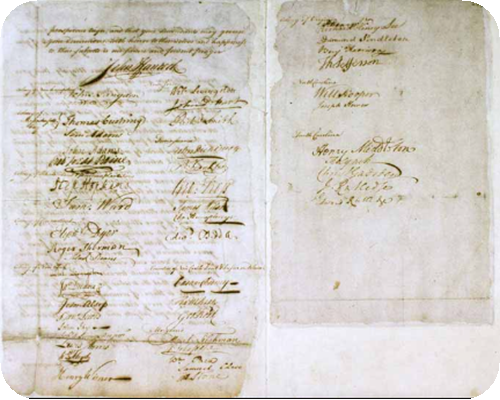
The petition was passed on July 5, 1775. John Hancock affixed his famous signature, followed by the other delegates, on July 8, and it was promptly sent by sailing ship to London.


John Adams was displeased with the decision to make a final pitch for peace. He was moving closer to wanting nothing less than full independence from Britain, and he wrote in a letter to a friend that the petition was a complete waste of time. Unfortunately for Adams, the Brits intercepted his letter and rushed it to London, where it arrived about the same time as the petition. That was seen by many as proof that the colonists were insincere at best and two-faced at worst.
As it turned out, the king never read it. George III had already branded the colonists rebels with a royal Proclamation of Rebellion in August, refusing to so much as receive their petition. And that was that. From that point, it was “on like Donkey Kong,” as future generations would say.
London heard from the gang in Philadelphia again 365 days later, when the Continental Congress passed a little thing called the Declaration of Independence.
The original Olive Branch Petition (the one sent to George & Co.) is housed in the U.K. National Archives at Kew, in southwest London. (A second signed copy survives, too; the New York Public Library acquired it in 1948.)
Look at it today, and one is tempted to indulge in a game of “What if?” What if George III had been less bellicose in his approach to his rebellious subjects? What if there had been more doves in Parliament willing to fight for peace? And the biggest what-if of all … What if the Olive Branch Petition had succeeded?
Instead of celebrating Independence Day on July 4, we might be commemorating Reconciliation Day on July 5 — while waving the Union Jack and singing “God Save the King.”