


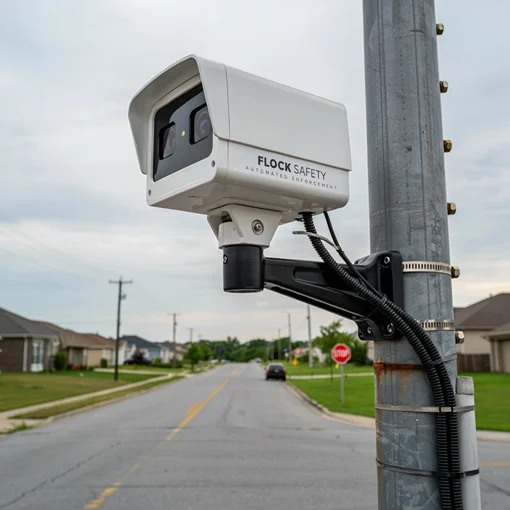
The Navajo Nation is turning to Flock Safety to help tackle crime despite privacy concerns by other governments.
America’s largest Native American reservation will deploy Flock Safety’s license plate reader cameras to help cover the 27,000-square-mile reservation that spans Arizona, New Mexico and Utah.
“The Navajo Nation faces some of the most difficult public safety challenges in the country, and [the cameras] will be a force multiplier for the Navajo Nation,” said Courtney Terlecki, a spokeswoman for Flock Safety, said in a written statement. We’re proud to stand with the [Navajo Department of Criminal Investigations] and [Navajo Police Department] to help close that gap.”
As the Navajo Nation is using Flock Safety cameras to assist with law enforcement, other parts of Arizona are pushing back against them.
Katelynn Contreras, a policy strategist for the American Civil Liberties Union of Arizona, told The Center Square this week that “people are worried about how their privacy is being violated.”
“People are becoming more aware around the pervasiveness of how this technology is being used and how data is being collected,” she said.
Navajo authorities face unique challenges.
According to the Navajo Police Department, the nation has “over 205 commissioned officers and over 100 civilian support staff, including police dispatchers,” serving a population of more than 178,000 people.
The Center Square reached out to the Navajo Police Department, but did not hear back before publication time.
Terlecki said that Flock Safety cameras “help law enforcement investigate and solve cases including stolen vehicles, burglaries, assaults, missing persons and other serious crimes.”
Terlecki said law enforcement agencies “can also receive real-time alerts on license plates tied to stolen vehicles, wanted suspects, or missing persons cases such as AMBER and Silver Alerts, which helps officers locate vehicles faster, close cases sooner, and recover victims and property.”
Terlecki said Flock Safety last year “supported more than 1 million criminal investigations and incidents, assisted an estimated 20% of solved cases in jurisdictions where its technology is deployed, and helped locate more than 10,000 missing persons.”
Canceling contracts
Residents in Sedona rebuffed Flock Safety cameras and saw its city council cancel its contract with the company in September 2025.
Three months later, Flagstaff City Council terminated its contract with Flock Safety after residents raised concerns.
Pinal County Sheriff Ross Teeple said this week that his sheriff’s department would not renew the county’s contract with Flock Safety when it expires in September, citing Fourth Amendment concerns.
The city of Chandler is currently weighing whether to renew its contract with Flock Safety after resident feedback.
According to Terlecki, “agencies own and control their data.”
“Access is limited to authorized users, every search requires a documented reason, and each search creates a permanent audit trail. Data is automatically deleted after 30 days by default unless an agency establishes a different retention period consistent with applicable law and policy,” she said.
Contreras said a Flock Safety contract does not say the “data has to be destroyed after 30 days.”
She added that it is “unlikely” Flock keeps data past 30 days due to the size of its network, but that 30-day period is “long enough to build a pattern of life on [people] to reasonably track where they could be” on a random day in that time span.
Contreras said data from Arizona Flock Safety cameras has appeared in Washington.
She explained once Flock data leaves Arizona, it is no longer governed by the Arizona Constitution. On top of this, she said when Flock data leaves America, it is no longer subject to the U.S. Constitution that protects Americans’ data.
“Flock is building a nationwide mass surveillance system piece by piece with municipalities, grid companies, homeowner associations and other various government entities,” Contreras said.
She added that these cameras are a “flagrant violation of [people’s] right to privacy,” which is protected by the Fourth Amendment of the U.S. Constitution and Article 2, Section 8 of the Arizona Constitution.
Contreras said this section of the Arizona Constitution gives residents “greater protection from unwanted government snooping.”
No state regulations
Arizona does not currently have any state law that regulates Flock or other automatic license plate reader technology, she noted.
Terlecki said over “40 courts across the country have determined that fixed license plate readers do not violate the Fourth Amendment and cannot track the whole of an individual’s movements.”