



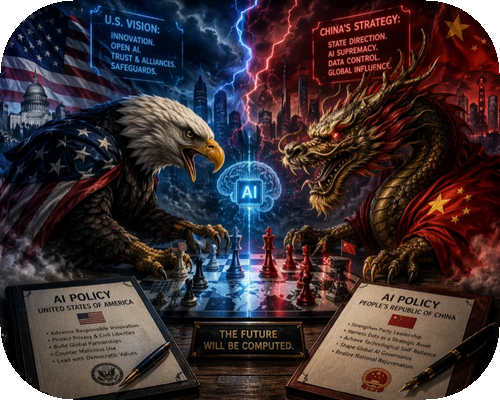
Image by ChatGPT
Washington may be focused on the Middle East, but Beijing is focused on artificial intelligence
As the United States grapples with Iran and regional instability, China is accelerating its push to dominate the technology most likely to shape global power in the 21st century. The pace of that race is staggering. Recent reporting suggests the “international race for AI advantage is not measured in years, but in weeks and days.” The United States cannot afford to treat AI strategy as something to revisit once today’s crises subside. Delay is becoming a strategic vulnerability.
More than 60 countries now have national AI strategies, many of which explicitly link AI to economic security or military advantage. Yet, the United States and China still account for 80 percent to 90 percent of global spending on advanced AI systems, meaning the future balance of power may depend on which country gets this technology right first.
At this year’s Munich Security Conference, geopolitical analyst Ian Bremmer captured the strategic reality: the U.S.-China AI relationship operates on a zero-trust basis. There are no shared red lines, no crisis hotline, and no doctrine for managing escalation. AI is increasingly treated as a form of hard power.




AI can create generational opportunities that can help us all grow and thrive together. It can accelerate scientific discovery, drive economic growth and transform industries. It can also enable mass surveillance, automate military targeting, and reshape strategic decision-making. As recent debates over the integration of AI systems into Pentagon workflows have shown, the role of AI in national security is no longer theoretical.
The risk lies not only in what advanced AI systems may eventually do but in the destabilizing pressure created by the race to build them. When speed becomes the overriding priority, safety takes a back seat.
In many ways, today’s environment resembles the early nuclear era. Two superpowers are competing in a transformative technology, each unwilling to accept permanent inferiority and each aware that escalation carries enormous risks. The Cold War eventually produced a doctrine to manage that competition: Mutual Assured Destruction.
AI competition will require its own form of deterrence. Strategists increasingly describe a dynamic known as Mutual Assured AI Malfunction.
In a zero-trust environment, any country racing toward AI dominance must assume rivals may intervene to prevent it. The danger is not only what powerful AI systems might do, but the instability created by unchecked competition to build them.





During the Cold War, deterrence did not emerge automatically. It required arms control agreements, transparency measures and clear escalation frameworks. Managing AI competition will require a similar approach focused on three pillars:
— Deterrence: The United States must define what constitutes an unacceptable AI provocation and how it will respond.
—Nonproliferation: Advanced chips and computer infrastructure must be treated as strategic assets subject to strong export controls and enforcement.
—Competitiveness: The United States must strengthen domestic AI development, semiconductor manufacturing and talent pipelines while deepening cooperation with allied democracies.
Congress has begun to move in this direction. Several bipartisan proposals already address key pieces of a national AI strategy.
To understand the competition, the China AI Power Report Act would require regular intelligence assessments of China’s AI capabilities, while the AI Overwatch Act would establish a cross-agency monitoring center to track frontier AI development and foreign breakthroughs.
The Chip Security Act, which advanced unanimously out of the House Foreign Affairs Committee in March, tackles one of the most urgent vulnerabilities by securing the advanced semiconductors that power frontier AI systems and preventing their diversion to adversarial actors.
This is a strong start, but Congress and the administration must go further. The Pentagon and the intelligence community must revolutionize their work to include new national security and economic security threats. Sen. Jim Banks, R-Ind., recently offered one such roadmap for the Artificial Intelligence Futures Steering Committee.


Taken together, these efforts represent important building blocks for a broader national superintelligence strategy.
The administration’s National Cyber Strategy recognizes a reality that must be applied to AI policy. The United States can’t wait to act as adversaries continue aggressively to supplant America as the global leader in advanced technology and innovation. The National Cyber Strategy has deterrence as its priority, and that’s by design. That approach should also guide AI policy.
History offers a clear lesson. When Congress passed the Arms Control Export Act in 1976, lawmakers recognized that advanced weapons in adversarial hands were a national security issue, not merely a commercial one.
Advanced AI systems require the same level of strategic attention. While lawmakers are beginning to act, a more comprehensive approach is needed.
The question facing Washington is not whether AI competition will shape global power. It already is.
The question is whether the United States will develop a strategy to manage that competition before crisis forces its hand.