




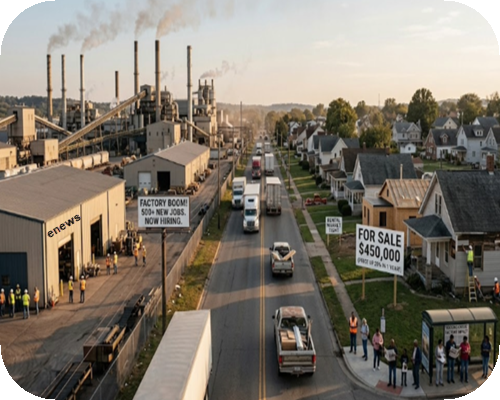
As the Trump administration boasts about a resurgence in American manufacturing, there are questions about the impact on housing in some already tight markets.
On April 2, the one-year anniversary of Liberation Day, officials released a statement saying that trillions of dollars in private and foreign investments are fueling a historic reshoring of American industry, bringing jobs, production, and supply chains back home.
“Investments span sectors and companies across the economy — from Apple to Toyota to Sharpie to Micron to Pfizer,” the statement says.
Officials said that in January 2026, a leading indicator based on surveys of U.S. manufacturers signaled that factory activity expanded for the first time in over two years. This trend has continued in February and March, they said.
How will this impact housing, especially in areas of the country where supply is already short?





Leaders at the American Enterprise Institute in Washington, DC, addressed that issue during a recent webinar hosted by AEI Housing Center. Ed Pinto, senior fellow and codirector of the Housing Center, was joined by Research Fellow Arthur Gailes and Senior Data Analyst Amanda Dial.
Titled “The Bigger the Factory, The Bigger the Housing Problem,” the webinar honed in on the Trump administration’s reshoring efforts to bring factories back to — or get them located — in the United States.
Pinto, who moderated the webinar, said the biggest opportunities for factories in the United States are in sectors like pharmaceuticals, cars, chips, and rare earths.
AEI Housing Center is monitoring more than 70 factories under construction in the U.S. and evaluating them for their level of “preparedness for housing workers,” Pinto noted.
“There’s a saying in economic development — which focuses on things like factories — a key part of economic development is also the homes that those workers can live in because, ultimately, homes are where those workers go to sleep,” Pinto said.


“And if you don’t have homes for them, they have to commute long distances or have temporary facilities near the factory and then commute from their home.”
Pinto said it would be considerably better if the housing situation were evaluated along with the economic development of the factory itself.
Gailes told The Mortgage Note that Pinto’s point about commuting is worth taking note of. Longer commutes are more expensive for workers, both in real transportation costs and in time, and an extra 30 minutes for driving means their workday is effectively an hour longer.
Gailes said when AEI Housing Center monitors the factories under construction, they project the median income for workers of those factories based on their industry and location.
“The announcements for those factories typically include the number of jobs. When we discuss housing affordability, it’s based on what those workers could reasonably afford,” Gailes said.
For factories, the question is twofold, he continued. “First and most importantly, more homes nearby means a better, more competitive talent pool to draw from. Fewer people means a possible labor shortage: you have to spend more time and money recruiting. Second, there’s research showing that workers become less productive, particularly among non-white-collar workers.”
Separately – but also important here, said Gailes, is “the legislators in the cities and counties that host the factories. Many of them have gone through an extensive process to get these factories approved. They also need to ensure that the infrastructure and legal environment are in place to allow housing and amenities nearby, otherwise they’re both underserving their constituents and losing out on the economic and tax revenue benefits the factories are capable of.”
Would employer-provided housing help?


Salim Furth, senior research fellow at Mercatus Center at George Mason University, told The Mortgage Note that employer-provided housing is “okay” in situations where the employer is — by necessity — remote, such as a ski resort, or even a rural school.
”But it’s not a strategy for long-term productivity gains or worker happiness.” Productivity and human thriving both benefit “far more from being in a thick labor market where workers can change jobs readily. Employer-provided housing is a prophylactic for productivity.”
The worker housing initiative isn’t new to Roger Valdez, director at the Center for Housing Economics. He told The Mortgage Note, “Back in 2025, I advocated for a bill that would have required better analysis of the possible impact of economic development, specifically incentive programs, that increased employment and presumably demand for housing.”
Consequently, Valdez sees this as “a very important need. When we get a good thing — more jobs — we have to remember that we need another good thing: more housing. If we don’t take care of that demand, we create scarcity and higher prices. That creates a backlash, often cultural, which has a negative influence on policy.”
How can local governments help?
Gailes said local governments planning for factories and the employees who will work there primarily need to allow more housing to be built — via liberalizing land use laws and restrictions.
He said there are options for local leaders who want to expand housing supply, including allowing smaller lots, single-family lot splits, and residential housing in commercial zones.
“Employing these steps would improve our housing grades for nearly half of the factories we measure,” Gailes said.
In more rural areas, planning may include expanding roads, water, and sewer systems.
“These systems are typically managed at the local level, but often require coordination with state funding and private developers to expand capacity,” Gailes said.
Valdez said the bottom line for officials across all levels of government is the same.
“More jobs bring more people, and where there are more people, we need more housing and fewer rules to be sure prices don’t surge along with demand,” Valdez said.
Editor Kimberley Haas contributed to this report.









1 thought on “As Factories Boom, What Is The Impact On Housing? – The Mortgage Note”
In SoCal to find affordable housing required looking farther away from employment centers . I drove 45 miles one way. You cannot manipulate the market.
The best way is for creative financing such as 40-50 year mortgages and adjustable rate mortgages (ARMS). We had 20 years of rapidly increased home prices without increased wages. THAT was and is the problem. It may take stagnant home prices and rapidly increased wages to bring housing back into a balance. Government cannot create affordable housing.
Comments are closed.