

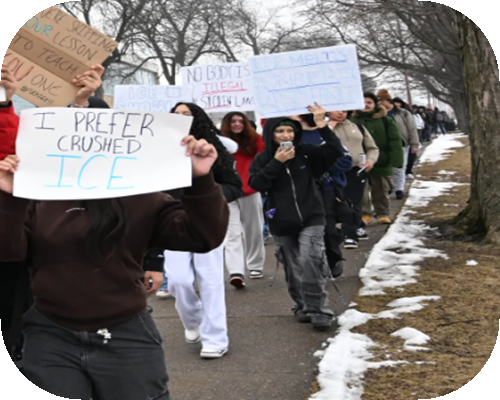
High school students gather for an anti-ICE protest
School officials ordered two eastern Pennsylvania schools into lockdown on Feb. 20, while dozens of students left the schools and became unruly. The move came after officials directed the students to cancel their planned protest against Immigration and Customs Enforcement (ICE) operations.
Quakertown High School and Quakertown Elementary School, about 50 miles north of Philadelphia, were locked down for nearly two hours.
School officials took the action after police notified them that high-schoolers, who had left the building without permission, “were engaging in unsafe and disruptive behavior in town,” acting Superintendent Lisa Hoffman wrote on the Quakertown Community School District website.
Her statement provides no further details about the students’ behavior, but CBS News reported that five students were arrested.




A video posted on X shows Quakertown police struggling to put a person into the back of a police SUV as a crowd mills around and some people shout. When an ambulance arrives, a man in plainclothes exits an unmarked vehicle, dabbing what appears to be a bloody nose while officers ask if he is OK.
School officials said they were waiting for more information from the police regarding reports of students’ actions. A Quaktertown police sergeant told The Epoch Times that he was not permitted to release a statement from the borough’s police administration.
Earlier in the day, Quakertown school officials had notified families and students that a planned “student-led walkout should no longer occur,” Hoffman wrote. District leaders made that decision after consulting with law enforcement over “a potential safety concern” in connection with the walkout.
However, in defiance of that directive, about 35 Quakertown High School students left the building around 11:30 a.m. Immediately, administrators worked with police and locked down the high school and the elementary school, stopping anyone from entering or leaving the buildings, Hoffman said.
“Students in both schools maintained their normal school day activities,” Hoffman wrote, and the lockdown was lifted around 1:15 p.m.


Meanwhile, in Spring Township, near Reading, Pennsylvania, the Wilson School District issued a statement addressing a widely circulated video showing Wilson High School Principal Daniel Weber telling student protesters they would be suspended if they didn’t return to class.
In response to “numerous” phone calls and emails about the video, Superintendent Chris Trickett posted a statement on Feb. 19, a day after Weber addressed the group amid an unauthorized walkout.
Trickett said that the video “captures only a portion of the interaction between school staff and students.” Further, he wrote, “The situation was particularly challenging because we had been informed that the demonstration would not take place.”
A careful review of the circumstances revealed that no one was disciplined for expressing political views, the superintendent said. Rather, disciplinary action was based on violations of the student handbook, which includes “leaving class or the building without permission,” he said.
“Longstanding legal guidance, including the U.S. Supreme Court’s decision in Tinker v. Des Moines, affirms that students do not ’shed their constitutional rights to freedom of speech or expression at the schoolhouse gate,’” Trickett wrote, referring to that 1969 landmark ruling.
However, “the Court made clear that schools may take action when conduct materially disrupts the educational environment or compromises student safety,” Trickett wrote. Further, schools can and must regulate demonstrations “in alignment with school rules and policies,” he said.
“Our response reflects this balance,” Trickett said, “between protecting student expression and fulfilling our responsibility to maintain safe and effective school operations.”