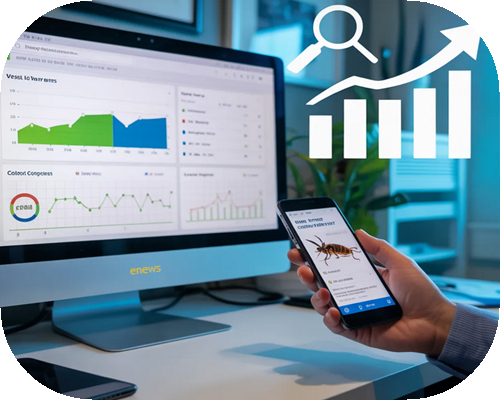
These days, pest control companies can’t just depend on word-of-mouth or the usual ads. When homeowners or business owners find termites in their walls, ants in their kitchens, or rodents in their attics, they usually head straight to search engines. If your business isn’t popping up online, you might be losing out on important leads.
The Shift to Digital Search
When people have a pest issue, they want quick answers. Most grab their phones and start searching for help almost instantly. If your website isn’t ranking well, chances are potential customers will go for a competitor who shows up first in search results.
That’s why putting money into pest control SEO is super important for companies wanting to stay visible. Search engine optimization can help your business show up higher on search engines, get listed on local maps, and attract those customers who are actively searching for pest control services.
Long-Term Growth Over Short-Term Ads




Sure, paid ads can bring in traffic fast, but once your budget’s gone, poof—so is your visibility. SEO is a different beast. When your website is set up right, it keeps pulling in organic traffic over time. This helps your company build lasting authority and credibility.
When folks see your business consistently at the top of search results, they start to trust you. Good rankings show you’re reliable, which is super important for homeowners making quick decisions on who to hire.
The Importance of Local Visibility
Most pest control companies operate within defined geographic service areas, making local search optimization essential for growth. When potential customers search for nearby pest control services, search engines prioritize businesses that are geographically relevant and properly optimized. Strong local SEO begins with a fully optimized Google Business Profile that includes accurate service information, updated hours, and clear descriptions. Consistency is equally important—your business name, address, and phone number should match across all online directories to build credibility with search engines.
Encouraging satisfied customers to leave positive reviews further strengthens local rankings and builds trust with prospective clients. Creating service-area-specific landing pages allows businesses to target individual communities more effectively, while naturally incorporating location-focused keywords into website content enhances relevance. When implemented correctly, these strategies significantly improve visibility in map listings and localized search results, often leading directly to phone calls and scheduled appointments.
Mobile Optimization Is Non-Negotiable
A significant portion of pest control searches occurs on mobile devices, particularly when customers are dealing with urgent infestations and need immediate assistance. If a website loads slowly, appears cluttered on a smartphone, or makes it difficult to find contact information, potential customers may leave within seconds.




A mobile-friendly website should load quickly, display properly across all screen sizes, and provide easily accessible call buttons so users can connect without frustration. Clear service descriptions and straightforward contact forms further streamline the user experience. Beyond convenience, mobile optimization also plays a direct role in search rankings, as search engines prioritize mobile-responsive websites.
Enhancing usability not only increases conversion rates but also strengthens overall SEO performance, ensuring that your business remains competitive in an increasingly mobile-driven marketplace.
Reviews and Reputation Management
Online reviews have a big impact on what people buy. Before getting in touch with a pest control company, prospective clients frequently read several reviews. Managing and replying to reviews on various platforms is an essential part of having a strong online presence.
In addition to increasing credibility, encouraging happy customers to share their experiences also increases search visibility. Consistently positive reviews are seen by search engines as an indication of relevance and legitimacy.
Professionally handling both favorable and unfavorable reviews shows responsibility and concern for customers. Even a considerate reaction to criticism can transform a bad circumstance into a chance to foster trust.
Tracking Performance and Continuous Improvement
Measurability is one of the biggest benefits of digital marketing. Website analytics, keyword rankings, conversion rates, and call tracking information can all be used to monitor SEO efforts.


Pest control businesses can determine which services bring in the most traffic, which pages convert the best, and where they need to make improvements by routinely evaluating performance. Better marketing choices and ongoing optimization are made possible by this data-driven strategy.
SEO offers unambiguous insights into what is and is not working, in contrast to traditional advertising, where results are frequently hard to measure precisely.
Staying Ahead of Competitors
The pest control industry is competitive, and many companies are beginning to invest heavily in digital marketing. Businesses that delay building a strong online presence risk falling behind competitors who dominate search results.
SEO is not a one-time effort. It requires consistent updates, content creation, technical improvements, and ongoing optimization. However, companies that commit to the process often see compounding results over time. As rankings improve, traffic increases. As traffic increases, more leads convert. As more customers leave positive reviews, credibility grows.
This cycle strengthens your online authority and creates a sustainable growth engine for your business.
Conclusion
Digital search has permanently changed how consumers look for pest control services. Businesses that put a high priority on their online presence set themselves up for long-term success, while those that disregard SEO run the risk of losing their potential customers.
Pest control companies can draw in high-intent leads, establish credibility, and become long-term authorities in their markets with the aid of a well-thought-out SEO strategy. In a competitive industry where trust and responsiveness matter most, investing in digital presence isn’t just a marketing strategy—it’s a critical component of modern business success.