


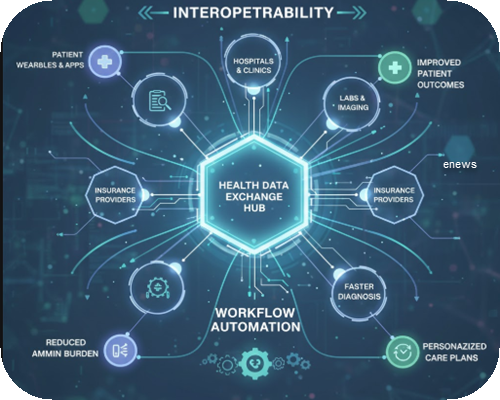
Efficiently managing data is a constant obstacle for healthcare systems. These solutions include interoperability and workflow automation. Such strategies ease measures and improve patient care. Healthcare providers recognize their significance and make informed choices that impact the functionality of their operations.
Understanding Interoperability
You can enhance patient outcomes through healthcare automation solutions that streamline data, ensure compliance, and facilitate seamless care delivery. Interoperability refers to the ability of various software and systems to communicate with each other and exchange data. That means different platforms can exchange information, and in the case of health care, patient data. Its access to medical information in a timely and accurate manner makes it more crucial.
For example, when a patient is treated at different hospitals, interoperability enables each doctor to view the patient’s complete medical history. This method yields fewer errors and more favorable treatment outcomes. Interoperability facilitates seamless data transfer, which is essential for delivering coordinated care across departments.
Benefits of Interoperability
There are many benefits to interoperability. Firstly, it improves patient safety because you can access all medical records. This reduced risk of medical errors enables clinicians to make more informed decisions. It also saves time and redundancy on data entry and paperwork.
Interoperability also improves efficiency. As a result, healthcare professionals can devote their attention to patient care instead of administrative tasks. Treatment options are modified in quick succession based on live data. Such flexibility directs attention to more optimal resource use and cost savings.





Role of Workflow Automation
Task automation, also known as workflow automation, is the use of technology to perform tasks in a repeatable and consistent manner. It entails that all processes, including scheduling, billing, and record management, can be organized and streamlined. It helps decrease manual errors and increase operational efficiencies.
Automating appointment scheduling, for instance, ensures that reminders are sent to patients promptly and efficiently. All of this ultimately results in fewer missed appointments and a more efficient clinic. Likewise, automated billing processes reduce errors and speed up the payment cycle.
Enhancing Data Exchange with Automation
Automation aids in the exchange of data. Automation of data entry and retrieval can ensure the accuracy and consistency of data in healthcare systems, thereby enhancing the reliability of healthcare information. Maintaining this level of uniformity is essential for ensuring the accuracy of core patient files.
Additionally, it also expedites the data handling process. It enables healthcare providers to access important information at a significantly faster rate, resulting in improved response times. In critical situations, the need for speedier decision-making intensifies.
The Challenges of Interoperability and Automation
The advantages achieved are evident; however, interoperability and automation present their challenges to address. Integration among different systems is one of the most significant challenges. Healthcare organizations may use multiple platforms that will require interoperability. To reach this compatibility takes organization and investment.


The other challenge is to ensure the safety of data, and higher interdependence between systems results in better protection of patient information against breaches. Strict regulations and strong security measures are necessary for healthcare providers.
Overcoming Barriers
To address these issues, healthcare organizations must collaborate and establish consistency across their operations. Providers can collaborate to create standardized protocols for data sharing. This partnership reduces compatibility hassles and fosters consistency.
Education is an investment, too. Staff need to be prepared to use new technologies efficiently. With proper training, everyone can contribute to the successful implementation of the project.
Future of Healthcare Data Exchange
As technology advances, the potential for interoperability and automation also increases. New developments, however, will facilitate even better data exchange. New technologies, such as artificial intelligence and machine learning, can evaluate and track information in ways that were previously inconceivable.
It helps in predicting patients’ needs and tailoring care plans to meet them. The incorporation of such advancements can further fortify healthcare systems. This forward-thinking strategy enables organizations to respond to emerging demands as they enter the business landscape.
Conclusion
Information exchange receives a big boost from interoperability and workflow automation. By ensuring smooth communication and automating processes, they improve patient care and operational efficiency. These are still significant challenges, but they are surmountable with strategic planning and a coordinated effort designed to achieve scale. The state of healthcare technology will become increasingly promising as the field continues to adapt to innovative technological solutions and advanced data management in the future. Familiarization and utilization of these tools can ensure all stakeholders have better outcomes.