




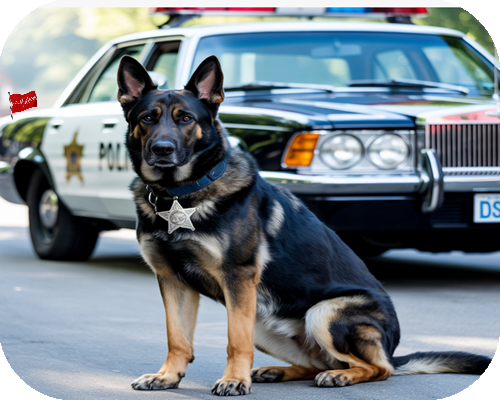
Sig is a good boy, trained to obey. So, according to court documents in a federal case, he complied when his police handler ordered him to enter a home in Highlands Ranch, Colo., and bite anyone inside.
The lack of a warrant did not bother Sig, a German shepherd with six years of experience at the Douglas County Sheriff’s Office. Sig keeps his nose down and leaves tactical decisions to the humans in charge. He trusted them when they sent him blindly into the home without knocking, announcing their intention or investigating who might be inside.
Possibilities were endless. Even a child could have been home. Sig’s handler and another deputy at the scene had no idea.
All they knew was someone had called 911 and reported a man breaking a front window in the unincorporated community south of Denver. When the deputies arrived at 6:40 p.m. on Feb. 11, 2022, they found shattered glass but heard no signs of violence or pleas for help.
They launched Sig through the window anyway, like a heat-seeking missile. Within seconds, he found Tyler Luethje sleeping in his bed, and pounced. The deputies ran to the room and unlatched the dog from Luethje’s arm while he screamed in pain: “I live here! I live here! I live here!”





Luethje could have explained that he had lost his keys and taken desperate measures to escape freezing weather. Yet, the deputies never asked. They confirmed after the fact that Luethje had broken his window and was home alone. Then, they handcuffed him and placed him in the back of a patrol vehicle.
A driver’s license confirmed Luethje’s address. He was telling the truth. Yet, the deputies re-entered the home — after sending Luethje away in an ambulance — and conducted a “thorough search.” They found nothing illegal.
Luethje was an innocent victim. So was Sig.
Like other police dogs, he aims to please. Far too often, law enforcement agencies use the eagerness of their K9 partners to violate civil liberties. Many dogs spend their careers shredding the Constitution’s 4th Amendment, which guarantees “the right of the people to be secure in their persons, houses, papers and effects, against unreasonable searches and seizures.”
Our public interest law firm, the Institute for Justice, has seen everything as part of our Project on the Fourth Amendment. One common tactic involves open-air sniffs during traffic stops. Officers need probable cause to search a vehicle, so they lead their K9 partners around the perimeter — often more than once — and then declare that a drug “alert” has occurred.


This is a rigged game. One Australian analysis suggests drug dogs are wrong 75 percent of the time. A Chicago analysis estimates a 56 percent error rate. Stephen Lara in Nevada, Eh Wah in Oklahoma, Alek Schott in Texas, and Phil Parhamovic in Wyoming had their vehicles searched following dog alerts, and none of these men possessed anything illegal.
Judges treat K9 alerts as infallible anyway.
The police know this; some jokingly refer to their K9 partners as “probable cause on four legs.” The result is exploitation, but police dogs cannot speak for themselves. Luethje does not have this limitation. He sued the deputies for violating his 4th Amendment rights.
The Douglas County Sheriff’s Office says that “when all of the facts are known,” the evidence will show that the deputies acted “legally and properly.” Yet, so far, all the deputies have done is try to stop all the facts from being known. Their first step was claiming qualified immunity, a judge-made doctrine that can stop a case before trial, shielding government employees from accountability.
Overcoming qualified immunity is difficult, but Luethje has scored two early wins. A federal judge denied the deputies’ motion for qualified immunity on June 5, 2024. The 10th U.S. Circuit Court of Appeals upheld the decision on March 19, 2025. The rulings mean Luethje can proceed to trial.
Sig will be oblivious. However, the case can address law enforcement overreach that turns dogs into collateral victims. Loyal K9 partners deserve better.







2 thoughts on “Police Dogs, the Silent Victims of 4th Amendment Abuse – Inside Sources”
I was eagerly expecting to finally see the truth about how the dogs themselves are routinely tortured, the fact that far more of them are killed by their handlers than by any suspects, and when not being hanged to unconsciousness, “helicoptered,” slammed to the ground and up against walls,
punched, kicked, electroshocked, etc., or when on patrol, they are kept in solitary confinement, which is psychologicaI torture to supplement the physical torture.
But, once again, although I (and a few others) have written about it, have extensive documentation, (and had a website up for 24 years) the Code of Silence on that subject remains firmly in place. Very disappointing.
I mistakenly gave the article a 1-star review; I meant to give it 4. Sorry. The reason for the 4 is that there is no mention of the brutal training methods and many other horrible abuses of police dogs, aside from sending them in to dangerous situations as heat-seeking missiles.
Comments are closed.