




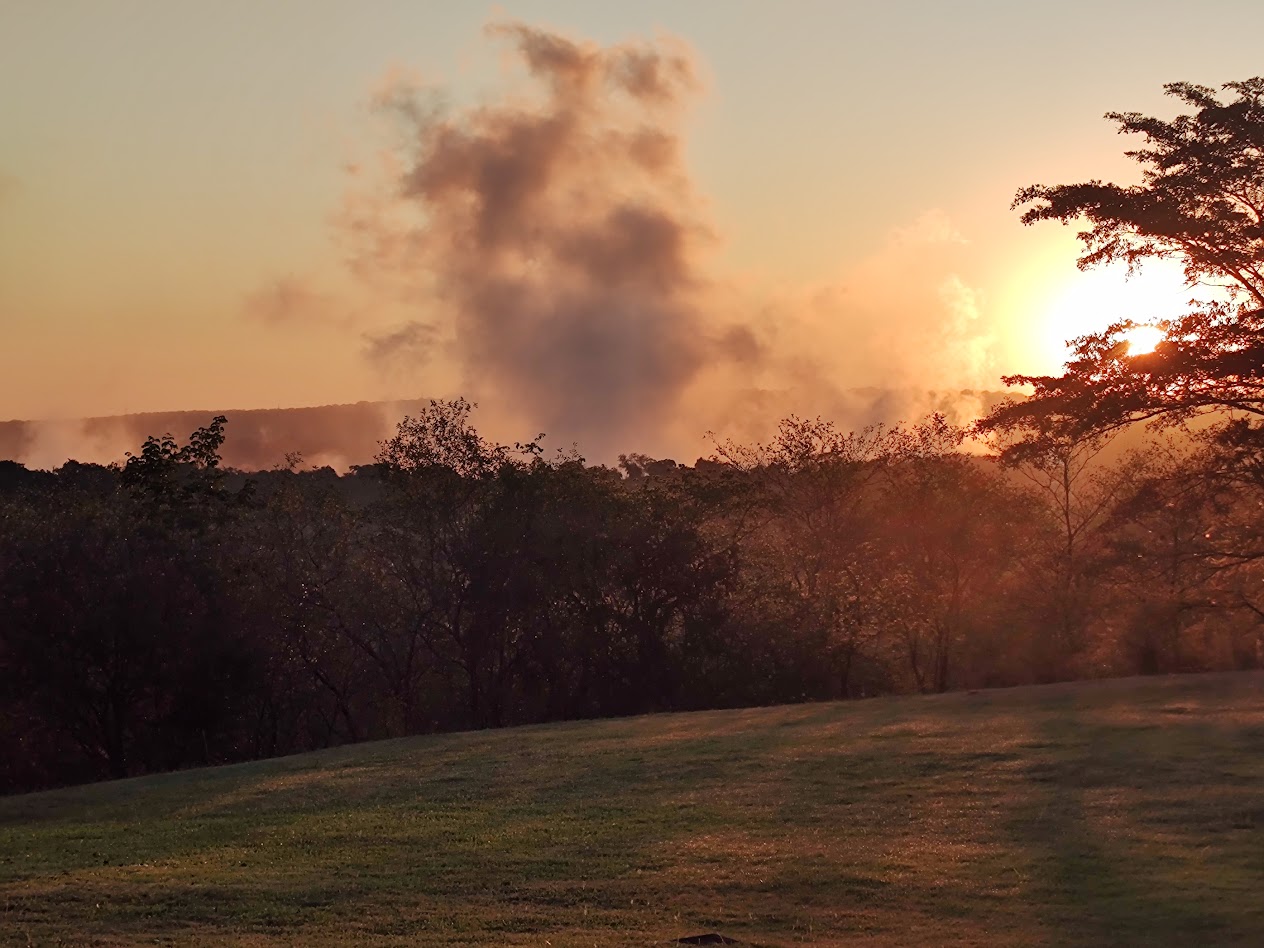
Photo: The spray from Victoria Falls
The Victoria Falls Bridge was on fire.
How else to explain the rising smoke obscuring my view of the iconic arched bridge from the veranda of the Victoria Falls Hotel, a 120-year-old genteel remnant of British colonial days when Zimbabwe was Southern Rhodesia before gaining independence in 1980.
“It’s the spray,” our trip leader Chris McWilliams explained. “A lot of people think it’s a bush fire.”
Visible from 30 miles away, the spray soars higher than the Eifel Tower (1,082 feet), sometimes surpassing the Empire State Building (1,486). It played a surprising role in the construction of the 650-foot long bridge, which provides the only railway link between Zambia and Zimbabwe as well as a bungee jump of 364 feet above the rapids of the Zambezi River rumbling through the Second Gorge. Actors Will Smith and Ewan McGregor have taken the plunge. You can watch them jump on YouTube.







Victoria Falls Bridge was the brainchild of English mining magnate and politician Cecil Rhodes to connect Cape Town to Cairo by rail through British territory, including Rhodesia (today Zambia and Zimbabwe), which was named after him.
“Build the bridge across the Zambezi,” he instructed his engineers, “where the trains, as they pass, will catch the spray of the Falls.”

Rhodes and his grand scheme died before the completion of the bridge in 1905. The stone marker at the Hotel reminds guests of his unfulfilled dream:






CAIRO | CAPE TOWN
5165 MILES | 1647 MILES
← →

The massive mist sustains a diverse rainforest ecosystem, including the cute black-faced vervet monkey and not-so-charming warthogs that greeted me at the entrance to Victoria Falls National Park, a UNESCO World Heritage Site.

Photo: The author at the park sign
The Park sign includes the original name the indigenous Lozi gave the Falls – Mosi-oa-Tuna (The Smoke that Thunders). I knew about the “smoke.” I was about to hear the thunder.



Photo: The Devil’s Cataract
As I approached the first overlook, the roar of the Falls, like a drum roll, heightened my anticipation to see one of the Seven Natural Wonders of the World. At Devil’s Cataract, there it was, as magnificent as I had hoped, the Zambezi plummeting 350 feet into the First Gorge with a rainbow adding the perfect touch. My only previous close-up exposure to a large waterfall had been on the Maid of the Mist boat excursion at Niagara Falls. Victoria Falls is roughly twice as high and twice as long.

Victoria Falls is neither the highest in the world (Angel Falls in Venezuela…think three Eifel Towers stacked on top of each other) nor the longest (Khone Pha Pheng Falls in southern Laos spreads nearly seven miles.), but it does produce the earth’s largest uninterrupted sheet of falling water. Every second, the Falls dumps 300,000 gallons over the height of a 35-story building (355 feet) for more than a mile (5,604 feet).
Not far from the First Gorge, I took an evening cruise on the Zambezi, which divides Zimbabwe and Zambia. On the Zambian side, a bloat of hippos suddenly popped out of the water with wide-open mouths like children responding to a dentist’s orders. Several Nile crocodiles crawled in the marshes of Livingstone Island, where the Scottish missionary David Livingstone became the first white person to see the Falls in 1855 and named it after Queen Victoria.

Photo: Statue of David Livingstone
“It has never been seen before by European eyes,” he marveled, “but scenes so lovely must have been gazed upon by angels in flight.”
I also visited Botswana and Namibia that converge with Zambia and Zimbabwe at the confluence of the Zambezi and Chobe rivers to form the only international quadripoint on Earth.
The African Four Corners is located near Chobe National Park in Botswana, the country with the largest concentration of elephants (130,000) in the world. The Kalahari Desert covers more than half of Botswana, but the semi-desert conditions support wildlife with large tracts of grasslands, deltas, savannahs and rivers.
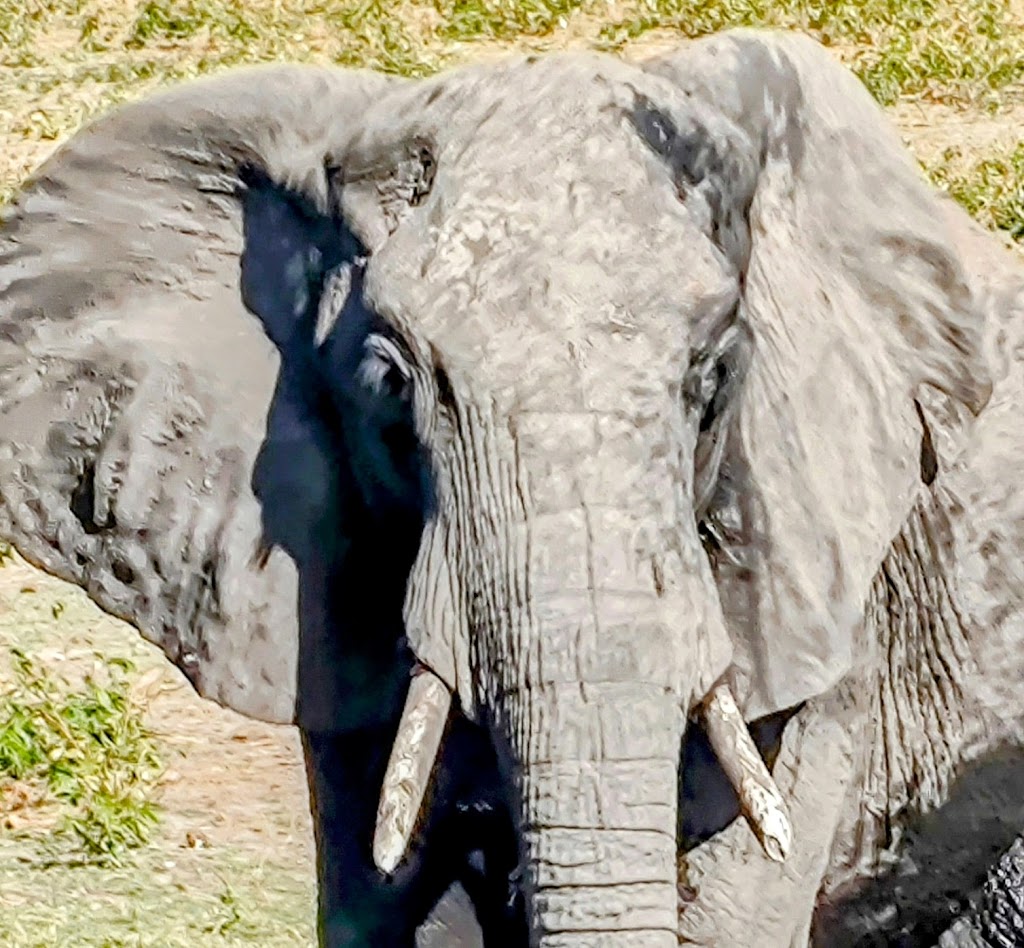
It’s impossible not to encounter some of the 50,000 elephants in Chobe, especially on a river safari. Our boat of 15 people approached several elephants slurping and splashing on the riverbanks, oblivious to us 50 feet away. The herd of menacing-looking buffalo grazed nearby, ignoring their huge neighbors. They are part of the Big Five (elephant, buffalo, lion, leopard and rhinoceros), a moniker created by big-game hunters in the late 19th century for the most dangerous and difficult animals to hunt on foot.
The buffalo stayed away from the Chobe riverbank, possibly to avoid an ambush by the largest freshwater predator in Africa, the Nile crocodile that can grow up to 17 feet and 1,650 pounds. We kept our distance, too, from the crocs we saw. Zambia reported 31 attacks on humans in 2023, 17 of them fatal.

A snoozing lion provided the highlight of the land safari. Our driver was ready to leave the lion sleeping under the shade of bushes when he suddenly awoke and marched across a fortuitous opening in the thick vegetation as if entering a stage to pose for our cell phones.
It took two flights to reach the next destination, Windhoek, the capital of Namibia, one of the youngest countries in the world that gained its independence from South Africa in 1990. Twice the size of California, Namibia is the second most sparsely populated country on earth (approximately eight people per square mile) behind Mongolia (six).
Namibia enjoyed a brief dose of worldwide fame in 2006 when Brad Pitt and Angelina Jolie chose Swakopmund, the country’s largest coastal town, to give birth to their daughter Shiloh. They also donated $2 million to the Namibia Wildlife Sanctuary. Times changed. The couple split 10 years later; and Shiloh, upon turning 18 this year, dropped Pitt from her last name.

Photo: The “Kalahari Ferrari”
Ninety percent of Namibia remains natural habitat, i.e. lots of sand. From Windhoek, to reach Namibia’s signature attraction – the towering Sossusvlei-area sand dunes in Namib-Naukluft National Park – we endured five hours of bone-crunching, bumpity-bumps mostly on dirt roads through the Kalahari Desert and the Naukluft Mountains bordering the world’s oldest desert, the Namib (55 million years, 11 times the age of the Sahara). The bus driver Godfrey broke the monotony with clever quips. He called the bumps “African Massages” and a cart full of kids we passed a “Kalahari Ferrari” with a three mule-power engine.
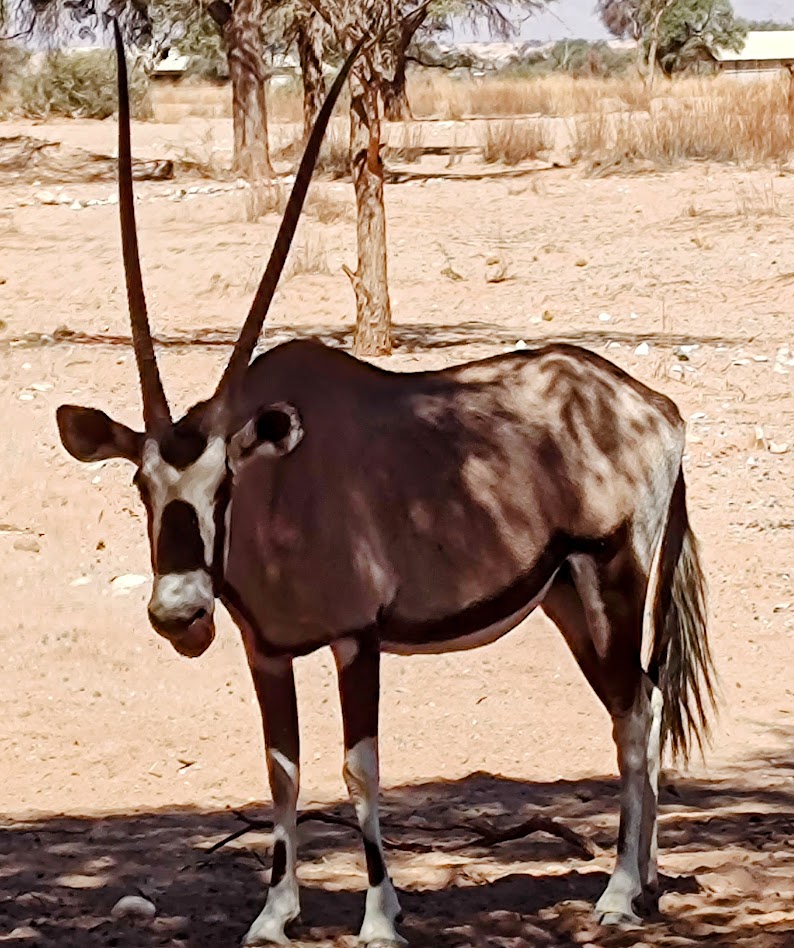
Photo: An oryx
At the lunch stop, I saw an oryx for the first time with distinctive horns that can grow as long as five feet. They prefer the near-desert conditions and can survive long periods without water. At Walvis Bay on the coast, seals, pelicans and flamingos frolicked in it.
Early the next morning, our bus joined the queue to enter the park as soon as it opened to take advantage of the best time to photograph the enormous orange dunes, some of the highest in the world. Climbers trudged up Big Daddy, the 1,066-foot monster that dwarfs Big Mama and the others.

The rising sun casts dark shadows on the dunes that create a distinct contrast with a kaleidoscope of vibrant orange hues, produced by high concentration of iron exposed to oxidation over many years We exited near the Tropic of Capricorn, the southernmost latitude where the sun can be seen directly overhead,

After two days on the coast, we departed for Cape Town, the oldest city in South Africa (1652) and seat of Parliament that has been rated the best place in the world to visit by the New York Times and other publications.
Cape Town’s natural beauty justifies its lofty ranking. Table Mountain, one of the most distinctive peaks in the world, resembles a flattened crew cut. It presides over the city and the waterfront like a 3,558-foot skyscraper. Devil’s Peak (3,281) and Lion’s Head (2,195) flank Table Mountain to complete the natural skyline.
While riding the circular cable car to the top of Table Mountain, I noticed my feet were moving. It was a new experience for me – a rotating floor in a cable car. Everyone got a good look at the steep cliffs below the two-mile long level plateau at the top. I was lucky. It was clear. When clouds shroud the top, it’s said the Mountain is wearing its table cloth.

Photo: The panorama from Table Mountain
In the far distance of the spectacular panorama stretched before me at Table Mountain, I found Robben Island, a speck in Table Bay, where Nelson Mandela spent 18 of his 27-year imprisonment. I took the six-mile ferry ride to the Alcatraz of Cape Town. It had been a maximum security prison, primarily for political prisoners, from the 1960s to 1991. Besides Mandela, two other future South African presidents – Kgalema Motlanthe and Jacob Zuma – spent 10 years there. It’s now a UNESCO World Heritage Site.

Photo: Mandela’s cell on Robben Island
The place was eerie, especially after hearing what actually went on inside the walls from our guide Sipho Msomy, who spent five years there for being a member of Mandela’s political party, the African National Congress. Mandela’s spartan 8-foot by 7-foot cell contained a straw mattress with a blanket, a green table with a bowl and a large red pot. It drew a crowd twisting their bodies to get a peek, like rubberneckers at a traffic accident. I was surprised to see a howitzer cannon and a machine gun pillbox on the grounds, testaments to Robben Island’s crucial point of defense in World War II.
I needed an uplifting break so I strolled along bustling Victoria and Alfred Waterfront (named after her second son). Amidst this shopping mecca of more than 450 upscale retail stores trying to “outlabel” each other, tug boats and fishing vessels still operate out of the oldest working harbor in the Southern Hemisphere.
Another reason for Cape Town’s popularity is its proximity to Winelands, the country’s scenic wine growing region 40 miles east, and the Cape of Good Hope, about 35 miles south to the tip of Cape Peninsula.
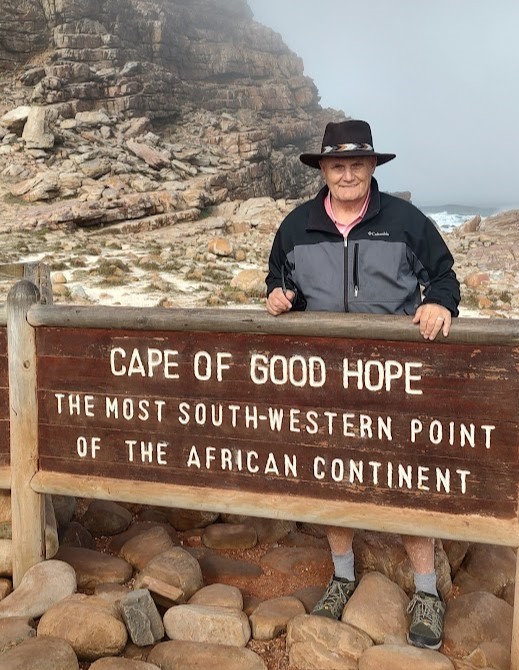
In picturesque Franschhoek Valley, we tasted the offerings of Rupert & Rothschild Vignerons. On the way to the Cape of Good Hope, I didn’t expect to see endangered African Penguins in a residential area. At the Boulders Penguin Colony in historic Simons Town, the “tuxedoed” stars waddled in a sheltered beach beneath a boardwalk crammed with tourists. A nearby sign warned the penguins will bite. They were too far away to find out. The penguins have been busy. From just two breeding pairs in 1982, the colony has grown to 2,000.
At the end of the road, I took a funicular to the top of Cape Point, a large rock formation jutting into the Atlantic that’s actually higher than the Cape of Good Hope. Then the fog rolled in.
I flew 11,510 miles from Dallas to Istanbul (that’s another story) to Cape Town to step foot on the southernmost point of Africa. Fog or no fog, the trip was worth it.






2 thoughts on “Southern Africa – Ed Wisneski”
Great pictures. Thanks!
Thanks Ed! In spite of the trouble we had operating your camera it took some great photos. Especially liked the pic of those “not-so-charming” warthogs. Was a really fun trip. A suggestion: Should add a photo or two of our sea excursion in Namibia with the pelican and deal that visited our boat.
Comments are closed.