



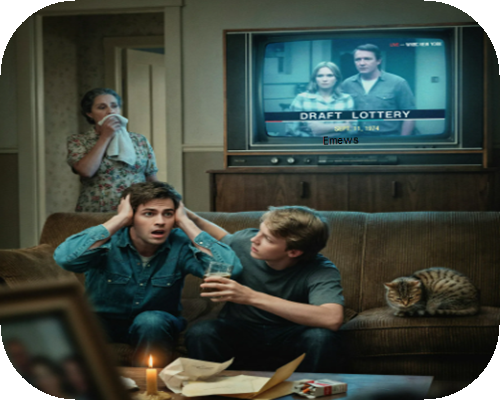
Hearts were racing from Connecticut to California and countless places in between. Americans were about to witness something they’d never seen before. It would bring immense relief to many households and deliver dark fear to others.
And it would all unfold right before their very eyes thanks to the modern miracle of television.
It had been a remarkable year for the young broadcast medium. So far in 1969, viewers had watched live as one president took office (Richard Nixon’s swearing-in); had said goodbye to another (Dwight Eisenhower’s funeral); had seen four Apollo space missions play out (including the first historic moonwalk on July 20); and even heard Sen. Edward Kennedy explain his actions in the Chappaquiddick incident to the nation.
As incredible as all that had been, nothing compared to what the tube brought into American homes on Dec. 1.
For viewers watching CBS’ top-rated lineup, it had started like any other Monday night. “Gunsmoke” was followed by “Here’s Lucy.” At 9 p.m., folks settled back into couches and recliners, ready for yet another top-rated show.




Instead, they heard an announcer say, “‘Mayberry R.F.D.’ will not be presented tonight but will return next week at its regularly scheduled time over most of these stations.” Tens of thousands of young men in the prime of life — plus their parents and siblings, their friends and sweethearts — all held their breath.
“The Draft Lottery,” another announcer solemnly intoned. “A live report on tonight’s picking of the birthdates for the draft. Here at Selective Service headquarters in Washington is CBS News correspondent Roger Mudd.”
The famous newsman appeared, arm draped over the back of a seat in a nondescript government conference room, and spoke softly as the night’s business proceeded behind him. The nation’s first military draft lottery since 1942 was underway, and Americans were watching.
The United States was mired in the depths of the Vietnam conflict (as Washington insisted on calling it) at the time. It had raged for most of the 1960s, sparked youth protests that helped drive the previous president, Lyndon Johnson, from office, and hung like an ominous, deadly question mark over the nation. With no end in sight.
Now it was time to replenish Uncle Sam’s ranks. Young males born from Jan. 1, 1944, through Dec. 31, 1950 — those who had reached 19 but had not yet turned 26 by Jan. 1, 1970, some 850,000 in all — were affected.






The drawing itself didn’t determine who would specifically be called. It simply established the order for calling those who eventually received the dreaded letter that typically began “(From) THE PRESIDENT OF THE UNITED STATES, Greetings. You are hereby ordered for induction into the Armed Forces of the United States…”
Here’s how it worked.
A large bin was filled with 366 blue plastic capsules, one for each day of the year. The order in which those capsules were picked determined the order in which men born on that particular date would be called to serve. The top third was almost a sure bet for being drafted; the middle was so-so; the bottom third was generally considered safe.
Rep. Alexander Pirnie, a Republican from New York, drew the first capsule. Sept. 14 became draft No. 001, followed by April 24, then Dec. 30 and Feb. 14 after that. That would be the order in which men were summoned: first selected, first called. June 8 finished the list at No. 366.
The Los Angeles Times called it a “grim Bingo game.”
Mathematicians and statisticians pointed out flaws; for example, more late-year dates were drawn early on, meaning men with those birthdays had a higher chance of being drafted.
Ultimately, the 1970 draft cutoff was No. 195. The military wasted no time summoning men born on Sept. 14, starting just weeks later in January 1970.
A massive student backlash followed. Things intensified when President Nixon announced on April 30, 1970, that U.S. troops had entered Cambodia. That led to the shootings at an antiwar protest on the Kent State campus in Ohio on May 4 that left four students dead, which, in turn, immediately sparked the rallying of approximately 100,000 antiwar demonstrators on the Ellipse in Washington just five days later.


Draft cards were burned, draft dodgers fled to Canada, war supporters shouted “America: Love it or leave it!” and the country, it felt like, was teetering on the brink of civil war.
A few months later, starting on Jan. 12, 1971, Americans watched as the generational divide separating antiwar advocates from war supporters played out in arguments that raged between “All in the Family” characters Archie Bunker and his son-in-law, Michael “Meathead” Stivic, in the Bunkers’ living room.
And it all began with watching the real-life drama unfold in America’s real-life living rooms that cold December Monday night in 1969.

J. Mark Powell | INSIDE SOURCES
Recent Articles
November Online Gardening Classes from Watters Garden Center
The Prescott Public Library Presents Star Talks: Mapping The Dark Side Of The Universe With The Nancy Grace Roman Space Telescope
Handel’s Ice Cream Brings Fresh, Handmade Ice Cream to Historic Downtown Prescott
Chino Valley Police Dept. Awarded $22,408 in Governor’s Office of Highway Safety Grants