




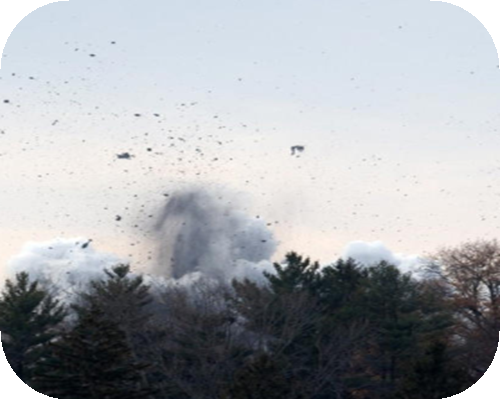
Debris flies into the air after the U.S. Army detonated lead azide in Middletown, Iowa – The Epoch Times
The U.S. Army completed its controlled detonation of bomb-making chemicals at the Iowa Army Ammunition Plant in Middletown, Iowa, on Nov. 25.
The operation was carried out at 9 a.m. CT on Wednesday, resulting in two plumes of smoke. Officials said the controlled detonation successfully reduced the risks posed by the roughly 9,700 pounds of lead azide stockpiled at the facility.
Amid pushback from environmental groups, federal officials said a controlled detonation was the only safe solution in light of an increased risk of spontaneous detonations caused by rapid deterioration of the chemicals in recent months.
Here is what to know in the aftermath of the Army’s controlled explosion at the Iowa ammunition plant.



1.1Controlled Detonation
Early indications from officials suggested that the Army’s mitigation efforts largely contained Wednesday’s explosion.
Acting Army Secretary Adam Telle said the Environmental Protection Agency’s (EPA) sensor array did not show any lead readings above 0.0 immediately following the detonation.
“The Army’s controlled, mitigated detonation exceeded all expectations and was a HUGE success. The threat of an uncontrolled spontaneous detonation has been eliminated,” he wrote in an X statement.
Maj. Gen. Eric Shirley, commanding general of the U.S. Army Sustainment Command, and President Donald Trump both said the detonation and mitigation efforts exceeded expectations.
Shirley confirmed that all of the barrels of the degraded lead azide were destroyed as a result of the detonation and that there were no secondary explosions, explosive kickout, or infrastructure damage. He attributed most of the visual effects observed immediately following the detonation to more than 3,600 gallons of aqueous foam used to contain the explosion.



“I believe absolutely that we reduced as close to zero as is absolutely humanly possible the risk to the health and safety of the people of Middletown and the extended communities throughout Iowa,” he said.
Iowa Gov. Kim Reynolds also said initial feedback indicated the detonation was successful, and the state would continue to monitor data from Iowa’s emergency operations center and keep residents informed.
Reynolds had issued a disaster emergency proclamation just one day before the detonation.
Projection maps released by the Army ahead of the detonations forecasted that dust from the explosion’s plume could drift into Missouri.
Missouri Gov. Mike Kehoe said an initial analysis provided by the Iowa Homeland Security and Emergency Management and federal partners indicated that the mitigation efforts were successful and the explosion was “well-contained.”
1.2Plans Following Detonation
EPA Administrator Lee Zeldin told CNN on Wednesday that government officials are prepared to take “the most comprehensive measures available” to mitigate any risks caused by the explosion.
“We’re going to immediately be deploying on-the-ground manpower, soil and water sampling—any remediation efforts that are necessary in the immediate hours that follow the controlled detonation that just finished,” he said.
The EPA had 300 employees and contractors deployed on the ground before Wednesday’s detonation. They will be conducting extensive monitoring by taking water, land, and air samples and will deploy remediation efforts if needed, Zeldin said in an X statement.


The EPA also collected 1,200 samples of water, air, dust, and land before the detonation, he said.
Telle said before the controlled detonation that air quality would be monitored “throughout the operation and well into the day.”
Federal Emergency Management Agency (FEMA) Administrator Cameron Hamilton told Fox News on Wednesday that officials will also ensure there is no unexploded ordnance and the scene is safe.
“That’s a fairly routine procedure. And then from there, what you should also see if there is residual bleed off or burn off of material. We didn’t really see that in this event, which means that all the materials that were intended to be detonated, we believe that is a successful detonation,” Hamilton said.
“Sometimes you’ll see black smoke that goes up for a while; that is usually residual fuel that will burn off. We’re not seeing any of that.”
1.3Exposure Risks
Prior to the operation, officials warned that the controlled detonation of thousands of pounds of lead azide could pose exposure risks for the public.
During a Nov. 24 news conference, Andy Nelson, director of the U.S. Army Engineer Research and Development Center’s Construction Engineering Research Laboratory, said the two potential risks of exposure to the chemicals were people encountering surface dust or inhaling particles in the air.
The Illinois Environmental Protection Agency has warned that there is “no safe level” of lead exposure and identified pregnant women and young children as particularly at risk.
Dr. Marjorie Peak, a consulting naturopathic physician with US BioTek Laboratories, a diagnostic lab that tests for heavy metals, environmental toxins, and other things like food sensitivities, underscored the acute and chronic effects of lead exposure in light of the controlled detonation.
Acute effects of lead poisoning include “abdominal cramps, weakness, possibly brain dysfunction, possibly even seizure or coma,” she previously told The Epoch Times.
Chronic effects of lead poisoning include heart issues, cancer, strokes, and longer-term brain issues.
Officials had recommended that all residents within Middletown and a five-mile zone southwest of the Iowa Army Ammunition Plant evacuate the area prior to the controlled detonation. The evacuation was supported by FEMA.
People unable to evacuate before the detonation were advised to remain indoors and keep windows and doors closed. Those outside the evacuation zone were encouraged to shelter in place and take necessary precautions.
Despite the potential exposure risks, Tom Croci, EPA associate administrator, told reporters that a controlled and monitored detonation reduced “the risk of dust that would pose a public health problem.”
Jeremy Lott contributed to this report.



Timothy Frudd is a reporter for The Epoch Times. | THE EPOCH TIMES
Recent Articles
Hotel St. Michael Heralds in the Holidays with 125-Year Anniversary
Pine Ridge Marketplace Announces Third Annual Tree Lighting and Holiday Events: Kickoff on November 24
Choirs, musicians, dancers to perform at annual ‘Celebration of Thanks’ in Prescott
City of Prescott Improves Searching Online City Code with Updates to Public Portal