




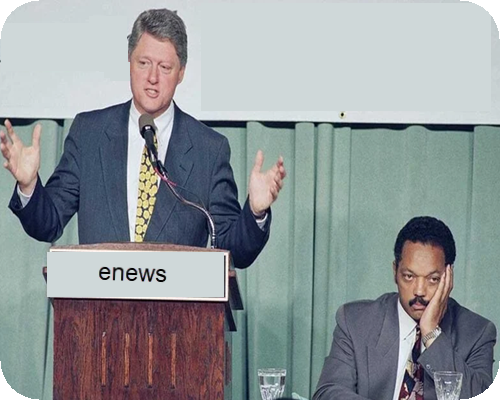
Every few weeks, political commentators demand a “Sister Souljah moment.” The premise never varies: before November, some candidate will stand before an audience expecting agreement, refuse to give it, and the country will take note.
It will not happen. Not because no candidate is brave enough; that is the standard explanation, and it is wrong. It will not happen because the Sister Souljah moment was never primarily political. It was a media production, and the equipment has been dismantled.
Recall what June 1992 actually required. Bill Clinton’s rebuke of the rap artist Sister Souljah at Jesse Jackson’s Rainbow Coalition conference worked because several conditions aligned at once. Each one depended on how news moved. A bottleneck existed: three broadcast networks and two wire services decided what the day’s news was, and clearing that gate reached the country at once.
The single version was delivered at a single hour, to an audience with no alternative feed. Joan Didion, covering that campaign, noted that reporters had been told in advance what the Rainbow speech was meant to demonstrate, so the interpretation arrived with the footage.
And there was a delay. Days passed before the full reaction, and in that interval, the story’s meaning hardened. Jackson’s angry response, carried on the same newscasts, extended the moment rather than muddying it.






None of those four conditions survives. There is no bottleneck; there are thousands of parallel channels, none of which any candidate must clear. No single version exists; a repudiation now enters the distribution system as raw material, arriving in each faction’s feed already cut to that faction’s satisfaction. There is no fixed frame; a campaign can brief every reporter in Washington and still watch the clip circulate stripped of setting, speaker and provocation. And there is no delay. Rebuttal now precedes comprehension.
Strip those conditions away, and you remove the only thing the maneuver was built to do: signal past one audience to another. It depended on narrowcasting being impossible, with the certainty that a message aimed at moderates could not be hidden from the base, and that a message the base heard could not be hidden from moderates.
That certainty is gone. The voters meant to be reassured never see the clip. The voters meant to be scandalized see it within minutes, in a version optimized to enrage them.
An older objection deserves credit. Writing in 2015, political journalist Matt Bai argued that no Sister Souljah moment exists unless a candidate has spent years making the argument underneath it. Clinton’s attack on a rapper landed because he had already broken with party orthodoxy on welfare, trade and the death penalty. Absent that record, the gesture is theater.
He was right. That critique assumed the delivery mechanism still worked for candidates who had done the work, that accumulated substance could still be transmitted through a decisive public act. In 1992, a record was a necessary condition. Today, it is no longer sufficient. A candidate can build the record and still find there is no stage on which to cash it in.






This year’s campaign cycle proves it. Candidates in both parties have broken with their own coalitions on immigration enforcement, public safety and trade, and none of it registered as a moment. It registered as content.
Republicans face the identical problem from the opposite direction: primary outcomes like Rep. Thomas Massie’s defeat in Kentucky and several failed Trump endorsements describe a party in which neither loyalty nor apostasy produces a clean national signal anymore. The absence is not partisan; it is architectural.
Which makes the demand itself the more revealing artifact. Commentators who keep prescribing this cure are expressing nostalgia for a period when causation in politics was legible, when the delivery system was narrow enough that a single act could be traced to a measurable effect. The lament is for a consequence you could see.
So stop asking candidates when their Sister Souljah moment is coming. It sounds like a test of nerve. It is actually a request for a broadcast architecture that has been gone for well over a quarter century. No amount of courage will rebuild it.


Stuart N. Brotman | INSIDE SOURCES
Recent Articles
November Voter Publicity Pamphlet has Error in it
CAFMA and Prescott Fire Department Invite Community to Help Shape Wildfire Protection Plan
City of Prescott Invites Community Members to Learn More About Long-Term Water Management Plan
October Gardening Classes Every Saturday at Watters Garden Center