




Once upon a time, American consumers took advice from a little man floating inside a toilet bowl.
No, really! Ask your parents. They’ll remember. There’s even a name for it — the Golden Age of TV commercials. From 1960 through 1980, 30-second ads built three television network empires, influenced shoppers’ purchases and kept us entertained.
One genre stood out from all the others: spokescharacter campaigns.
The name says it all: a mashup of a fictional character serving as a spokesperson for a company or product. Nobody knows who coined it, although the smart money says it originated with Madison Avenue types in the early 1970s when that advertising technique was in full flower.
A case can be made that the very first TV spokescharacter was Adelaide Hawley Cumming, who began portraying Betty Crocker on television in 1950. But purists reject that claim, since Betty Crocker’s name had appeared in print as far back as 1921.





Although her character didn’t have a name, dancer Floria Vestoff became an early commercial favorite starting in 1949 when she hoofed across fuzzy black-and-white screens wearing a cardboard box of Old Gold cigarettes. She appeared as the prancing pitchwoman so often, she’d worn out 12 cardboard costumes by 1952!
Mr. Clean — in the form of actor House Peters Jr. — first blew into households in 1958 in a burly blend of real life and animation.
And with that, the floodgates were open.
Juan Valdez and his burro ambled down a mountainside with bags of “100% Colombian coffee” in 1959. The character (whose name was much easier to remember than the sponsor’s, the National Federation of Coffee Growers of Colombia) was played for a decade by actor Jose Duval, with Carlos Sanchez carrying on the role into the new century.
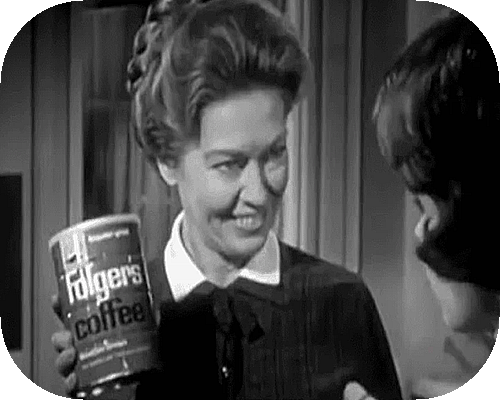
Speaking of java, arguably the greatest spokescharacter of all pitched a particular brand. Mrs. Olson performed one matrimonial miracle after another, saving more marriages than Dr. Phil McGraw, all over a friendly cup of Folgers coffee.




First appearing in 1965, Mrs. Olson (who seems to have been born without a first name) was the wise older neighbor who counseled young newlyweds in a soft Scandinavian accent. Never mind that actress Virginia Christine was actually born and raised in Stanton, Iowa; her soothing coffee counsel kept couples together until 1986, selling carloads of Folgers in the process. (Folks back in Stanton were so proud of their Local Girl Made Good that they erected a coffee pot-shaped water tower in her honor in 1971.)
Another spokescharacter superstar had a weird fetish. One day in 1964, a fussy, likable but slightly neurotic neighborhood grocer burst into living rooms fretting about toilet paper. George Whipple (although he had a Christian name, the creators needn’t have bothered, because he was known simply as Mr. Whipple) lived in terror that shoppers couldn’t resist squeezing Charmin toilet tissue rolls. (Why that was a bad thing was never fully explained.) After delivering his catchphrase, “Please don’t squeeze the Charmin!” he was always caught doing just that.
Speaking of names, you may be surprised to learn that the biggest sad sack spokescharacter actually had one. Commencing in 1967, veteran comedy actor Jesse White was perpetually frustrated at having nothing to do at work day after day. While TV viewers loved him simply as The Maytag Repairman, the character was officially dubbed Ol’ Lonely. White played him for 21 years, followed by Gordon Jump, Hardy Rawls, Clay Earl Jackson and Colin Ferguson.
Another job-related spokescharacter also used her profession to pitch a product. When bubbly screen veteran Jane Withers first pulled on a pair of white coveralls and picked up a wrench in 1963, she probably had no idea she’d just struck commercial gold. Josephine the Plumber took a break from repairing household pipe problems to preach the stain-removing power of Comet cleanser, which, coincidentally, she always happened to have on her. Josephine proved so popular that, at one point, Withers was filming 30 storylines a year before hanging up her toolbox for good in 1974.
Time doesn’t permit mentioning them all, like a certain clown named Ronald McDonald (whose 1963 debut looked nothing like today’s version, with a paper cup for a nose and a food tray for a hat, yet who nonetheless went on to sell billions of burgers), or Madge the Manicurist, who delighted in duping women customers into soaking their fingers in bowls of Palmolive dishwashing detergent.
Oh, and that skipper nattily decked out in white slacks, blue blazer and a captain’s hat who shouted advice from the bottom of the family commode? He was the Ty-D-Bowl Man who, from 1968 to 1984, was played by a parade of B-list actors, including Dan Resin, best remembered today as Dr. Beeper in “Caddyshack.”


J. Mark Powell | INSIDE SOURCES
Recent Articles
CAFMA and Prescott Fire Department Invite Community to Help Shape Wildfire Protection Plan
City of Prescott Invites Community Members to Learn More About Long-Term Water Management Plan
October Gardening Classes Every Saturday at Watters Garden Center
City of Prescott to Host Public Meeting on Willow Lake Management Plan