




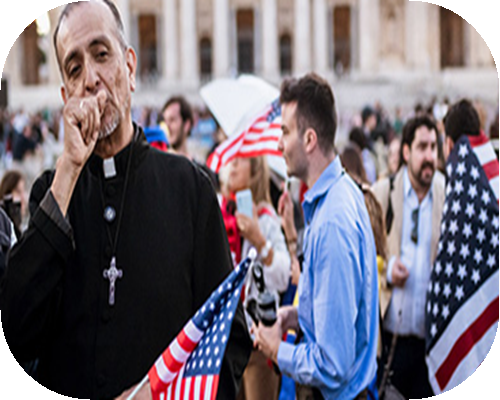
Credit Image: © Valeria Ferraro/SOPA Images via ZUMA Press Wire
One lens through which to view the seeming collapse of the West is that it is a crisis of European identity. In his 2008 book, Defending Identity, Soviet dissident and Jewish activist Natan Sharansky noted identity’s power, calling it the “magnetic force field in which the energies of the world are moving.” [SH 1] He also saw that Europeans and their descendants on other continents struggled with their identities, adding that “it is a force field that is little understood in the West.” [SH 1]
In the 20th century, at the very height of their influence, Europeans and their far-flung descendants, once the most confident and centered of peoples, seemed to stop knowing who they were. Indeed, according to Mr. Sharansky, “the West seems shorn of any clear identity, with each individual living for the day, in pursuit of purely egoistic, materialistic goals.” [SH 2] Now encumbered by pervasive doubt about their place in the world, Westerners have adopted highly destructive alternate identities and perspectives; as a result, they are easily exploited by enemies and competitors from within and without.
The Western retreat from identity has contributed greatly to the emerging egalitarian, multipolar world. Western peoples have lost control of their own governments, and formerly backward countries such as China, India, and Brazil are starting to surpass the former major European colonial powers, while the United States is hollowed out through debt and demographic replacement. A huge demographic transformation threatens white majorities in their own countries.
Identity is a complex issue. Political scientist Samuel Huntington wrote that “the concept of identity . . . is as indispensable as it is unclear.” He also noted that the psychologist who has most explored identity, Erik Erikson, calls it “vague and unfathomable.” [H 21]




Mr. Sharansky agreed that identity is elusive: “It is not easy to formulate a single definition.” One key aspect is that “identity can involve a person’s connection with history.” [SH 5] Identity removes humanity from its isolation and creates a bond with those who share the identity. The bond is not merely for the present; Mr. Sharansky linked it with Edmund Burke’s “Contract Between the Generations”: a “pact between the dead, the living, and the as yet unborn.” [SH 7] It gives a sense of “belonging to something greater than the self;” [SH 5] it gives meaning to life beyond mere existence.
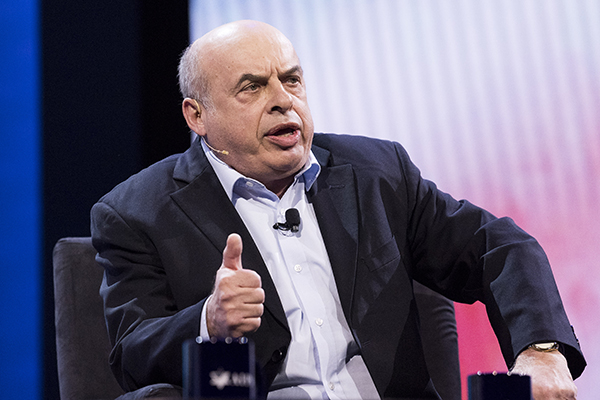
Natan Sharansky. (Credit Image: © Michael Brochstein/ZUMA Wire)
Most of the literature written about identity is about individual psychology and the formation of a personality; how one interacts with the world, whether one matures successfully, one’s self-esteem, and so on. Perhaps the classic concept is Erik Erikson’s “eight stages of psychosocial development,” in which he posits that humans mature through a series of interlocking conflict resolutions, ideally resulting in an adult with a healthy personal identity. [ER 42-57]
It is another sense of identity — with which groups does one identify, have a sense of belonging to, and feel loyalty toward — that concerns political observers, especially in multicultural nations. Which groups will people defend and rely on for safety? Which groups will help them thrive; which will earn their allegiance? With which groups is one naturally affiliated? It is a tribal sentiment. Looking at it from one perspective, identity moves outward as if in concentric circles: self, immediate family, extended family, community, tribe, nation.






An important facet of group identity is that such identities are “the product of interaction between the self and others,” wrote Huntington. [HU 23] Something has no identity if it is no different from other things; only through discovery of those characteristics that set it apart can an identity be discovered. Competition and conflict are often included in the identification process; a sense of superiority to outgroups commonly appears. But, as Huntington suggested, similarities with others can be the identifying link. [H 24]
A group identity may be derived from a single aspect of one’s life or may be constructed from many aspects; for instance, one may identify as a Christian, a father, and a businessman without any contradiction. Huntington wrote that somebody “may be a member of many groups and hence is able to shift identities.” [HU 22] One person can make a specific aspect of his life his central defining characteristic; another might completely reject that same characteristic when forming his own identity. Huntington explained how one may identify primarily with his profession, or he may hate his work and reject it as part of his identity. [HU 27] Huntington also suggested that identities need not be particularly connected to reality; he calls them “imagined selves.” [HU 22]
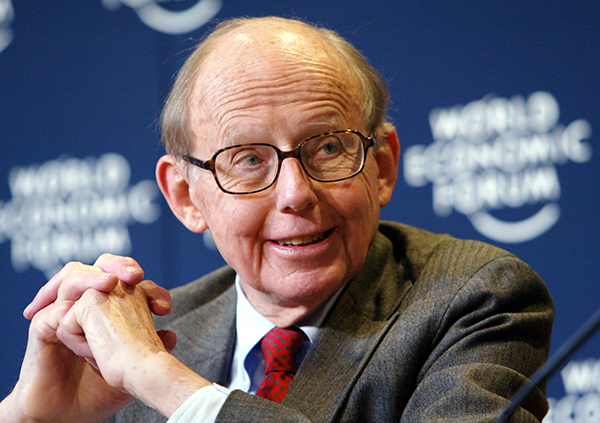
Samuel Huntington. (Copyright World Economic Forum, swiss-image.ch/Photo by Photo by Peter Lauth, CC BY-SA 2.0, via Wikimedia Commons)
But there will often be one aspect of life that dominates one’s vision of himself, to which one gives ultimate loyalty. Some people feel the connection to their group so strongly they will lay down their lives for it; others are for sale to any group that will have them, ready to leave at the first sign of difficulty. While such opportunism may work for some individuals seeking to gain advantage within a society, the lack of a strong sense of group belonging can be devastating, resulting in a life without purpose. It can be even more disastrous for a group to have members without strong attachments; weak connections are easily severed.
Having a strong group is valuable in many ways, giving members pride, confidence, resilience, and purpose. It increases the willingness to sacrifice oneself for the whole and increases the expectation that the group will endure after one is gone.
The potential for resistance through group identity is what most threatens totalitarians, central planners, and globalists. Mr. Sharansky described how the Soviets dealt with it: “So they set out to cut off each person from every possible attachment. The individual would then stand alone against the awesome power of the state.” [SH 35]
Atomized man


The individual alone is powerless. Individual will and memory, apart from the reinforcement of associative tradition, are weak and ephemeral. How well the totalitarian rulers know it.
— Dr. Robert Nisbet, The Quest for Community [NB 184]
The desire by political establishments for an easily controlled, rootless, atomized population did not die with the Soviet Union. It is the preferred model in today’s West. The atomized individual is beloved of social scientists, politicians, and financiers who would reduce humans to actors in supply and demand curves; no human ties, thoughts, or emotions prevent him from acting precisely as the equations predict or as the propaganda urges. Ideally, he is unconnected with his fellow man except for commercial activities and fleeting pleasures and offers no collective resistance to the designs of elites.
The tendency toward atomization in industrial and post-industrial societies is obvious, and there is considerable literature describing it. Karl Marx chronicled Western man’s growing “alienation” in 1844. More recently, political scientist Robert Putnam detailed how Americans were disengaging from fellow members of their communities in his 2000 book Bowling Alone.
But atomization is only an intermediate step. Duquesne University political scientist Luke Sheahan, writing about Robert Nisbet’s 1953 book The Quest for Community, told how the growing loss of the sense of community may drive individuals “to pursue unhealthy forms of community in totalitarian states or withdraw into alienation and anomie.” Mr. Nisbet himself wrote:
The totalitarian order will use force and terror, where necessary, to destroy organized minorities — refractory labor unions, churches, ethnic groups — but to the masses of individuals who are left when these social relationships are destroyed, a totally different approach is employed. It is an approach based upon the arts of psychological manipulation — cajolery, flattery, bribery, mass identification with new images, and all the modern techniques of indoctrination.” [NB 177-78]
The same process can work in the case of identity as people struggle to find meaning in modern societies, where people have a wide array of identities from which to choose, many of them irrational, temporary, or self-negating. Most obvious of these are the various sexual identities, including transsexualism. The authorities do not seem displeased when people adopt identities based on left-wing activism: feminism, environmentalism, advocacy for immigrants or minorities, and so on. And while black impersonator Rachel Dolezal may have been beyond the pale even for the radical Left, whites are encouraged to blend their identities with those of non-whites, to adopt non-white culture, speech patterns, dress, and to admire famous non-whites as personal heroes.
As Mr. Nisbet suggested, when the masses unsuccessfully yearn to belong to something greater than themselves, they become ripe for indoctrination. Any part of the political spectrum may seek control. Today, conservatives resist atomization by promoting religious identities and civic nationalism. Both can make an individual stronger, and make religious and political entities stronger, but both lack permanence.
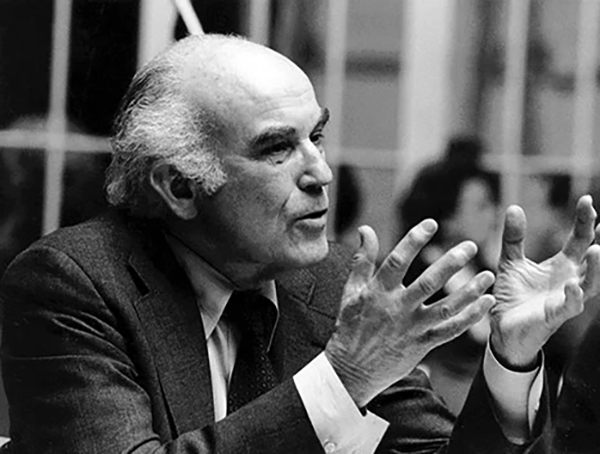
Dr. Robert Nisbet. (Melosasiempre, CC BY-SA 4.0, via Wikimedia Commons)
Defying Leviathan
Perhaps nobody has written more eloquently and more perceptively about the value of group identity than Natan Sharansky in Defending Identity. His thoughts arose from a period of imprisonment when he was able to call upon his Jewish identity for strength while being interrogated by the KGB.
Mr. Sharansky wrote that “the Soviet regime was predicated on controlling, largely through fear, the minds and thoughts of hundreds of millions of people. The existence of even a single person who does not succumb to fear, who publicly defies it, endangers the entire system.” [SH 18] He told of how the Soviet Union recognized that traditional identities were its enemy. “All identities had to be destroyed so a new identity, based on the solidarity of working people, would be the foundation for a new world where everyone was equal and happy.” [SH 10] Of course, the solidarity, equality, and happiness were myths; the only reality was the mass crushing of souls.
But in the basement of Moscow’s notorious Lefortovo Prison, surrounded by KGB interrogators, Mr. Sharansky discovered that he had a defense that kept him from breaking. “The stronger a prisoner’s identity, the greater the likelihood that the KGB would not succeed in destroying him,” he wrote, [SH 35] adding that strong identities would “prove essential in resisting and ultimately defeating an evil empire.” [SH 17]
He had spent much of his formative period as the sort of atomized individual the Soviet Union desired. He was Jewish in name only and concentrated on studying science. But he began a slow transformation toward identity, culminating in an epiphany: “I suddenly discovered a new world: I was no longer an isolated Soviet citizen but part of a vibrant community with a long history of struggle and liberation — that history that had left great empires in its wake.” [SH 21]
He suggested that reason alone was powerless in the face of KGB interrogation and indoctrination techniques. Something deeper, closer to one’s animal core was needed. “Resistance, I realized, could not just rely on computing logical reasons, but instead meant maintaining a sense of the ties that had given me my powerful sense of inner freedom.” [SH 21–22]
He also needed to believe that resistance mattered, that beyond the isolation of the interrogation room there were people who would approve and thank him for his resolve. “Instead of focusing on your own survival, you must focus on the survival of your people, your history, your culture, and the timeless principles for which you are fighting.” [SH 22]
Furthermore, Mr. Sharansky posited that those with strong identities tend to attract each other and form alliances against those in power. “Invariably, the ones you could count on to be your allies in resisting the KGB were those who possessed identities . . . ” [SH 34-5]
Categories
How, then, to understand identity? One way is to divide it into categories. Samuel Huntington suggested that identities could be classified according to six “sources.” [HU 27] They are:
- Ascriptive: age, ancestry, gender, kin, ethnicity and race;
- Cultural: clan, tribe, ethnicity — meaning way of life — language, nationality, religion, civilization;
- Territorial: neighborhood, village, town, city, province, state, section, country, geographical area, continent, hemisphere;
- Political: faction, clique, leader, interest group, movement, cause, party, ideology, state;
- Economic: job, occupation, profession, work group, employer, industry, economic sector, labor union, class;
- Social: friends, club, team, colleagues, leisure group, status.
To simplify, and also for the sake of argument, I prefer to divide identity according to three bases: ideas, situations, and biological roots.
Identities from ideas
People are powerfully drawn to ideas, so much so they will make an intellectual theory or a system of belief the most important part of their identity. This is often an act of choice, although it may not always be that, because someone may be born into a belief and live in a society that permits no other reality. But no matter how powerfully an idea-based identity is imposed on someone, he can cast it off should he no longer sense its truth.
In fact, there is considerable impermanence to identities built on ideas. Ideas change; a person can change his perspectives many times throughout his lifetime. The doctrines upon which identities are built also change from, say, “four legs good, two legs bad” to “four legs good, two legs better.” [OR 91]
Two of the most common identities based on ideas are religious and political.
Religion
The most common identities may be religious. Religious identity is based on belief; it accords with Huntington’s observation that identities are our “imagined selves.” In earlier times, religion was less of a choice. People were born into an identity that pervaded every part of their lives. Openly rejecting religion was to invite ostracism — or even torture or death. Today, however, in modern Western societies, religion is a choice; while many people feel their faith deeply, others change religions almost the way others change jobs or homes.
Nationality
A great many others identify according to nationality. Nation, however, is another unclear concept, particularly when it comes to identity. A nation can be based on different criteria; perhaps most began as extended kin groups. Political scientist Walker Connor defined a nation as “the largest group that can command a person’s loyalty because of felt kinship ties.” [TA 131]
But that does not fully capture the idea of a nation. A nation may also be forged from multiple unrelated kin groups, largely through warfare. For instance, England became a nation due to waves of invasions from outsiders supplanting the ruling classes rather than based on the kinship ties of the inhabitants. More important today, particularly for America, is the concept of the “creedal nation,” in which membership is based on belief in a set of ideas rather than kinship.
Once, the claim that one’s nation — and therefore a good part of one’s identity — is one’s country of birth seemed almost self-evident. After several centuries of increasing migration, that is no longer true. More and more, new residents of Western nations cling to their prior national identities despite being born in their adopted countries. Civic nationalism, like religion, is a choice, and many newcomers choose not to belong to their new land.
Civic nationalism
Of paramount importance in the United States and even in Europe is the emphasis placed on having a civic identity. All that is needed to be an accepted member of the nation is to live there and accept the prevailing beliefs. The creedal civic nation has become the only acceptable model in the West; Huntington wrote that the widely accepted view is that nations based on creed are “good,” and those based on ethnicity or culture are “bad.” [HU 29] Such thinking essentially forbids the majority ethnic group to identify according to kinship, and Western nations have acted on this belief. But only for some: Western governments have repressed the common identity of whites as whites, while encouraging ethnic solidarity for all others.
This means that the civic nation is not fixed but fluid: someone with deep national roots and widespread kinship ties, whose ancestors fought in the nation’s wars, who initially settled the land and built the infrastructure, but who now questions the national government may be seen as having only tenuous ties to the current nation. Another person, who recently arrived but professes adherence to the creed can be politically elevated above dissident members of the founding stock. Such a system is unstable.
Adding to the instability, the creed itself can be fluid. In America today, many people whose ancestors helped form the nation and who hold to the original tenets of the Constitution find themselves at odds with the legal, accepted beliefs that now convey citizenship. Their beliefs didn’t change; the creed did.
Situational identities
Often, people form an identity based on situations, such as their jobs, family role, social class, lifestyle choices. In a modern Western society, these situations are, as with identities based on ideas, generally the result of a choice. One chooses to marry and have children, and being a parent becomes part of one’s identity.
Most situational identities based on choice lack permanence. One chooses a profession, and that may become part of one’s identity. Or it may merely be a way to earn a paycheck. And changing jobs is common.
Social class can appear to be a permanent fact of life in some hierarchical societies and certainly invokes strong emotions. Yet, even with the most rigid class structures, the mighty sometimes fall and the lowly occasionally rise, and identities change accordingly.
Biological identities
The above bases for identity can change; only one type of foundation for identity is permanent: the biological. Race and sex have permanence. No matter how many operations somebody has or how many drugs he takes, someone born a man cannot give birth, and someone born a woman cannot impregnate anyone. And no one can choose race. Because they are biological and so deep within us, identities based on biology will accord with nature in ways that other identities do not. They are self-evident.
Only for a tiny, highly confused few is there any question about sex — we know which we are. But as we have seen in recent decades, sex can become a divisive identity. The most natural way to describe the sexes is that they are complementary: two parts of a system that produces the next generation. Today, however, male and female are defined as competitive, and the competition threatens to tear society apart. In a normal, natural world, sex attaches members of one group to members of the opposite group.
Race is inherently an undeniable, permanent, and natural division between groups, but modern society tries to deny race. It is often called a mere “construct,” and for nearly a century, our intellectual leaders have demanded that we define everything in terms of culture instead of biology. Historian Carl Degler wrote in his 1991 book In Search of Human Nature: The Decline and Revival of Darwinism in American Social Thought that, “today, in the thinking of citizens and social scientists alike the deeply held assumption is that culture has severed for good the linkage between human behavior and biology.” [DEG viii] Even Huntington suggested that “ethnicity and race” can “be redefined or rejected, and the meaning and applicability of race changes over time.” [HU 23]
Race results from actual and specific genetic codes. It is hard-wired into us; it cannot realistically be denied, and therefore has a power other identities lack.
The reality of evolutionary biology is that life is competition; Charles Darwin explicitly called life “a struggle for existence.” The driving force of life is the need of genes to replicate themselves in new generations; as Darwin wrote, we must “never . . . forget that every single organic being around us may be said to be striving to the utmost to increase in numbers.” [DAR 65] And we know that organisms great and small will altruistically sacrifice themselves to preserve related organisms if doing so will preserve their own genetic characteristics. Belgian-American social scientist Pierre van den Berghe writes: “The degree of cooperation between organisms can be expected to be a direct proportion of the genes they share; conversely, the degree of conflict between them is an inverse function of the proportion of shared genes.” [TA 114]
Human nature is often the result of this competition. According to Finnish political scientist Tatu Vanhanen, “our behavioral predisposition to ethnic nepotism evolved in the struggle for existence because it was rational and useful.” [TA 114] Some may wish to make the competition a matter of cultural differences, but Vanhanen emphasized the genetic component of ethnic struggles: “The struggle for existence concerns the survival of our genes through our own and our relatives’ descendants.” [TA 125]
Identification with one’s own kind is often instinctive. Animals have a remarkable ability to tell kin from strangers. If unhatched frog eggs from various mothers are mixed together, after the hatch, tadpoles from the same mother will eventually cluster together with siblings. [TA 114–115]
There is also considerable evidence that homogenous countries function better than those with mixed populations. Vanhanen’s book-length study on the degree of ethnic diversity and levels of conflict found that highly “homogenous countries like Japan and Iceland show very low levels of conflict, while highly diverse countries like Lebanon and Sudan are wracked with strife.” [TA 125]
Other research confirms that people in “diverse” workgroups — not only of race but also age and professional background — are less loyal to the group, more likely to resign, and generally less satisfied than people who work with people like themselves. [TA 127]
It would seem that, by denying racial identity, we deny ourselves a harmonious present and even a secure genetic future.
Conclusion
Whites seem to have evolved with less inclination towards strong in-group preferences and group identity than other races. It is common to theorize that the harsh climate and isolation of northwest Europe strongly influenced our natures, as our Western Hunter-Gatherer ancestors battled the elements more than they fought rival tribes: “Under ecologically adverse circumstances, adaptations are more directed at coping with the physical environment than at competing with other groups.” [MAC 94]
Those living in warm, densely populated regions tended to see other people as the greater threat to existence. As a result, we became more open to outsiders than others, and these tendencies now appear to be innate. In recent decades, any degree of racial solidarity that formerly existed among whites has collapsed. Members of other groups with no illusions about life being a competition for genetic survival and who wish to supplant us have noticed that this lack of unity is our Achilles heel, and they exploit it with great success. Since the Second World War, white identity has been repressed, and other racial identities encouraged.
Sometimes, this appears to be deliberate. In Who Are We? Huntington wrote that, in 1996, former New Republic editor and social critic Leon Wieseltier wrote a book called Against Identity denouncing the concept of ethnic identity, and two years later “published another book, Kaddish, an eloquent, passionate affirmation of his own Jewish identity.” [HU 21] Huntington did not explain or justify this double standard.
Whites have submitted to this “two-tier” conception of identity. Around 1913, we were roughly 30 percent of the world population, and we were unquestionably the dominant race. Now, our percentage approaches single digits. This threatens our survival. Without a reversal of sensibilities, we will continue to produce societies inimical to our interests and will intermarry at high rates. For the white race to thrive, as Jared Taylor wrote, “whites must recognize something all others take for granted: that race is a fundamental part of individual and group identity.” [TA 292]
The failure to do this is a particularly difficult problem in the United States. One reason is that a strong case can be made that, unlike in Europe where nations were formed from tribes and ethnicities, we are a creedal nation created through a social contract that laid out basic beliefs.
But our population was relatively ethnically homogenous at our founding. We were roughly 85 percent English, with almost all the rest from closely related Western European countries. The US is therefore both creedal and ethnic; creed and ethnicity are tied together, with the creed dependent on ethnicity. The specific American creed could have been created by no other people and, as the original stock has dwindled, the creed has been altered, ignored, and rendered irrelevant. It was the biological element that gave the nation permanence; once European stock became diluted, the connection between people and creed was lost, and there was no intrinsic power with which to defend the creed against special interests.
The permanence of racial identity as a defense against decline or tyranny cannot be overstated. Race is potentially permanent — and therefore is a threat to anyone who would atomize, indoctrinate, or eliminate us. Racial solidarity is perhaps the strongest guarantor of freedom and justice.
Today, it is assumed that freedom is dependent on some form of democracy. Mr. Sharansky insists that a just society must have a balance between democracy and identity: “For some in the democratic world committed to freedom and human rights, identity means prejudice, intolerance, distrust and violence against those who are different.” At the same time, he acknowledges that in a world without identity, the state can impose its will on people with impunity, and the things people hold most dear are disposed of according to political expediency. Without identity, freedom can seem excessive, becoming “egoistic, materialistic, decadent, and weak.” [SH 8]
It is the last word — weak — that may pose the biggest threat to a society that rejects identity. Without strong bonds, people are unlikely to risk death to protect one another, to do the hard things that must be done to defend freedom or nation.
Mr. Sharansky failed to see that identity has primacy over democracy; without identity, there is no people to express its will through elections, only a collection of atomized individuals and small groups that are easily manipulated. That is the problem we face in today’s United States, not a lack of “democracy.” It is imperative that racial identity — and more specifically, the identity of whites, the ones who have most promoted freedom and self-government — be preserved. Ethnic identity is the solid rock upon which all other associations are built; once again, it accords with nature and has permanence in ways no other association can have.
We are told that there is great shame in being white, that we are alternately evil, stupid, and weak. We are encouraged to reject our common whiteness, to out-marry, to adopt alternate identities. Many of our people have internalized these sentiments, and a large majority of Americans and Europeans live as defeated people, whether they realize it or not. Even those of us who know our real history must live with internal turmoil if we want to get along without conflict in society. For the most part, we drift along without resisting what will be an increasingly troubled future; great injuries are imposed on us with hardly a murmur of resistance.
Yet, knowing the actual history of the West, how could we not feel a proud connection with such a people? Why are we afraid of identifying ourselves as visionaries, innovators, conquerors? Why have we no popular origin story, no reverence for our past?
Everything good flows from identity; it is the basis for society, for creating a culture, for defending oneself against invaders, tyrants, and manipulators. And the most solid basis for an identity is race or ethnicity; others eventually turn out to be ephemeral or ripe for corruption and manipulation.
Fortunately, some of our people are gravitating back toward racial identity — more than in decades. Until now, it has been a slow trickle, but there is now hope that we will once again realize who we are as a people, and will again thrive.
Bibliography
Format: [Author-abbreviation Page]
DAR: Darwin, Charles. On the Origin of Species. Signet Classics. New York, NY. 2003. (Originally published 1859).
DEG: Degler, Carl N. In Search of Human Nature: The Decline and Revival of Darwinism in American Social Thought. Oxford University Press. New York, NY. 1991.
HU: Huntington, Samuel. Who Are We? America’s Great Debate. Simon & Schuster, New York, NY. 2005.
NB: Nisbet, Robert. The Quest for Community: A Study in the Ethics of Order and Freedom. ISI Books. Wilmington, DE. 2010. (Originally published 1953)
OR: Orwell, George. Animal Farm. Berkley Publishing Group (Penguin Random House). New York, NY. 2023. (Originally published 1946).
SH: Sharansky, Natan. Defending Identity: Its Indispensable Role in Protecting Democracy. PublicAffairs Books, New York, NY. 2009.
TA: Taylor, Jared. White Identity: Racial Consciousness in the 21st Century. New Century Books. Virginia. 2011.
MAC: MacDonald, Kevin. Individualism and the Western Liberal Tradition: Evolutionary Origins, History, and Prospects for the Future. Kindle Direct Publishing. 2019.
ER: Muus, Rolf; Velder, Eli; Porton, Harriet. Theories of Adolescence. McGraw-Hill Publishing. Columbus, OH. 1996. pp. 42-57.



Derek Stark
Recent Articles
October Gardening Classes Every Saturday at Watters Garden Center
City of Prescott to Host Public Meeting on Willow Lake Management Plan
Prescott Fine Art Launches Monthly Art Auctions at Pine Ridge Marketplace
Town of Chino Valley Selected for Community Beautification Project as APS Celebrates 140 Years in Arizona