




What is it about that frigid April night that haunts us so relentlessly? More than a century has passed. Other tragedies have horrified us: the Hindenburg, Chernobyl, the Challenger. Each an intersection between mankind and technological progress where something went terribly, catastrophically wrong.
Yet none surpassed our collective obsession with the giant ship that was supposed to be unsinkable, the iceberg that gashed a fatal hole, and the appallingly large loss of life that resulted from it. From hit movies to books to touring national exhibits of its recovered relics, the Titanic still fascinates unlike anything else.
However, two ships were involved that night. While one lives on in legend, the other is nearly forgotten; a footnote at best, a neglected oversight at worst. And she met with her own sad ending, too. This is her story.
The North Atlantic is a lonely place in the dead of night. Although the calendar said spring, the frozen formations all around resembled the dead of winter. And so Captain Arthur Roston threaded his vessel through them slowly, carefully, all too aware that danger could be lurking just below the dark surface.
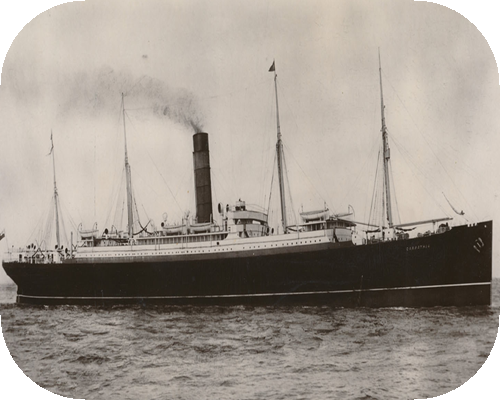
The RMS Carpathia was also a passenger ship. But unlike the glittering Titanic, that brand-new floating 5-star hotel and pride of the prestigious White Star Line, Cunard’s Carpathia did yeoman’s service in the transatlantic trade. While Titanic catered to millionaire travelers, Carpathia was its blue-collar cousin. For nine years it had shuttled mostly poor immigrants between the Old and New Worlds. It wasn’t glamorous, but it was profitable and helped keep Cunard afloat during several lean years.




She was doing so yet again on the night of April 14-15, 1912, headed out of New York bound for modern-day Croatia. She was filled to the brim with around 125 first-class, 65 second-class, and 550 third-class travelers, plus crew.
It was just after midnight when the ship’s wireless operator picked up Titanic’s distress signal and immediately rushed it to the captain. Carpathia was 58 miles away.
Realizing it was a matter of life or death, Roston rolled into action. He not only ordered the ship at full speed ahead, but he also summoned an extra shift of stokers, men who shoveled coal into Carpathia’s massive furnace to make it blazing hot. He even shut off the ship’s heating and water supply to provide the maximum amount of steam possible for powering Carpathia’s two massive propellers.
A ship designed to cruise at 14 knots was now rocketing through hazardous waters at 17 knots, and in the dark, no less. But Roston couldn’t think about it, for he knew it was a race against time.
And he lost. When he finally reached its last reported position, the “Ship of Dreams” had been sitting on the bottom for 90 minutes.






Yet, she was still a lifesaver. For over four hours, Carpathia combed the area looking for lifeboats, hauling the traumatized passengers and crew onboard until the last one was found at 8:30 a.m. More than 700 survivors were rescued because of Roston’s heroic response. Without it, Titanic’s toll would likely have been even greater.
Three days later, the survivors were finally in New York. Those who lived through the disaster, including Margaret “The Unsinkable Molly” Brown, presented him with a silver cup. He went on to receive the official Thanks of Congress and the Congressional Gold Medal, along with dozens of prestigious honors and awards (including a knighthood from King George V).
And that’s where Carpathia’s story always stops, the lone flicker of brightness in an otherwise dismal tale. But what happened after that?
Her moment of glory behind her, she returned to the dreary transatlantic trade. When World War I broke out, Carpathia’s passengers were suddenly all soldiers as she ferried Canadians (and later Americans) to the fighting in France.
She was in convoy from Liverpool bound for Boston when, on the morning of July 17, 1918, the skipper of Germany’s U-55 spotted her in his periscope off the Irish coast. He fired two torpedoes. 218 of the 223 people she carried got off safely. The U-55 surfaced and fired a third torpedo as the crew was trying to flee. There was a massive explosion, and RMS Carpathia disappeared beneath the surface. Her wreckage wasn’t discovered until 1999.
And so, both ships sit at opposite ends of the same ocean, rusting reminders of a time when man’s hubris convinced him nature’s threats were finally tamed; the other of the humanity displayed while recovering from the damage resulting from that terrible fall.



J. Mark Powell | INSIDE SOURCES
Recent Articles
October Gardening Classes Every Saturday at Watters Garden Center
City of Prescott to Host Public Meeting on Willow Lake Management Plan
Prescott Fine Art Launches Monthly Art Auctions at Pine Ridge Marketplace
Town of Chino Valley Selected for Community Beautification Project as APS Celebrates 140 Years in Arizona