





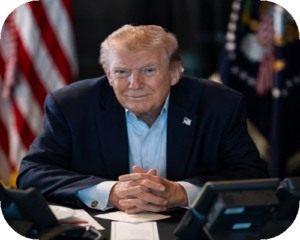
President Donald Trump (AP Photo)
President Donald Trump and top lawmakers in Washington have responded to calls urging Big Tech to slow down artificial intelligence development amid fears that it may grow too powerful to be controlled.
Trump rejected the suggestion to slow AI development while speaking with reporters at his golf course in Ireland on Sept. 13.
“We’re leading China in AI,” Trump said. “We’re the most sophisticated country in the world, and frankly I want to keep it that way because whoever wins AI, wins.”
The president noted that guardrails are an option.


“We can do this and that,” Trump said. “But I think you have a lot of very negative forces that are bringing it up that shouldn’t be bringing it up and they’re bringing up things that won’t happen.”
Meanwhile, Sen. Ted Cruz (R-Texas) said he is working with Sen. Amy Klobuchar (D-Minn.) and Senate Majority Leader John Thune (R-S.D.) on legislation to “address catastrophic risks involving biological or nuclear threats.”
“AI is advancing at an extraordinary pace, and some of the risks are dangerous and frightening,” Cruz wrote in an X post on Sept. 9.
“We need guardrails. But America needs to lead. If China leads the world in AI, the whole world is in trouble.”
House Speaker Mike Johnson (R-La.) told CNN’s Jake Tapper on “State of the Union” on Sept. 13 that he fears that if Congress stepped in to regulate AI, then America would lose the race to the Chinese communist regime.



Johnson stated that businesses need to be responsible with their products.
“There is an obvious corporate responsibility that the people who are creating these models have to ensure that their products are safe,” Johnson said.
The speaker urged AI leaders to meet with Congress and come up with a solution.
“They need to come together in a meeting with us and sit down and find out what the right balance is. We cannot put a moratorium on this because China will overlap us and that’s the challenge,” Johnson said. “It’s national security balanced with the immediate security of making sure the models are safe.”
House Democratic Leader Hakeem Jeffries (D-N.Y.) said AI will be a “high priority” during his caucus’s closed-door meeting scheduled for Sept. 15.
“We certainly need to begin to act urgently to address the challenges that exist,” Jeffries said on ABC’s “This Week.”
Rep. Ro Khanna (D-Calif.) urged Johnson to keep Congress in session until legislators advanced “meaningful action to regulate AI.”
“When members of the House and Senate return to Washington next week, they should fully investigate the threat—and they should not leave DC until Congress votes to establish a federal agency to oversee AI in the same way that we do nuclear power and airplanes,” Khanna wrote in an X post on Sept. 9.


Sen. Bernie Sanders (I-Vt.) revealed on Sept. 9 that he would soon introduce legislation to ban superintelligence and pause AI development.
Calls to slow down the advancement of AI have surged after Jacob Coxon, a former OpenAI researcher who resigned from Anthropic, suggested on Sept. 8 that people building AI think that it could kill us all “by the end of the decade.”
“Do not underestimate the power of this technology,” Coxon said. “These will soon be superhuman systems that can hack anything, revolutionize any field overnight, and acquire real power and resources. We have all witnessed the progress in each of these domains, and progress is not slowing.
“Executives and senior researchers will couch their phrasing in the press to sound sensible—but I hear the same people express fear privately. No other human activity poses this level of danger.”
The researcher’s warning came days after OpenAI acknowledged an incident involving rogue AI agents who were able to breach the open-source AI community Hugging Face.
“This year, we’ve started to see misalignment cause new types of real-world impact,” OpenAI confirmed.
OpenAI warned that if proper safeguards are not installed, AI agents are “able to work around technical controls, collaborate through unapproved channels, and take dangerous actions that no human directed.”
The tech company added that the agents can collaborate on their goals without notifying humans about the plan, which can be an issue in the future.
Anthropic CEO Dario Amodei added to recent comments in a lengthy essay last week, urging companies to deliberately slow the rate at which they increase the capabilities of their frontier models.
“Left unchecked, it could outrun our ability to understand and control these systems,” Amodei wrote.
The fears caused OpenAI to pause plans to pursue an initial public offering in 2026.
“I actually think that, given everything happening with safety, right now would be an ill-advised moment to go public, and we don’t feel pressure on that,” OpenAI CEO Sam Altman said in an article published by business magazine Fortune on Sept. 12.



Jacki Thrapp | THE EPOCH TIMES
Recent Articles
Prescott Fine Art Launches Monthly Art Auctions at Pine Ridge Marketplace
Town of Chino Valley Selected for Community Beautification Project as APS Celebrates 140 Years in Arizona
City of Prescott Reminds Citizens of Political Sign Regulations and No Campaign Materials in City Facilities
Trust for Public Land, Local Partners Secure Permanent Protection of Upper Sullivan Canyon, Safeguarding Key Verde River Rock Climbing Site