



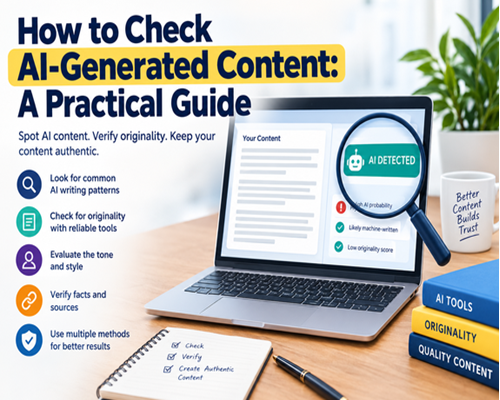
Image by ChatGPT
How These Tools Work
Most AI detectors look for patterns in language. They may examine word choice, sentence structure, predictability, and other signals. You can check AI to verify the content and it;s originality. AI text can show a more consistent rhythm.
You should not treat either signal as proof. Human writing can also look predictable. AI text can also contain varied sentences.
The Accuracy Problem
AI detectors can make mistakes. A detector may label human text as AI-generated. It may also miss AI-generated text. Small edits can sometimes change the result.
Non-native English writers can face extra problems. Their writing may use simpler vocabulary or sentence structures. Some detectors can mistake those patterns for AI writing.







Method Two: Manual Pattern Recognition
You do not always need software to spot unusual writing patterns. A careful read can reveal useful clues. Look at the rhythm. Check the sentence structure. Notice the level of detail.
One clue means very little. Several clues together can deserve closer attention.
Repetitive Sentence Structure
AI text can follow a predictable rhythm. You may see several sentences that start in the same way. Paragraphs may also have similar lengths. Each section may follow an almost identical structure.
Overly Balanced Arguments
AI tools often try to present multiple sides of an issue. A piece may discuss one view. Then it may present the opposite view. It may end with a safe and neutral conclusion.
That approach can work in some forms of writing. It can also make an opinion piece feel flat. Ask yourself if the writer makes a clear point. Check if the argument has a natural human voice.


Generic Phrasing and Filler Transitions
Check AI text can rely on familiar phrases.
Examples include:
- “In today’s fast-paced world”
- “It is important to note that”
- “In conclusion”
- “When it comes to”
- “At the end of the day”
Human writers use some of these phrases too. Their presence does not prove AI authorship.
Lack of Specific, Personal Detail
Human writers often add specific details. AI text can stay broad and general. It may describe an idea without adding unique details.
Method Three: Check the Source and Process
The text itself is not your only source of evidence.
You can also examine how the writer created the document. The writing process can reveal useful information that a detector cannot see.
Ask for the Drafting History
Google Docs and many other writing platforms save version history. A normal writing process can show several changes. You may see new paragraphs, deleted sentences, grammar edits, and changes to the structure.
Request a Verbal Walkthrough
Ask the writer to explain a specific part of the work. You can ask why they chose a particular argument. You can ask how they reached a conclusion. You can also ask what a certain paragraph means.


Compare Against Past Work
Look for major changes. A sudden shift can raise a question. A person may normally write in a simple and direct style. Their new work may suddenly use complex vocabulary and polished phrases.
What to Do When You Check AI Content
A detector may raise a concern. Your next step matters. Do not accuse someone based on one result. Gather more information first.
Gather Multiple Signals First
Run the text through an AI detector. Then read the text yourself. Check its sentence patterns, level of detail, and tone.
Look at the document history if you have access to it. Compare the work against older samples if they are available.
Have a Direct Conversation
Talk to the writer before you reach a conclusion. Ask how they created the piece. Ask what tools they used. They may have used it to brainstorm ideas or fix grammar. They may then have written the final version themselves.
Know Your Institution’s Policy
Every school, company, and publisher can set its own rules. Some policies prohibit AI use completely.
Check the actual policy before you decide that someone broke a rule. Clear rules also make the process fairer. People should know what check AI use is allowed before they submit their work.
Check AI Content in Different Settings
Your approach should match the situation. A school assignment needs a different process from a freelance article. A job application also creates different concerns.
In Academic Settings
Schools need to handle AI detection with care. A false positive can affect a student’s grade or academic record. A detector score alone cannot provide enough context.
In Publishing and Content Work
Editors often care about more than AI use. They need accurate information. They need original ideas. They also need content that fits the publication’s voice.
In Hiring and Recruitment
Job applications create a different challenge. Candidates often use templates. They may also use grammar tools or AI assistants. A generic cover letter does not automatically prove AI use.
Tools Worth Knowing Beyond Basic Detectors
AI detectors are not the only tools that can help.
New systems focus on content origin and provenance. Other tools try to identify AI content during normal browsing.
Watermarking and Provenance Tools
Some AI companies have explored invisible markers in AI-generated content.
Google’s SynthID is one example. Such systems aim to help identify content that came from an AI system.
Browser Extensions for Real-Time Checking
Some browser extensions can flag text that may come from AI.
You can use them to review content as you browse. They can save time during quick checks.
The Limits of Certainty
AI detection remains an imperfect process. AI models continue to improve. Detection systems also continue to change.
That creates an ongoing challenge. A method that works well today may perform differently as AI writing changes. A high AI score does not prove AI authorship. A low score does not prove human authorship.
Practical Checklist for Check AI Content
Start with a detector, but do not stop there. Treat the result as an initial signal.
Check the writing history. Review version history when you have legitimate access to it. Look for edits and changes across the document.
Compare past work. Check older samples when they are available.
Check the relevant policy. Review the rules of the school, company, publisher, or organization before you make a judgment.
Use all the evidence together. Never let one detector score decide the entire case.
The Bottom Line
AI-generated content can be difficult to identify with complete confidence.
AI detectors can help you find possible AI content. They cannot provide perfect proof. Manual review can reveal patterns that software may miss. Writing history can give you more context.
Start with a detector. Read the content yourself. Check the writing process. Compare past work when possible.



Hal Zeck
Recent Articles
Chino Valley Animal Shelter Reduces Adoption Fees as Shelter Reaches Capacity
Findlay Subaru Prescott Hosts “Puppy Wish Party” to Surprise Local Wish Kid with Her Dream Dachshund
Victory Wealth Services Announces Annual Sock Drive to Support Local Homeless Shelters
Free Garden Classes for September at Watters Garden Center