

Wallingford, Connecticut, has a long industrial history shaped by manufacturing and trades that supported the town’s growth across generations. For residents and former workers, that history can make questions about past workplace conditions especially important when a serious illness emerges years later. An asbestos-related diagnosis may prompt families to examine old job sites, building materials, military service, or secondhand exposure while also trying to understand what medical care lies ahead. Abdominal mesothelioma presents particular challenges because its early signs may resemble digestive problems, allowing the disease to remain unrecognized until further testing becomes necessary.
Once doctors identify the cancer, they consider its distribution, the patient’s overall health, and whether aggressive procedures are appropriate. For people in Wallingford, understanding peritoneal mesothelioma can also provide context for investigating when and where asbestos exposure may have occurred. These details can become relevant when patients or surviving family members speak with an attorney about potential compensation, medical expenses, lost income, and other asbestos-related losses.
Symptoms And Diagnosis
Early peritoneal mesothelioma often causes few noticeable symptoms. As tumors grow, patients can develop abdominal discomfort, nausea, weight loss, or swelling. Some also experience fever, night sweats, blood-clotting problems, or fluid buildup called peritoneal effusion.
Because these symptoms resemble common digestive conditions, doctors need a complete medical history. Patients should report past occupational, household, or environmental asbestos exposure, even if it occurred decades earlier. That information can guide the physician’s choice of diagnostic tests.
Doctors often start with imaging scans to examine the abdomen and locate tumors or fluid. A biopsy provides tissue for laboratory analysis and confirms whether mesothelioma is present. Pathologists identify the cancer’s cell type, while additional tests show how far the disease has spread.





How The Disease Progresses
Peritoneal mesothelioma is difficult to detect during its early stage. Tumors can spread across the abdominal lining before symptoms become severe. Advanced disease can cause substantial fluid buildup, intense pain, intestinal obstruction, or difficulty eating.
Before recommending treatment, doctors assess the amount and location of cancer. They also review the patient’s age, general health, tumor distribution, and ability to recover from major surgery. These factors help determine whether surgery, chemotherapy, immunotherapy, or combined treatment is appropriate.
Treatment Options
Surgery And Heated Chemotherapy
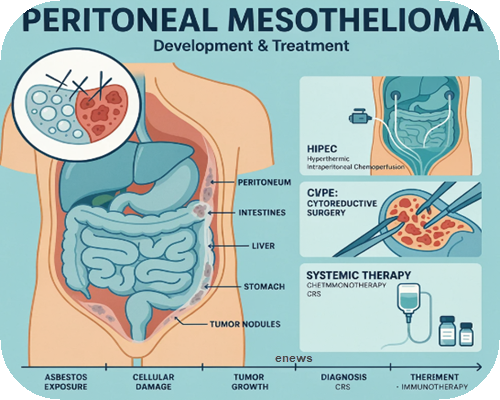
For eligible patients, surgery followed by heated chemotherapy is the standard treatment approach. During cytoreductive surgery, the surgeon removes visible tumors from the abdominal cavity. The procedure can involve removing affected areas of the peritoneum and, in some cases, nearby organs.
After the surgeon removes the tumors, doctors circulate heated chemotherapy through the abdomen. This treatment, called hyperthermic intraperitoneal chemotherapy, targets remaining cancer cells near the surgical site. Heat helps the medicine act directly inside the abdominal cavity while limiting exposure elsewhere in the body.
This approach requires careful patient selection because the operation is extensive. Recovery can include hospital care, nutritional support, pain management, and monitoring for infection or other complications. A specialized mesothelioma team assesses whether the expected benefits justify the surgical risks.


Systemic Treatment
Chemotherapy uses medication that travels through the bloodstream to attack cancer cells. Doctors prescribe it before surgery, after surgery, or as the primary treatment when an operation is unsuitable. The treatment plan depends on tumor spread and the patient’s health.
Immunotherapy helps the immune system identify and attack cancer cells. Physicians may recommend it when surgery is not possible or when the disease returns. Some patients receive combined treatments to control tumor growth and reduce symptoms.
Palliative care also plays a role at every stage of the disease. It addresses pain, nausea, abdominal pressure, nutrition, and other problems caused by cancer or its treatment. This care can continue alongside therapy directed at the cancer.
Factors That Affect Prognosis
Prognosis depends on the disease’s extent, cell type, patient’s age, general health, and response to treatment. Patients diagnosed at a younger age often have better outcomes, while extensive tumor spread creates greater treatment challenges.
Treatment remains the most reliable way to improve prognosis. The inspected medical source reports a median survival of about 2.5 years after diagnosis, although individual results vary. Without treatment, survival is often four to six months, while about half of treated patients live 2.5 years or longer.
Conclusion
Peritoneal mesothelioma develops after asbestos fibers damage the abdominal lining, often after a person ingests contaminated dust. Early symptoms can remain mild, so anyone with a history of exposure should seek medical evaluation for abdominal pain, swelling, nausea, or unexplained weight loss. Imaging and biopsy confirm the diagnosis. Treatment can include surgery, heated chemotherapy, systemic therapy, immunotherapy, and palliative care. A mesothelioma specialist can review treatment eligibility and recommend the next diagnostic step.