


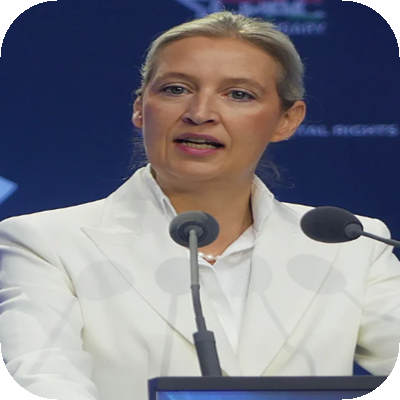
Alice Weidel, co-chairwoman of Germany’s right-wing Alternative for Germany Party (Wikipedia)
The Alternative for Germany (AfD) party won 44.5 percent of the vote in the Sept. 6 state election in Saxony-Anhalt, emerging as the winner of the election in the eastern state, according to exit polls.
The center-right Christian Democratic Union (CDU) of Chancellor Friedrich Merz, which has led the government of this eastern state of 2.1 million people since 2002, fell to 18.5 percent from 37.1 percent in 2021.
This result marks a major breakthrough for the party and a setback for Merz’s CDU.
However, the AfD appears to have fallen short of a parliamentary majority, which requires 42 out of the 83 seats in the state legislature.




Ulrich Siegmund, AfD lead candidate for governor of Saxony-Anhalt, ran on a platform promising a “deportation and remigration offensive,” a state baby bonus, cuts to public broadcasting, deregulation and tax cuts, a reduction in the number of state ministries, and the creation of a parliamentary inquiry into the handling of the COVID-19 pandemic crisis.
“A new era is dawning here, an era in which people are saying very clearly, enough is enough,” Siegmund told The Epoch Times. Voters, he said, want “fundamental political change“ and a government that “once again makes policy in the interest of its own people and its own country.”
Siegmund also said he would adopt a position on relations with Washington that he described as distinct from that of the federal government. “I will not presume to constantly criticize the decisions of other countries, as Chancellor Merz currently does so often with decisions taken by the Americans,” he said.
He described the United States as “a very important and strong country in today’s world” and said he looked forward to “continued excellent cooperation” with it.
President Donald Trump shared a screenshot of the German television projection on his Truth Social account.





Siegmund said that he also “wanted to get along with Russia.”
Sven Schulze, the Christian Democrat who heads the outgoing state government, delivered a brief statement on German television after the result. “Some would say it was a dark day for Saxony-Anhalt,” he said. “I say this is democracy.” Pointing to the high turnout, he acknowledged that “the people have sent a clear message.”
CDU General Secretary Franziska Hoppermann told public broadcaster ARD that the outcome was “a defeat overall for the Christian Democrats.” She nonetheless ruled out any coalition with the AfD. “We do not work with extremists,” she said.
Speaking to The Epoch Times, AfD co-chair Alice Weidel hailed “a huge success, historic, sensational.” Sven Tritschler, Deputy Federal Chairman of the AfD, said the result was “also a win for the wider right-wing movement in Europe, because it gives hope for change in many of the areas that right-wing parties across the continent are fighting on, such as migration and energy.”

Maximilian Kneller, an AfD member of the Bundestag, Germany’s federal parliament, told The Epoch Times that the “firewall that the so-called conservative CDU has maintained alongside the left has now been breached.” The CDU, he added, had “better change course or they will lose all their remaining votes, especially in Eastern Germany.”
Several AfD supporters also pointed to the legacy of Angela Merkel, the former CDU chancellor who opened Germany’s borders to more than a million migrants in 2015 and 2016, and who set the country on the path to abandoning nuclear power.
Lars Klingbeil, leader of the Social Democrats (SPD), the CDU’s coalition partner in Berlin, told broadcaster ZDF that “an incredibly large number” of people in Saxony-Anhalt and across Germany were now afraid and worried in light of the AfD’s result. He and his party would “do everything to ensure that they can continue to live safely in Germany and that our country remains a cosmopolitan nation,” he said.
A ‘Firewall’ Under Strain


The vote is the sharpest test yet of a so-called firewall: an agreement among Germany’s established parties to refuse to govern with the AfD.
In September 2024 the party came first in neighboring Thuringia with 32.8 percent and was kept out of office by a three-party minority government; it finished a close second in Saxony and Brandenburg.
In Saxony-Anhalt, the AfD has sat in opposition since it entered the legislature in 2016 with 24.3 percent. It slipped to 20.8 percent in 2021, when Reiner Haseloff’s CDU won a clear victory and formed a coalition with the Social Democratic Party and Free Democratic Party; the surge came afterward, with 37.1 percent of the state’s vote in the February 2025 federal election, in which the AfD finished first in every eastern state outside Berlin, and 40 percent to 43 percent in the final pre-election polls.

The party’s rise has coincided with escalating official scrutiny. The state’s domestic intelligence office has classified the AfD’s Saxony-Anhalt branch as a “confirmed right-wing extremist” organization since October 2023 and says its membership grew by more than one-third last year, to 3,500. The federal agency applied the same label to the whole party in May 2025, a decision the AfD is contesting in court.
The federal decision also drew sharp criticism from Washington.
“Germany just gave its spy agency new powers to surveil the opposition. That’s not democracy: it’s tyranny in disguise,” U.S. Secretary of State Marco Rubio wrote on X in May 2025.
The label has done little to dent the party’s standing in the polls. Nationally, the AfD leads: The August ARD-DeutschlandTrend survey by the political research institute Infratest dimap put it at a record 28 percent, 7 points ahead of Merz’s CDU, with 85 percent of Germans rating the federal government negatively and 14 percent satisfied with the chancellor.
Alice Weidel, AfD co-chairwoman, told the ZDF broadcasting company in August that the party would govern in the states and eventually in Berlin. The next tests come on Sept. 20, when Mecklenburg-Vorpommern, where the AfD leads at about 37 percent, and Berlin elect new parliaments.
What Drives the Vote?
Migration and public security are the AfD’s signature issues, and in Saxony-Anhalt they are tied to a specific event: On Dec. 20, 2024, a Saudi doctor granted asylum in Germany in 2016 drove a rental car into Magdeburg’s Christmas market, killing six people and injuring more than 300. He was sentenced to life in prison in June.
The numbers show how the issue has moved. Infratest dimap’s July survey for the public broadcaster MDR ranked immigration as the state’s most important problem, ahead of education and the economy, and found that 36 percent of voters trusted the AfD most to handle the state’s key tasks, against 16 percent for the CDU; five years earlier, the figures were 9 percent and 40 percent.
The state’s foreign population reached a record 192,155 at the end of 2025, more than double the 83,051 of 2015, with the largest increases coming from Ukraine and Syria.

The economy competes for first place. The ZDF Politbarometer a week before the vote put the economy (22 percent), unemployment (17 percent), and schools (17 percent) at the top of voters’ concerns; unemployment stood at 8.1 percent in July, according to the Federal Employment Agency.