


(CREDIT: History of Canadian Science and Technology/Flickr)
What’s in a name, Shakespeare once famously asked? Plenty, when it happens to be the moniker of both the place where you live and the symbol of pure evil. However, it didn’t start out that way.
In fact, it began with something totally unexpected.
Marcus Powell was walking through a farm field in eastern Ontario, Canada, one afternoon in 1866. His day job was clerking in the local court. But his passion, his part-time profession, was prospecting. He was hoping to find copper. But that day he stumbled upon something infinitely more valuable.
Gold. The shiny metal that has held sway over mankind’s desires since the dawn of recorded time. Wars were fought over it; empires rose and fell because of it. And there it was, right in Canada’s heartland.





Powell leased the farm from its owner, brought in a pair of investors from Chicago, and in 1867 the Richardson Mine began digging. It was soon producing gold nuggets the size of walnuts. And with that, the Ontario Gold Rush was on.
Though lost in the shadow of other, larger, more lucrative booms, such as the California Gold Rush of 1848-1850 and the 1865-1890 Klondike Gold Rush (which produced around 12 million and more than 6 million troy ounces of bullion respectively), Ontario’s was far smaller. However, it ultimately yielded a respectable 22,000 troy ounces.
Unlike many booms that come and soon play out, this one stretched into the early 20th century. Which is where the town and its unusual (to say the least) name enter the story.
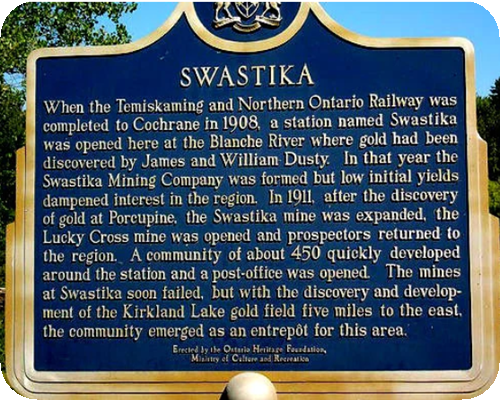
Brothers James and William Dusty were prospectors under contract with the Tavistock Mining Partnership. They’d been working the soil for several years and had yet to strike it big. But their fortunes changed one late summer day.
Because on September 7, 1907, they discovered something in the Kirkland Lake district that made them famous in their time. That Monday, James lowered himself into a shallow opening in some exposed bedrock. And there it was, just a few feet below the surface. His eyes fell on a quartz vein containing that unmistakable metal glowing within.






“Gold!” he screamed excitedly.
James scrambled to the surface. Others were down and quickly confirmed it.
Jubilation took over as the men dreamed of what would come next. For that tiny hole in the ground was about to be turned into a gold mine. Literally. Someone asked what it would be called.
A young girl had accompanied her father, one of Tavistock’s directors, to the site. James looked at the twisted cross she wore on her necklace and instantly had the answer.
“Swastika,” he said. “We’ll call it the Swastika Mine.”
Shocked? Don’t be. In 1907, Adolf Hitler was a failed artist living in a Vienna flophouse amid his delusions of grandeur and the Nazi Party he went on to lead was still 12 years in the future.
Rather, the swastika was a Sanskrit figure that had been around for centuries. In the Edwardian Era, it was seen as a good luck symbol, much like four-leaf clovers, horseshoes, and rabbit’s feet. The child was wearing it that day for that reason, not to promote any political ideology.
Prospectors (just like their emotional first cousins, gamblers) are always taking risks, and thus always begging fortune to smile on them. And so it was when the Swastika Mine officially opened for business. Hence its name.


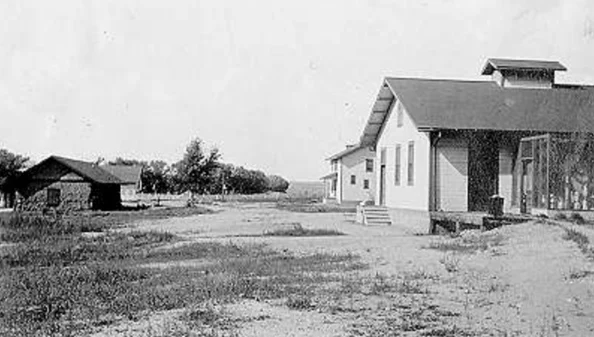
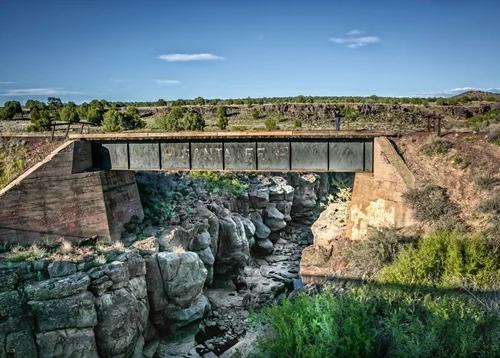
Trains from the Temiskaming and Northern Ontario Railway began stopping at the mining camp. By 1908, the town of Swastika was officially on the map. Nobody gave its name a second thought.
Until 31 years later, when Canada went to war with Nazi Germany. In the intervening years, Hitler had set the swastika in a white circle on a field of fiery red. It now symbolized a dire threat to Western civilization.
In short, the town of Swastika’s very name was suddenly linked to the Bad Guys. So, the provincial government changed the town sign to “Winston” (presumably in honor of Churchill) for the duration. After V-E Day, locals tore it down and replaced it with another sign saying, “To hell with Hitler, we had the swastika first.”
And so, they stubbornly cling to it to this very day, a handful of friendly people in a hamlet whose name carries ugly connotations from long ago.