


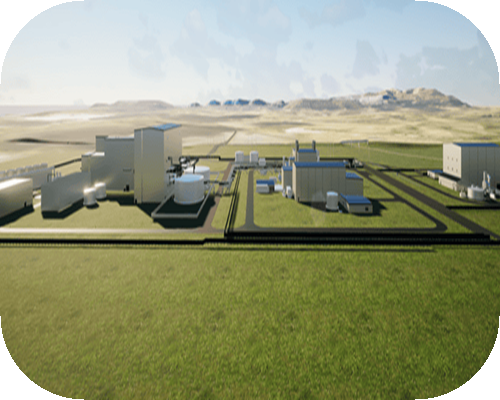
TerraPower’s Kemmerer Power Station Unit in Wyoming. (Courtesy of TerraPower)
Across the American Heartland, a different industrial revolution is quietly reshaping the landscape. Down rural highways, heavy haulers roll past grain silos toward rising gigafactories, battery hubs and advanced nuclear sites. In towns long defined by legacy manufacturing, the modern workforce is building next-generation clean power and tech facilities — yet the officials in those statehouses remain overwhelmingly conservative.
Call it the Heartland Energy Paradox. While national politics treats clean energy as a partisan battlefield, red America is quietly becoming the engine room of the green transition.
The numbers tell a story that cuts straight through cable-news talking points. According to nationwide project tracking by the nonpartisan business group E2 and Rhodium Group, conservative-leaning congressional districts host 80 percent of major new clean energy infrastructure investments — spanning utility-scale solar, battery manufacturing, advanced nuclear and hydrogen projects.
“Private capital doesn’t care about red or blue bumper stickers,” said Bob Keefe, executive director of E2. “There should be nothing partisan about creating jobs, driving economic growth and cutting costs for consumers — and that’s why the vast majority of major new clean energy factory investments are landing in conservative districts.”





Take Dalton, Ga. Known for generations as the carpet manufacturing capital of the world, this conservative industrial stronghold is now home to North America’s largest solar panel manufacturing site. South Korea-based Qcells poured $2.5 billion into expanding its operations across Whitfield and Bartow counties, filling former textile corridors with automated production lines that churn out nearly 30,000 solar panels a day and employ thousands of local workers.
For Whitfield County commissioners, the facility isn’t an ideological climate statement — it’s a reliable 30-year tax base that funds local schools and emergency services without raising property taxes on farmers.
Farther west, a similar transformation is happening in Kemmerer, Wyo. Long anchored by coal extraction and ranching, this deeply conservative, high-desert town is now the site of TerraPower’s $4 billion Natrium advanced nuclear plant.
Built directly adjacent to a retiring coal-fired power station, the advanced reactor project preserves the region’s identity as an energy powerhouse. It taps into the existing high-voltage transmission grid while bringing 1,600 construction jobs and retraining veteran energy workers for high-wage, next-generation 24/7 power production.
Skeptics naturally push back. In a political environment where national leaders routinely mock wind energy, attack electric vehicles and question climate policy, can conservative America truly sustain this role? How can red states lead a transition that their own national party rhetoric routinely dismisses on television?


Because the view from a rural county commission room looks entirely different from a cable television studio in Washington.
While national commentary focuses on symbolic culture-war battles, local leadership zeroes in on ratepayer costs, infrastructure resiliency and expanding the local tax base. State lawmakers may publicly rail against federal energy mandates, but behind closed doors, they fight tooth and nail to keep a multi-billion-dollar advanced manufacturing facility from locating across the state line.
As Heather Reams, the president of Citizens for Responsible Energy Solutions, frequently emphasizes in her outreach to policymakers of all stripes, right-of-center energy leadership focuses on practical results rather than ideological debates. When electricity demand spikes and utility bills rise, pragmatic local leaders focus on expanding energy capacity to ensure reliability and create jobs.
California may dominate headlines for setting aggressive environmental mandates and leading software design, but the industrial realities of the modern energy economy tell a different story. Regulators in Sacramento can pass targets, but it is the Heartland — with its abundant land, fast-track permitting and deep manufacturing roots — that is actually building the physical facilities. Coastal policy might set the direction, but conservative America is fueling the results.
When the national noise dies down, economic gravity takes over. Technology isn’t driving the transition; balance sheets, land availability, fast grid interconnections, and local economic survival are powering the changes.
The future of American energy dominance won’t be decided on Capitol Hill or cable news studios. It will be built by the American Heartland — the machine shops, transmission corridors and rural industrial parks that pump blood and oxygen through the national economy.