


Say “Founding Fathers,” and the names pour forth. George Washington and Benjamin Franklin. Thomas Jefferson and John Adams. Patrick Henry and John Hancock. Dozens of heroic figures whose vision and courage created the country we know today.
Yet one name is usually missing. And it’s a pity. Though he didn’t thunder “Give me liberty or give me death,” and didn’t pen inspiring words such as “We hold these truths to be self-evident,” his critical contributions made it possible for others to do so.
Because without Haym Solomon, America’s independence might have ended as quickly as it had begun.
Born into a Jewish family in what is now Poland in 1740 and fluent in several languages, Solomon traveled extensively in western Europe. There he gained a keen understanding of international finance and how nations did business with one another, which he put to use in his career as a financial broker.
When he was 30, deteriorating conditions in his homeland convinced him it was time to move, first to England, and then to New York City, then as now the financial capital of Britain’s North American colonies.





His arrival in the New World in 1775 coincided with the start of the Revolutionary War. As colonials were picking sides, Solomon immediately knew which cause held his heart. He joined the Sons of Liberty.
Arrested in September 1776 on suspicion of being a spy, he was quickly pardoned — and then forced to serve 18 months on a British ship as a translator for German-speaking Hessian mercenaries. Meanwhile, he secretly aided the Patriot cause by helping Continental POWs escape. Nabbed again in 1778, the Brits charged him with espionage. But Solomon cheated the hangman by secretly slipping away.
Settling down in Philadelphia, he went back to his profession as a financial broker. And that’s where he truly made his mark. Solomon became acquainted with Robert Morris, the just-appointed Superintendent of Finance of the United States, the Revolutionary version of today’s Treasury secretary.
They became a kind of Dynamic Duo of the business world. Morris had an immediate and almost overwhelming problem; the 13 colonies were both flat broke and needed money. Lots and lots of money.
Solomon’s expertise in international finance was just what Morris and the infant nation needed. Between his personal loans and fundraising, he provided more than $15 million in today’s currency, money that kept his adopted country’s cause afloat.


However, his most vital service was yet to come.
Solomon had picked up a side hustle that later proved invaluable when he became paymaster for all French forces in North America. Late in the war, France recognized America’s independence, extended a huge cash loan and, most important, sent its powerful navy and soldiers to bolster the Patriots.
As summer drew to a close in 1781, the British army under Lord Charles Cornwallis became bottlenecked on a Virginia peninsula at Yorktown. Gen. George Washington sensed a strategic opportunity. If he could get his troops and the allied French army to Yorktown, the combined force could deliver a coup de grace that could end the war.
There was just one problem, and it was a biggie. Washington’s army was in New York’s Hudson Valley just then. Moving it 350 miles to Virginia would cost a lot of money. And the Patriots’ piggybank was empty. Not low on funds — flat broke.
Washington knew what to do, and with one order changed the situation. “Send for Haym Solomon.”
Solomon swiftly rolled into action, brokering the sale of bills of exchange. The $20,000 he quickly raised made it possible for Washington’s troops to redeploy and win the final triumph that fall.
Solomon lived to see victory, but he didn’t get to enjoy watching the country he had helped create reach maturity. His unyielding generosity to the patriot cause cost him all his money and likely damaged his health. He died suddenly, and in poverty, in Philadelphia just six days in 1785. He was only 44.
His wife and four young children were left penniless. All the Continental debts he had sunk his fortune into were now worth pennies on the dollar. He was quietly laid to rest in the cemetery of Philadelphia’s Jewish synagogue, and then faded from the nation’s memory.


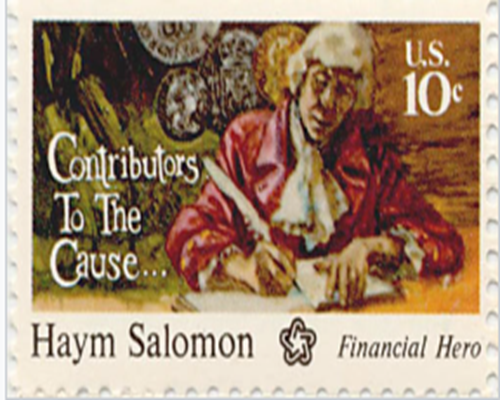
He was every bit as much a hero as the soldiers who fought at Lexington and Concord and endured Valley Forge. They don’t put your face on coins or stamps for being a financial hero. Which is a shame. Because Haym Solomon was the Founding Father who literally put his money where his mouth was.