


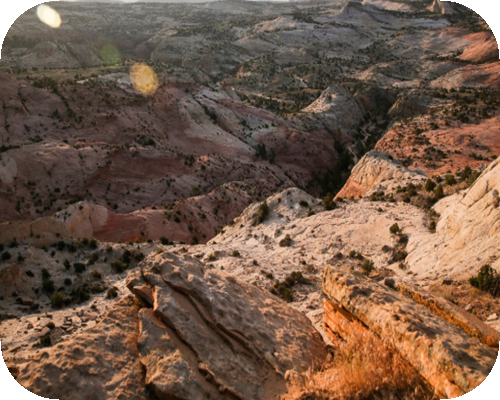
The Grand Staircase-Escalante National Monument in Utah is seen on July 9,2017. (Spenser Heaps/The Deseret News via AP, File)
President Donald Trump signed two proclamations in the Oval Office late on July 13, shrinking the Bears Ears and Grand Staircase-Escalante national monuments in Utah by approximately 3 million acres, combined.
‘We’re terminating certain monuments,” Trump said. “They call it monuments—not the ones we have outside.”
The president previously reduced the monuments’ boundaries with a December 2017 proclamation during his first term, but President Joe Biden reversed the decision in 2021.
Grand Staircase-Escalante was protected by President Bill Clinton with a national monument designation in 1996.




Staircase cliffs and vast canyons in the region are known for their rich natural history beloved by paleontologists, with dinosaur fossils scattered throughout the nearly 1.9 million acres.
New boundaries reduce the area, with the remaining slightly more than 350,000 acres containing the Grand Staircase, Escalante Canyons, and the Kaiparowits Plateau.
Trump challenged the “vague” descriptions in his predecessor’s order of protection, declaring that scenic views do not necessarily qualify for national monument protection.
Special attention was paid to the region, as it “contains several resources that are vital to our economic and national security,” including, among others, chromium, cobalt, copper, manganese, titanium, uranium, and zirconium, according to the order.
Trump has repeatedly prioritized identifying domestic sources for the natural resources needed for defense, manufacturing, transportation, and communication.


“Modifying the Monument’s boundaries will help ensure that adequate domestic supplies exist, thereby reducing the threat posed by our Nation’s reliance on foreign sources,” the proclamation reads.
President Barack Obama designated Bears Ears a national monument in December 2016, protecting approximately 1.35 million acres that contain historical cultural landscapes considered sacred by several native tribes, Pueblo cliff dwellings, artwork, and ancient ceremonial sites.
Trump found the protection order was “not confined to the smallest area compatible with the proper care and management of the objects of scientific or historic interest identified therein.”
The new guidelines cut the acreage to about 121,000 acres, creating two separate areas, the Bears Ears and Indian Creek units.
Significant artwork and sites remain protected, including the Moon and Doll House Ruins and Newspaper Rock.
Reduced protections allow for more economic opportunities, including livestock grazing, mineral and natural resource development, as well as recreational activity.
Prior restrictions prevented locals and visitors from exploring and enjoying the land, according to the president.
“You can’t do anything. You can’t go hunting. You can’t go fishing,” Trump said. “You can virtually not even walk on it.”


Utah Gov. Spencer Cox said the rollbacks are beneficial to the state and its residents.
“This is a big day for Utah,” Cox said during the signing ceremony, describing the orders as appropriate applications of the Antiquities Act, which called for the federal government to protect the smallest areas possible when designating national monuments.
“These multi-million-acre monuments that are bigger than the state of Delaware certainly do not fit that designation.”
Safeguarding the environment while balancing public access remains a priority, according to the governor.
“Now we care. We definitely care about protecting these antiquities and will continue to do so,” Cox said, noting the challenges that come with protecting millions of acres of land with minimal resources.
“This does not remove the other protections that already exist in those areas, just making the monuments more manageable so that we have the resources necessary to continue to protect these antiquities.”
Deputy Secretary of the Interior Kate MacGregor said the new rules reflect the intention of the act passed to protect historic lands and national treasures.
“The Antiquities Act is 120 years old, but the first monument that was created was only 1,200 acres,” she said. “Since then, President Clinton, President Obama, and President Biden have increased the acreage in the state of Utah and locked those acres up, over 3 million acres for nobody to use.”
Critics of the move, including the Bears Ears Inter-Tribal Coalition, the Southern Utah Wilderness Alliance, and other environmental and conservation groups, argue the Antiquities Act only granted one-way power, suggesting the president does not have the authority to reduce protected acreage.
Legal challenges followed the 2017 reductions, and more lawsuits are now expected.