


There was much anxiety in the early 1970s inside Chrysler’s Highland Park, Mich., headquarters outside Detroit. Everywhere the Big 3 automaker turned, serious trouble was staring it right in the face.
For starters, sales were declining in a sluggish economy. Then there was the Arab oil embargo, which sent gasoline prices skyrocketing to the unheard-of price of 50 cents a gallon or more. That was a blow to the bottom line of a company that made gas-hungry big cars.
But the worst problem by far was that American consumers were turning their backs on full-scale four-door sedans, which were Chrysler’s bread and butter. The car maker needed something new, something bold, something daring — and pronto — or it faced the very real risk of going the way of Studebaker, Packard and DeSoto.
So, the boys in the Chrysler’s C-Suite did some brainstorming. Car buyers were crazy just then for what the industry called “intermediate personal luxury coupes,” two-door models that carried the vibe of top-of-the-line models, but which came in a smaller, more energy-efficient size.
The ailing automaker needed one of its own. And so, the big brass pulled out all the stops in designing, building, and promoting one.





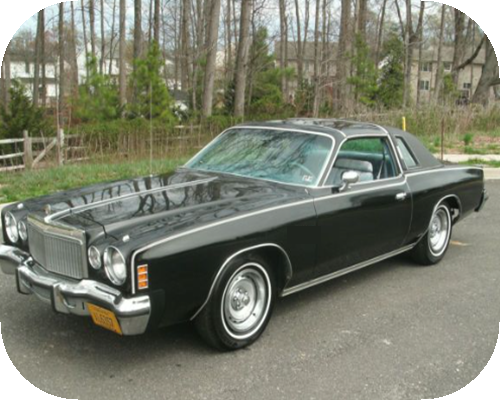
The result was the 1975 Chrysler Cordoba.
Designed to compete against Ford’s Thunderbird and Chevy’s Monte Carlo, buyers were dazzled when the first models rolled into showrooms in the fall of 1974. The Cordoba boasted a Rolls-Royce-inspired grille, hidden windshield wipers, a ritzy raised hood ornament, and even an optional vinyl roof.
However, its showcase was the interior. That was where Chrysler really went all out. It paid handsomely for an aggressive TV advertising campaign trumpeting this elegance on four wheels. The sophisticated actor Ricardo Montalbán walked around a Cordoba parked in what appeared to be an Old World plaza, a Spanish guitar strumming as he gushed about “pride, the very cornerstone of a new automobile.”
Then the camera cut to car’s interior, and the magic words rolled off Montalbán’s tongue: “Here is the warmth of thickly cushioned contoured seats, available even in fine Corinthian leather.”
For some reason, the American public latched on to those three words, “fine Corinthian leather.” They came to symbolize what set this new car apart from its competitors. Suddenly, Joe Six Pack could haul the wife and two kids (three if they were small) around town as their fannies savored the same “fine Corinthian leather” heretofore enjoyed only by the bottoms of the rich and famous.


The Cordoba was a big hit, selling 151,000 cars in its first year. It became one of Chrysler’s best sellers and helped save its bacon, pulling the company back from the brink of possible ruin. Later ill-advised and unrelated decisions put it back in that precarious position at the end of the decade. (It would take a congressional bailout and the genius of Lee Iacocca to snatch it from the jaws of Chapter 11.)
But for the moment, Chrysler’s future looked brighter thanks to the Cordoba.
As the 1970s rolled on, Montalbán kept hawking the Cordoba, invariably including a special plug for the luxury of “Corinthian leather.” Sometimes it was “rich Corinthian,” other times “fine” or “soft.” But always “Corinthian,” the one detail about the car that consumers remembered—and responded to positively—above all others.
There was just one small problem. There is no such thing as Corinthian leather, fine or otherwise. A creative writer had simply made it up. The Cordoba’s interior was upholstered in pretty much the same material found in most other cars of that era.
Appearing on “Late Night With David Letterman” on April 14, 1987, Montalbán finally addressed the issue head-on.
Letterman: “So what was the deal with Corinthian leather?”
Montalbán admitted, “Jim Nichols, who wrote the commercials for Chrysler… wanted to find a word that sounded sort of elegant that I could say like a little verb. So, ‘Corinthian,’ you know?”
Letterman: “But does it mean anything?’


Montalbán: “Nothing … it’s a trade name.”
As author Paul Fussell wrote in his 1991 book “BAD: Or, the Dumbing of America,” the leather “never saw Corinth at all.” It was just an advertising gimmick
By the time the last Cordoba rolled off the assembly line in the summer of 1983, 691,263 had been sold.
And fine Corinthian leather had been available for each and every one of them.