


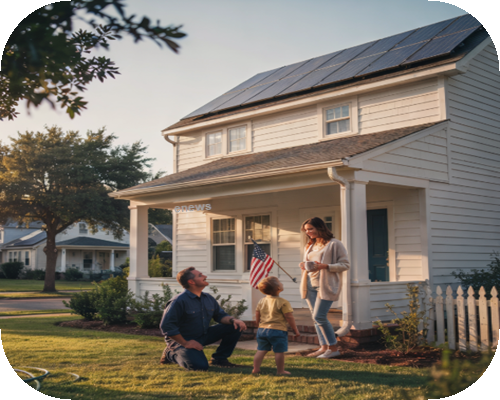
America is short 4.7 million homes. That shortage is reshaping the life choices of millions of people. Young families are delaying having children, first-time buyers are stuck renting longer than they planned, and middle-class workers are commuting farther than ever just to find something within reach.
In the face of this challenge, public policy should have a clear and urgent focus: build more homes, quickly and at prices Americans can afford on Day 1 and five years from now.
Affordable energy efficiency should be a key part of that effort.
Homes built after 2010 are already the most energy-efficient in American history. Advances in insulation, air sealing, HVAC systems and high-performance windows have dramatically reduced energy use per square foot compared to homes built just a generation ago. These improvements are a quiet success story, lowering utility bills for families while reducing energy consumption.
The question today is how to build on that progress while keeping homeownership attainable.





Research, including work by Stanford University scholars on building decarbonization, confirms that efficiency measures like improved insulation and tighter building envelopes can meaningfully reduce emissions associated with heating and cooling. This research highlights an important reality: the largest gains tend to come from the most cost-effective early improvements. As efficiency standards become more stringent, each additional incremental improvement often delivers smaller emissions reductions at a higher cost.
That cost does not stay on paper. It shows up in the price of a home. Every upgrade, from additional insulation to more advanced systems or construction requirements, adds to upfront building costs. For homebuyers, those costs translate directly into higher mortgage payments, larger down payments, or in some cases, the inability to qualify for a loan at all. Energy savings over time are valuable, but they cannot help families who are priced out before they ever get the keys.
We need to develop energy codes that balance long-term energy savings and upfront costs. All homes consume energy, and improving efficiency is a worthwhile goal. The central policy question is not whether to build efficient homes; it is how to achieve meaningful efficiency gains at a cost that keeps housing accessible. For families already navigating higher interest rates and broader cost-of-living pressures, even modest increases in upfront housing costs can have significant consequences.
Energy codes should play an important role in striking that balance. They help ensure safety, durability and a strong baseline of efficiency across the housing market. When they focus on practical, proven measures, they can support both affordability and sustainability. However, as requirements become more complex or more costly, the cumulative effect on construction can grow in ways that are not always immediately visible.
For example, higher insulation requirements can influence building design, materials and labor. Adjustments to wall assemblies, structural components, and construction practices can create ripple effects that add cost throughout the building process. These changes are not inherently negative, but they underscore the importance of carefully weighing benefits against real-world affordability.





At the same time, expanding the supply of new, reasonably efficient homes is one of the most effective ways to reduce overall energy use in the housing industry. When families have access to newer homes, they benefit from modern construction techniques that are significantly more efficient than much of the existing housing stock. If new construction becomes too expensive, demand shifts toward older homes that often consume more energy, limiting gains in affordability and environmental progress. Additionally, energy-efficiency upgrades to older homes are often impractical, as structural limitations and high retrofit costs can yield minimal savings or extended payback periods.
The United States does not need a small number of highly optimized homes to make a meaningful effect. It needs millions of well-built, energy-efficient homes that people across a wide range of incomes can afford. Teachers, nurses, tradespeople and young professionals all benefit when efficient housing is broadly attainable rather than narrowly available.
This is not a choice between affordability and sustainability. The country can advance both goals with thoughtful policy. By prioritizing the most effective efficiency measures and maintaining a clear focus on upfront affordability, policymakers can help expand housing supply while still delivering long-term energy savings.
Affordable energy efficiency is a strategy. It lowers utility bills, supports environmental progress and keeps the door to homeownership open for more Americans.
The American Dream has always been rooted in access: access to opportunity, stability and a place to call home. By aligning energy policy with housing affordability, we can ensure that dream remains within reach, not just for today’s buyers but for the next generation.