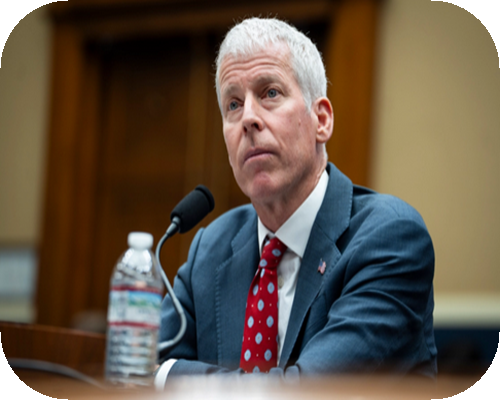
Energy Secretary Chris Wright testifies on Capitol Hill in Washington on April 16, 2026. Madalina Kilroy/The Epoch Times
U.S. Secretary of Energy Chris Wright said on June 21 that commercial shipping traffic through the Strait of Hormuz is “back to normal” after the United States and Iran signed a preliminary agreement to open the waterway and end hostilities.
Wright further predicted that oil, gas, and energy prices will decline. During the conflict, Iran effectively shut down the Strait of Hormuz, a critical waterway that normally carries about one-fifth of the world’s traded oil, causing prices to surge.
“I’m long out of the business of predicting oil or gasoline prices, but they will continue to head down,” he told ABC News’s “This Week.” “Flows of oil and natural gas through the straits have already returned to normal, and they will continue that way whatever happens with the negotiations with the Iranians.”
Although Wright did not elaborate on how many barrels of oil are currently passing through the strait, he said that production is increasing in the United States, production is “surging” in Venezuela, and the U.S. government has “cooperation with all the other energy producers of the world.”
“So I think Americans can expect continued declines in energy prices,” he said.
As of the afternoon of June 21, the American Automobile Association said that the price for a gallon of regular gasoline stood at $3.94 nationwide, a decline of about 13 cents from seven days ago and a decline of more than 60 cents from one month ago. The price of diesel had dropped by more than 60 cents, to $5 per gallon, from a month ago.
The U.S. Central Command said in a statement on June 20 that 55 merchant ships transited the strait and moved more than 17 million barrels of oil to markets worldwide, noting that a maritime operations center said it deemed that all vessels are safe to pass through the waterway.
U.S. Vice President JD Vance, U.S. special envoy Steve Witkoff, and Jared Kushner are currently in Lucerne, Switzerland, for their first negotiations with Iranian officials since the signing of a memorandum of understanding between the two countries last week. Among other provisions, the memo called for Iran not to impede traffic through the Strait of Hormuz, and the U.S. government has agreed to waive sanctions against the country’s oil industry.
Speaking about the talks, Wright told ABC on June 21 that there is “candid dialogue” between both sides, but he stressed that Tehran does not “have the leverage” it had in talks before.
Wright said he believes that Trump signed the memorandum to offset economic consequences due to higher energy prices worldwide, noting that U.S. military strikes against Iran carry “enormous risk” to worldwide energy flows.
“But [Trump] simply was unwilling to leave to his successor a nuclear-armed Iran,” Wright said. “There’s just no greater risk to energy prices, to the economy of the world, than a nuclear-armed Iran. He knew he was going to drive up energy prices in the short run. He had the courage to take the action anyway, to destroy their air force, their navy, most of their nuclear program, and a lot of their military-industrial complex.”