




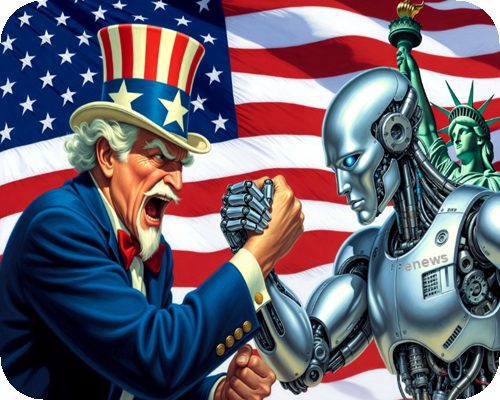
The American Dream is built on a “work hard, move up” narrative. It’s a vision fueled by the Founding Fathers’ recognition of inalienable rights that has taken flight among homesteaders, gold rushers, freedom marchers, Silicon Valley pioneers and a host of others who believed in it.
Those seeking life, liberty and the pursuit of happiness in 2026 have a problem. With AI, the “work hard, move up” narrative is no longer a promise. It’s a gamble.
The new dividing line isn’t AI versus no AI, but whether people use AI to extend their judgment or quietly outsource it. Used well, AI is leverage. Used badly, it’s anesthesia.
The framework for the American Dream hasn’t collapsed publicly, but it is already failing quietly for millions of Americans. What people call “economic pressure” is actually system-level replacement. The “work hard, move up” narrative can’t gain traction in the changing climate.
Automation isn’t coming for jobs; it’s reclassifying humans. Goldman Sachs signaled that the narrative was changing in 2023 when it warned that 300 million jobs were at risk of being lost to AI automation. Three years later, AI restructuring has become commonplace.






Companies say they’re reducing headcounts because AI streamlines efficiency. What we’re really seeing is mass role compression, not efficiency. And role compression runs counter to the American Dream.
Role compression means retirement doesn’t create a position for lower-level workers to advance into. Rather, responsibilities are compressed, with workers who remain at that level managing more, aided by AI.
Role compression also reduces the number of available entry-level jobs. AI models, not junior associates, are now used to support upper-level workers. Role compression makes it hard to climb the ladder and even harder to find the bottom rung.
Many who have achieved the American Dream know that hard work also involves smart work. AI is upending that pathway by replacing labor alongside cognitive effort, which may be the more dangerous shift.
Historically, people built careers by learning to think, communicate, persuade, decide and solve problems under pressure. That process wasn’t always efficient, but it built capability. AI can make strong thinkers stronger, but it can also make weak thinkers feel competent. That’s the danger — not the tool, but the dependency.






AI is triggering income inequality, but the real outcome is relevance inequality. The uncomfortable truth is that AI is making entire populations economically optional. AI is causing the soft collapse of human thinking.
The moment AI starts speaking for you, you stop learning who you are. Embracing AI involves outsourcing emotional processing, judgment and communication. Keeping the American Dream alive requires prioritizing independent thinking, judgment under uncertainty, and human-led strategy and interpretation.
Ultimately, the core divide will be between those who use AI to extend thinking and those who let it replace thinking.
By the time most people see the problem, it will be too late to turn back.
The damage AI causes to the American Dream is gradual in effect but exponential in outcome. By the time it feels real, positioning will already be locked in. The real divide isn’t knowledge, but timing.
That doesn’t mean ambition is dead. It means the old version of the American Dream is.
The next version won’t belong to people who simply work hard and wait their turn, but to those who can think clearly, adapt quickly, use powerful tools without becoming dependent on them, and build leverage before the market forces them to.
AI alone won’t kill the American Dream. However, it will expose who’s building real capability and who’s only following the script. The question now is whether America rebuilds the ladder or keeps selling people a climb that no longer exists.











2 thoughts on “250 Years Later, Has AI Broken the American Dream? – Inside Sources”
A lot of hype! The Industrial Revolution was criticized for the same reasons. Henry Ford perfecting the assembly line was also condemned. Watch the movie “Metropolis” made in the 1920s.
A well researched and well thought-out article. It not only gives the problem but also how to work with it and around it.
Comments are closed.