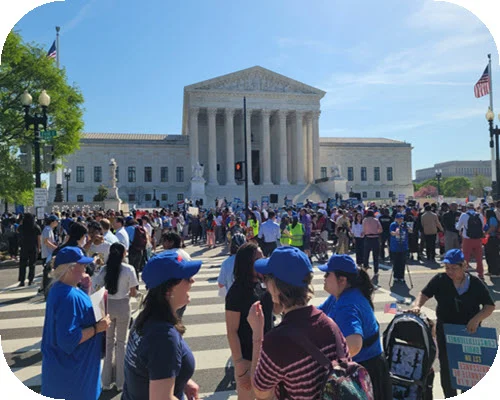
The Supreme Court in Washington on April 22, 2026. Madalina Kilroy/The Epoch Times
The government cannot prosecute a man for owning a firearm just because he has habitually smoked marijuana, the Supreme Court decided on June 18. The ruling clarifies a section of the Gun Control Act that forbids a person who “is an unlawful user of, or addicted to, any controlled substance” from owning guns.
“The government maintains that it may automatically strip Mr. [Ali Danial] Hemani of his Second Amendment right to possess a firearm because he uses marijuana a few times a week,” Justice Neil Gorsuch wrote.
“It makes no difference either if he keeps a firearm only in his home for self-defense, never misuses a gun while intoxicated, and never poses a danger to himself or others as a result of his marijuana use. The only thing the government must show, it says, is that an individual like Mr. Hemani regularly uses any amount of any controlled substance.”
The decisio was unanimous, although Justices Clarence Thomas, Ketanji Brown Jackson, and Samuel Alito all filed separate concurring opinions.





The FBI searched the Texas home of suspected drug dealer Ali Danial Hemani in 2022 and found marijuana, a small amount of cocaine, and a Glock 9 mm pistol. Hemani admitted to law enforcement that he smoked weed approximately every other day, but that he was not on drugs during the search.
He was indicted for unlawful possession of the gun, but challenged that, arguing that the wording of the statute was too vague and violated the Second Amendment.
A previous Supreme Court decision, New York State Rifle & Pistol Association v. Bruen, held that states can enact laws that restrict the right to bear arms, but only when those laws are “consistent with the Nation’s historical tradition of firearm regulation.”
The government had argued that the statute in question is “analogous to founding-era laws restricting the rights of drunkards.” Hemani’s attorneys countered that the correlation is false, since “‘habitual drunkard’ laws targeted people who regularly abused alcohol, not people who regularly used it,” as with Hemani’s use of cannabis.
“The government’s claim that historical laws targeted habitual drunkards for the same reason [Section] 922(g)(3) targets unlawful users—because they regularly use intoxicants—is difficult to square with the historical record,” the majority opinion states.




Those laws were meant to target individuals so intoxicated that they could not function, Gorsuch wrote.
Although she joined with the rest of the court, Jackson’s opinion criticizes the previous Bruen decision, calling it “unworkable” because “it imposes on judges the unfamiliar and difficult tasks of sifting through centuries-old evidence” to answer modern-day questions.
“Given those challenges, it is unsurprising that Bruen’s test is vulnerable to inconsistent and arbitrary application, as judges draw different conclusions from the same historical evidence and reach divergent assessments of the same laws,” she wrote.