


A 1965 “Wizard of Id” comic strip by Johnny Hart and Brant Parker went as follows: The diminutive but tyrannical king is addressing his subjects on the need for peace and harmony. He then proclaims, “We must all live by the Golden Rule.”
The people were confused at what he meant until the Joker clued them in: “He means whoever has the gold makes the rules.”
The converse is also true: “Whoever makes the rules has the gold.”
I was reminded of this when I saw that Elbridge Gerry is in the news again.
Unfortunately, not for the fact that he was a member of the Second Continental Congress. Nor that he signed the Declaration of Independence and Articles of Confederation. Not even that he served as vice president under James Madison. Instead, he’s in the news because the Democratic and Republican parties are once again “gerrymandering.”




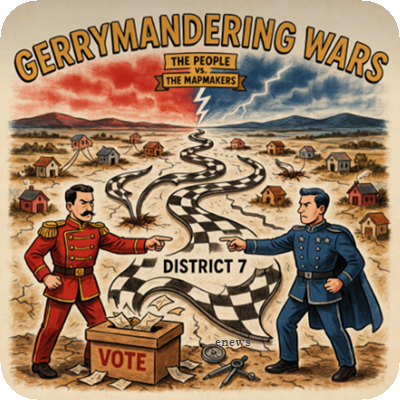
The term comes from the shape of a political district that Gerry, then Massachusetts governor, allowed his Democratic-Republican Party to draw to gain an extra congressional seat. It looked like a salamander, and the term gerrymandering was born.
Gerry found the idea “highly disagreeable,” but signed the gerrymander bill anyway.
Gerry was not alone among the Founders in opposing such political gamesmanship. Along with the protection of minority rights, a core American principle is the idea of limiting the ability of any one “faction” from taking power and tyrannizing the rest of the country.
What makes the U.S. Constitution so brilliant and enduring is the many ways in which it works to prevent permanent factions. In Federalist No. 10, Madison noted that, since the “CAUSES of faction cannot be removed,” efforts need to be sought in the “means of controlling its EFFECTS.”
Yet, political parties emerged so quickly that when George Washington was leaving office, his warnings against parties formed a central part of his Farewell Address: “I have already intimated to you the danger of parties in the State,” he warned.


They serve to “organize faction, to give it an extraordinary force; to put, in the place of the delegated will of the nation the will of a party, often a small but artful and enterprising minority of the community …”
And when there is a lot of back and forth, as we are experiencing today, “The alternative domination of one faction over another, sharpened by the spirit of revenge … is itself a frightful despotism.”
In 1986, economist James Buchanan won a Nobel Prize in economics for the development of a field of study known as Public Choice. Buchanan’s key insight was that the self-interested behavior of individuals in private life was likely to continue when they entered politics. In other words, being elected doesn’t somehow turn a human into an angel.
Or as the Nobel committee wrote in announcing Buchanan’s prize, “Individuals who behave selfishly (in) markets can hardly (be expected to) behave wholly altruistically in political life. … Political parties … will try to obtain as many votes as possible in order to reach positions of power or receive large budget allocations.” In short, whoever makes the rules gets the gold.
While there probably is no cure for this, the antidote is careful rulemaking. As the Nobel Committee noted, Buchanan showed that “the design of constitutional rules takes on great importance.” In fact, it’s the key.
While members of Congress have always been popularly elected, it wasn’t until the passage of the Apportionment Act of 1842 that states with multiple representatives were required to divide themselves into single-member districts, as we have today. With such districts, the theory goes, it is difficult for any one party consistently to win every congressional seat in a state. Local concentrations of people with different interests are often enough to activate Madison’s idea of factions canceling each other out.
Today’s gerrymandering wars are nothing other than an attempt by both parties to predetermine the outcome of elections.
Most Americans today are unhappy not only with the parties but with the system itself. They are tired of letting the king make the rules. The last time this happened, nearly 250 years ago this month, it led to a revolution.