


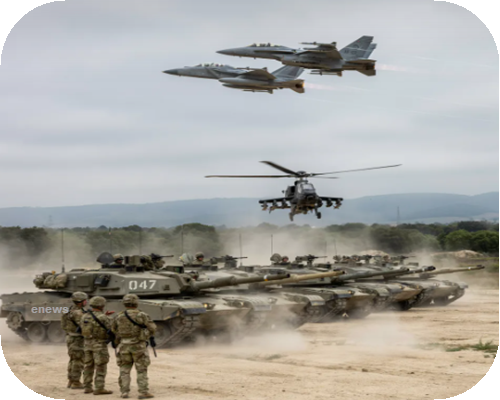
President Donald Trump’s threats to withdraw the United States from NATO, as well as ongoing tensions over the Iran conflict, have reinvigorated calls among European leaders for military independence from the United States.
However, analysts have been skeptical of proposed alternatives, raising concerns about the timing and internal dynamics among European states.
Among the proposals are a standing European Union army, which Spain’s foreign minister floated earlier this month. According to multiple media outlets, Spanish Foreign Minister José Manuel Albares said the EU should not have to wait to see what the United States will do next.
His comments followed Trump’s decision to withdraw troops from Germany and his criticism of nations such as Spain, which has refused to let the United States use its bases and airspace during the war with Iran.
Trump has said that U.S. operations against the Iranian regime are beneficial to other countries’ security. He has also criticized NATO for not actively providing assistance during the conflict and said in late March that the United States therefore does not “have to be there for NATO.”


EU Defense Commissioner Andrius Kubilius told the European Parliament on Feb. 10: “European responsibility for defense demands an institutional framework for our cooperation. A European defense union.”
German Chancellor Friedrich Merz, French President Emmanuel Macron, and European Commission President Ursula von der Leyen have all said that the EU had to take responsibility for its own security.
However, EU foreign policy chief Kaja Kallas said in early February that creating a separate EU army alongside NATO would be “extremely dangerous,” arguing that its advocates “haven’t really thought this through practically.”
A Decades-Old Debate, Revived
The idea of a European army dates back to the Eisenhower administration, which once persuaded European leaders to agree to create one. The French Parliament blocked the project in 1954 and, for decades afterward, U.S. opposition to the army, as well as its commitment to NATO, kept the project off the table.
Since then, nations such as France and Germany have urged the continent to pursue strategic autonomy. Both Macron and former German Chancellor Angela Merkel backed the idea of an army during Trump’s first administration.



Max Bergmann, director of the Europe, Russia, and Eurasia Program at the Center for Strategic and International Studies, argued in January that the question needed to be revisited in Trump’s second term.
In an analysis for the Center for Strategic and International Studies, Bergmann acknowledged concerns that an EU army was not practical, but said it was also not practical for the continent to rely on the United States, which he said was no longer interested in serving as guarantor of security.
He proposed a standing common force similar to the reaction force that former British Prime Minister Tony Blair and former French President Jacques Chirac agreed to in 1998.
Bergmann argued for a unified command structure that would sit above each nation’s military.
“Concerns over duplication with NATO and U.S. opposition blocked its creation,” he said. “However, now that there may be a clear division between the United States and Europe on defense, it makes sense for Europe to have an independent command capacity at the very least to prevent any organizational gaps in European defense.”
Other analysts, such as Patrick Edery, a geopolitical analyst based in Poland and head of the strategic consultancy Partenaire Europe, remain more skeptical. Edery told The Epoch Times that the structural obstacles to a European defense union remain.
“Every time you study the question closely, the verdict is the same: It cannot be done,” he said.
A Divided Europe
One of the biggest perceived obstacles to an EU army has been divergent political interests among European governments.


“Each EU country has its own foreign policy and its own interests,” Edery said.
He noted Poland’s early military backing for Ukraine versus Germany’s initial hesitation, following Russia’s 2022 invasion.
Hugo Meijer, a CNRS research fellow at Sciences Po’s Center for International Studies, and Stephen G. Brooks, professor of government at Dartmouth College, called this the “strategic cacophony” problem.
In a 2021 article in the journal International Security, they defined the problem as “profound, continent-wide divergences across all the domains of national defense policies, most notably threat perceptions.” The problem ran so deep, they argued, that overcoming it “would require a long-term, sustained and coordinated effort.”
Europeans were therefore highly unlikely to build an autonomous defense capacity anytime soon, they argued, even if the United States withdrew from the continent entirely.
European armies also operate independently of one another and apply different rules of engagement.
In most EU member states, parliamentary approval is required for the deployment of armed forces abroad; only France stands out as granting its executive significantly greater flexibility to initiate and sustain military operations with fewer immediate parliamentary constraints.
The continent’s equipment compounds the problem. More than a dozen European NATO members already operate or have ordered the American F-35 combat aircraft; France’s army is the only major European force that does not use it.
American control over the key assets needed to build the F-35 has entrenched Europe’s dependency on the United States, Brussels-based think tank Bruegel explained in an analysis published last year.
In March, German officials raised concerns over what they called a “kill switch” embedded in the F-35. Multiple experts say there is no hard evidence that such a mechanism exists, but argue that Washington would not need one to block the aircraft’s use. It could simply withhold ammunition and spare parts.
The existence of a kill switch is “probably nonsense,” argued Brandon J. Weichert, a senior national security editor and author of “Winning Space: How America Remains a Superpower.”
“Instead, the real kill switch is in the absolute dependence on U.S. defense firms for software, maintenance, and data links for the effective operation of these fifth-generation warplanes,” Weichert wrote in a January article published in The National Interest.
There is also the question of a unified command structure.
Bergmann argued that the EU could develop its own command headquarters that could both direct the EU force and sit as supreme European authority above the national militaries.
However, Edery said that “no European general today is trained to command an army of 1 million, or even 500,000 soldiers of different nationalities.”
Those who favor a European army acknowledge the scale of the political and bureaucratic work the project would demand.
A paper last month signed by Thomas Enders, former Airbus CEO who now chairs the German Council on Foreign Relations, and economist Moritz Schularick of the Kiel Institute for the World Economy, among others, estimated that Europe could close most of its capability gaps for about 50 billion euros ($59 billion) per year over a decade, but acknowledged that the effort is akin to a “Manhattan Project.”
It is a task, the authors wrote, “that requires concentrated political will, coordinated resource mobilisation and institutional capacity to act to a degree comparable to the historic large-scale programmes of technological and industrial mobilisation.”
Bergmann argues that building “a more cohesive fighting force” would mean encouraging, under Brussels’ supervision, the EU’s non-frontline militaries either to contribute to a European force rather than build up their own, or to fold their forces into a common one altogether.
Member states could also pay 1 percent of gross domestic product into a shared EU fund to support the force, he argued, while providing personnel and legacy equipment.
Over the past several years, the EU has developed new competencies to support and strengthen Europe’s defense industrial base.
Since 2017, it has launched a series of programs to fund collaborative defense projects among member states, including the European Defence Fund, the EU’s flagship program for collaborative defense research and development, which channels about 1 billion euros per year through 2027; and ReArm Europe, the European Commission’s major defense investment initiative, which is aimed at mobilizing up to 800 billion euros ($931 billion) in additional defense spending by 2030.
However, while pro-Brussels voices have described these initiatives as a step forward, they have also criticized what they consider shortcomings.
Bruegel has noted that ReArm Europe focuses almost entirely on national spending and national delivery, rather than creating European public goods, capabilities financed and delivered at the EU level, and therefore does little to strengthen European coordination.
The Ukraine Demonstration
The conflict with Iran, which started at the end of February, tested Europe’s relationship with the United States, but some say its reliance on American resources was proven several years earlier.
More specifically, Edery said the war in Ukraine had exposed the extent of European reliance on U.S. capabilities in real time.
Ukrainian forces depend on U.S.-made Starlink satellite terminals for battlefield communications, targeting, and drone operations, as well as on weapons and intelligence supplied or enabled by Washington.
“If the Americans stop selling Europeans the arms they pass on to Kyiv, Russia would win. If they cut off intelligence, Russia would win,” he told The Epoch Times.
Starlink, SpaceX’s high-speed internet service, was a “real game-changer” for Ukraine, Edery said.
SpaceX CEO Elon Musk himself has underscored Starlink’s importance to Kyiv.
“My Starlink system is the backbone of the Ukrainian army,” he wrote on X in March 2025. “Their entire front line would collapse if I turned it off.”
Ukraine’s government has expressed interest in European satellite projects, among them GOVSATCOM, an EU initiative to pool satellite resources from member states and industry to provide services to governments.
Privately, however, some Ukrainian officials say the existing alternatives to Starlink have limitations that would take time and money to overcome.
Arthur de Liedekerke, senior director of European affairs at the Brussels-based political consultancy Rasmussen Global, told Euronews in an interview published in April 2025 that he did not think GOVSATCOM could replace the battlefield connectivity Ukraine needs, since it remains, for now, a secure satellite communications service for EU governments.
Ukrainian President Volodymyr Zelenskyy has also emphasized that Kyiv “can’t win” its war with Russia without U.S. support.
“If we are speaking [about whether] we win without American support, no,” he said in December 2025.
“Without American support, we can’t defend the sky. Even now, it’s very difficult. American support with missiles for air defense is really helpful and strong.
“Of course we can’t win.”