

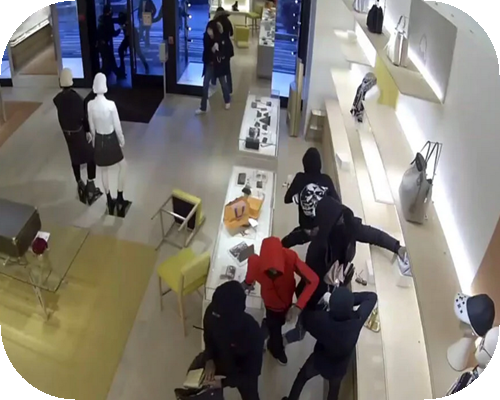
Retail theft at Louis Vuitton in Oak Brook. IL., (CREDIT: Oak Brook Police Dept.)
The passage of the Combating Organized Retail Crime Act by the House, during National Police Week no less, reignited an important conversation about how we can confront the pervasive challenge law enforcement faces in confronting organized retail crime.
I’m often asked how we can better equip the men and women who protect our communities to keep up with the evolving tactics of organized retail crime groups. After all, these are enormous crime networks that operate not just interstate, but transnationally.
There are three key opportunities in front of us to help make law enforcement more efficient in the great work they do to keep our communities safe.
First, break down the barriers that keep law enforcement working in isolation.


Crimes were once treated as isolated events. That model no longer works. Organized retail crime is driven by repeat offenders across multiple retail stores and jurisdictions, making up multi-billion-dollar enterprises that fuel other crimes such as gun trafficking, counterfeiting, wildlife smuggling, and human trafficking. They are not brand loyal or city specific; they “steal-to-order.” What once looked like petty theft is now a sophisticated financial engine for global crime.
While leading teams at Homeland Security Investigations, we treated these groups like sophisticated criminal enterprises. By leveraging financial data in collaboration with multiple agencies, we changed the game in how we attack organized retail crime at a national scale. This led to Operation Boiling Point, which combined law enforcement engagement with retailers at every level. In 2021, organized retail crime investigations increased by more than 200 percent, and more than $9 million in assets were seized.
That’s the power of a true “coalition of the willing.” When federal agents learn from our partners, we can outmaneuver even the most sophisticated criminal networks.
That lesson was clear at the recent 2026 United to Safeguard America from Illegal Trade National Summit. Across law enforcement, industry, and nonprofit partners, there was a strong consensus: piecemeal efforts will always fall short. The intelligence sharing, real-time communication, and trust that drove Operation Boiling Point must expand across all forms of illegal trade. The broader the coalition, the stronger the effect.
Second, embracing secure technology is the key to surfacing these networks.



The only way to see the true scale of this widespread and volumetric offending is through digital collaboration. By giving police the tools to connect with retailers on this information, they can identify patterns and the highest-harm offenders, and bridge the information gap to get on top of fast-moving organized crime.
When we enable this collaboration, the outcomes are huge. Just last year, a $1 billion multi-state organized retail crime operation based in Texas was dismantled, thanks to intelligence sharing across retailers and law enforcement.
Finally, political leaders have a big role to play. The passing of the Combating Organized Retail Crime Act by the House is welcome news. This is the federal leadership needed to formalize cooperation and equip law enforcement with the tools it needs to keep pace. We must maintain momentum.
Aligning federal resources under a unified strategy and strengthening prosecutorial tools — such as designating organized retail crime as a predicate offense for money laundering — enables agencies to dismantle criminal networks from the top down. It encourages the partnerships necessary to protect our economy and secure public safety.
As I reflect on USA-IT’s National Summit and policy priorities, I implore legislators and jurisdictions to continue working to equip law enforcement with the tools and technology it needs to focus its resources efficiently and effectively on the highest harm: serious offenders in our neighborhoods.