

It was a very busy day for Richard Nixon. From the moment Air Force One touched down in Mobile, Alabama, on May 25, 1971, it was a nonstop whirlwind of events.
Gov. George Wallace, who had run against Nixon for the presidency in 1968 and would do so again a year later, greeted him. A newlywed, Wallace’s second wife was already making her influence over him known. The Democrat’s usual dark business suit was hanging in a closet back in the governor’s mansion, replaced by a wild, ultramodern white suit with a salmon shirt and plaid salmon tie. (That was, after all, the mercifully brief “Peacock Revolution,” when outlandish, garish colors dominated Swinging Seventies fashion.)
The president was followed by a high-profile entourage, including daughter Julie and husband David Eisenhower — Ike’s grandson and the namesake of presidential retreat Camp David — along with three GOP congressmen and Nixon’s recent postmaster general, Alabamian Winton Blount.
After formally dedicating the new Tennessee-Tombigbee Waterway project, it was off to Birmingham, where Nixon addressed newspaper editors from around the Southeast. It was there that the presidential party encountered the trip’s only momentary unpleasantness. Some Peace Party demonstrators tried to block the motorcade. (This was the waning days of the Vietnam War, and anti-war protests were still common.) Wallace leaned out of the presidential limousine window and was heard telling his security detail, “Tell ’em that’s far enough, boys.” The motorcade passed on without incident.
Apart from that, Nixon’s six-hour visit to the Heart of Dixie was a lovefest. An estimated 180,000 people lined the route in both cities to wave and cheer. A journalist traveling with the president reported reading signs proclaiming:






“Wetumpka Loves Nixon”
“Y’all Come Back Soon”
“Right On, Brother Nixon”
“Alabama Believes In Apple Pie, Motherhood, and Mr. Nixon”
“The Nixons Are Beautiful People”






“Richard Nixon Super Star”
That last point was underscored in an unusual way during the first leg of the trip.
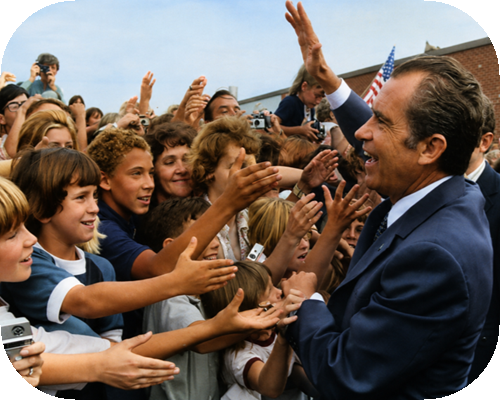
Mobile turned out in force to welcome the president. As Nixon’s limo wound its way through cheering crowds, every so often it would stop so he could jump out and shake hands with the folks he always called “my fellow Americans.”
For instance, a group of Azalea Trail Maids, decked out in obligatory Southern belle hoop skirts, each got a handshake.
But pressing the presidential flesh in a jostling, exciting crowd can turn into a contact sport. As people reached, stretched and grabbed Nixon’s hand, a cuff link came loose from his shirt. He was seen for a while with the sleeve flapping until a replacement was found for him.
When the exciting moment had passed and the motorcade had moved on, a teenager spotted something lying on the ground. And thus began Debra Norman’s 15 minutes of fame.
The 18-year-old was a senior at a local Catholic high school. It didn’t take her long to do the right thing. She immediately wrote a letter explaining that she had found the missing link and asked if it was OK for her to hold onto it as a keepsake. But she added she’d be happy to send it to the president if it held sentimental value to him.
Imagine her surprise when, a short time later, a small parcel was delivered to her home with a return address that simply said, “The White House.” Nixon wrote back saying, “Losing cuff links has become one of the minor handicaps of a career in public life, but I was glad to learn that your alertness has brought the happy return of the cuff link I lost when I was visiting in Mobile. In this case, it means the return of something my daughter, Julie, had given me.”


He wanted to make it up to her, however. He sent her a different set of presidential cuff links, explaining they were the ones he had worn that day after losing Julie’s gift, plus a bronze makeup compact engraved with the presidential seal.
A photo of Debra proudly displaying her presidential swag appeared in newspapers around the country. Then, just as fast as it had happened, the incident disappeared. However, it was never forgotten by the family who had experienced it.
Richard Nixon is remembered today for many things, some good, some less than good. But the case of the missing cuff link reminds us that presidents are just people after all. That brief moment spoke volumes about one chief executive’s love for his daughter and his kindness toward the girl who had restored the cherished memento his child had given him.