




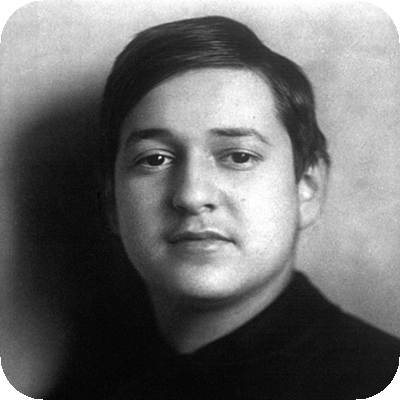
A young Erich Wolfgang Korngold
Korngold wrote it for a play. Brahms held it for two years.
The violin-piano version of Korngold’s Much Ado About Nothing exists because a theater run outlasted its orchestra. In 1918, director Max Reinhardt commissioned the 21-year-old Erich Wolfgang Korngold to write incidental music for Shakespeare’s comedy. Korngold wrote 18 pieces for full orchestra; the production premiered at Schönbrunn Palace in May 1920, with Korngold himself conducting Vienna Philharmonic members in the pit. It then ran more than 80 performances at the Burgtheater. When performances continued in venues without an orchestra, Korngold arranged four of those scenes for violin and piano (featured on our May 3rd concert: Dances and Dialogue).
Each movement depicts a different corner of Shakespeare’s social world. The Maiden in the Bridal Chamber is warm and unhurried, Hero on her wedding morning before everything goes wrong. Dogberry and Verges: March of the Watch is a march for Shakespeare’s pompously confused constable; the humor comes from Korngold playing the pomposity completely straight. Scene in the Garden is a slow waltz with abrupt key shifts, evoking the trick where Beatrice and Benedick are separately convinced the other is secretly in love with them. Masquerade-Hornpipe is the masked ball where they finally spar and dance together.
Sixteen years after the Vienna production, Max Reinhardt brought Korngold to Hollywood, where he became the highest-paid film composer in the industry.




After intermission, Brahms’s Violin Sonata No. 3 in D minor provides the afternoon’s most sustained drama. Brahms composed it in the summer of 1886, a summer that also produced his Cello Sonata and Piano Trio. He finished the violin sonata but held it for two years before publishing. The finale explains why: it does not end quietly. The opening movement sets a nervous, soft violin line against a restless, syncopated piano; the development section sustains that tension for 46 measures over a single repeated bass note. The middle movements bring a dignified tender waltz and a gossamer, uneasy scherzo. Then the finale arrives in driving 6/8, with the energy of a tarantella, and earns its two-year wait.
Brahms reached for D minor, the key of Beethoven’s most monumental symphony, his most serious violin sonata, his only one in four movements. He premiered it himself at the piano in Budapest in 1888, with Jenő Hubay on violin.
Arizona Philharmonic presents Dances and Dialogue: Courtship, Crossings, and Celebration with Katherine McLin, violin, and Andrew Campbell, piano, on Sunday, May 3, 2026, at 3 pm at Ruth Street Theater, 1050 Ruth St, Prescott. A pre-concert talk begins at 2 pm. Tickets start at $28, $10 for youth 21 and under. Art4All pay-what-you-can tickets available.
Come a few days early for Performance Prelude: In the Artist’s Words on Thursday, April 30 at 4:00 pm at Mountain Artists Guild, 228 N. Alarcon St, featuring Artistic Director Henry Flurry and Principal Timpanist Maria Flurry in an accessible exploration of how composers shape what we hear and feel.
All tickets and information are at AZPhil.org.







1 thought on “Shakespeare in Vienna, Brahms in D Minor – Arizona Philharmonic”
Thank you for the review. please allow me to offer a couple of small corrections regarding Erich Wolfgang Korngold. (1) His Much Ado About Nothing score was not commissioned by Max Reinhardt who had no connection to the production. It was commissioned by the Vienna Volksbuhne. (2) Korngold was not the highest-paid composer in Hollywood, far from it. He usually earned about $12,500 per film. By comparison, Max Steiner (his colleague at Warner Bros) was paid $100,000 + because he was on the music staff writing or arranging music for 8-12 film per year whereas Korngold’s contract stipulated just 1 or at most 2 films per annum. I hope you can please make the corrections. Thank you. Kind regards , Brendan Carroll (The Korngold Society)
Comments are closed.