Building utilities all at once can undermine finances
Developers rarely open every door on day one. Most projects roll out in phases, responding to absorption rates, financing terms, and market demand. Retail pads wait for tenants. Apartment buildings rise in tranches. Master-planned communities (MPCs) expand as buyers arrive. Yet utility infrastructure often follows a different script.
Conventional utility wastewater treatment plant planning begins with the end. Designers project full-occupancy flows and thus size tanks, clarifiers, blowers, and lift stations to match the final buildout. Engineers run the numbers, regulators review long-term compliance, and contractors construct plants designed to handle a future that may be years away. Developers then fund and build that full capacity before any actual demand.
The logic feels efficient: Build it once, avoid disruption later, and eliminate the need for future retrofits. But that approach creates a structural mismatch between phased vertical construction and all-at-once horizontal infrastructure. The result is that capital goes to work long before revenue arrives.
Traditional Overbuild and Its Financial Weight






Across the United States, water and wastewater capital spending continues to climb, with total projected investment expected to exceed $515 billion by 2035. Those numbers reflect aging assets, tightening requirements, and perhaps most of all, how expensive treatment infrastructure has become. When an MPC developer builds a plant for ultimate buildout on day one, a significant share of that investment can sit idle during early phases.
Unused basins still require inspection. Installed equipment still depreciates. Operators still monitor systems sized for flows that have not arrived. Developers start servicing debt and carry operating costs immediately. They tie up capital that could otherwise fund additional vertical construction or amenities. In slower absorption cycles, that imbalance strains returns.
For many projects, this financial drag becomes visible only after construction begins. Early residents occupy homes while treatment infrastructure operates far below its design capacity. Equipment designed to support thousands of future connections may initially serve only a fraction of that load. From a regulatory perspective, the plant performs as intended, but from a capital efficiency standpoint, the asset is underutilized. The result is that early project phases carry infrastructure costs intended for later phases, compressing margins during the most financially sensitive period of development.
The Cost of Idle Capacity in Phased MPCs
Idle wastewater capacity does not just occupy space. It occupies capital.






In phased residential and mixed-use projects, occupancy ramps gradually. Revenue builds over time. When infrastructure precedes demand by years, early-phase returns absorb the cost of systems designed for later phases. These hidden costs of premature utility extensions and oversized infrastructure can be financially crippling.
What looks conservative from an engineering standpoint can prove aggressive from a capital allocation standpoint.
Aligning MPC Treatment Capacity with Real Demand
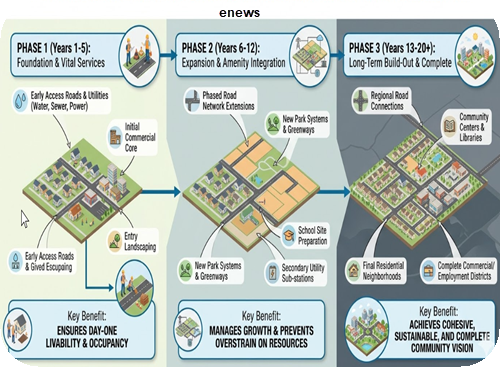
Developers already phase vertical construction to manage risk; they can apply the same discipline to utilities. Instead of constructing full buildout capacity at once, projects can deploy scalable wastewater systems that expand in step with occupancy. Initial modules serve the early phases. Planned expansions add capacity as new units come online.
This strategy reduces idle infrastructure and keeps capital aligned with delivered units. It also shortens timelines to first occupancy, since developers do not have to wait for ultimate buildout capacity before opening doors. Phased installation can match treatment capacity to development timelines, and developers can avoid the carrying costs of oversized systems by pairing capacity additions with actual growth.
Importantly, scalable planning does not mean underbuilding; it requires early master planning that anticipates expansion. Designers allocate land for future modules. Engineers establish hydraulic and permitting pathways that support staged growth. Developers simply time capital deployment to match real demand rather than hypothetical demand.
In practice, this approach mirrors how most large developments already manage roads, utilities, and community amenities. Infrastructure corridors are reserved, easements are established, and future expansion is anticipated even if the physical infrastructure is not yet installed. Wastewater treatment can follow the same philosophy. A plant designed for phased expansion can maintain regulatory compliance at each stage while preserving the flexibility to grow alongside the community it serves.
Across infrastructure sectors, the same principle is gaining traction: match investment to verified load rather than long-range projections.


In uncertain markets, flexible infrastructure protects projects from serious cash flow bottlenecks. Phased vertical construction already reflects that reality. When utility planning adopts the same mindset, infrastructure becomes a tool for risk management rather than a financial drag.
Modular wastewater systems extend that flexibility beyond design and into finance. Developers can install right-sized capacity for early phases, then expand in planned increments as occupancy grows. When paired with timeline-based leasing or performance-based Build-Own-Operate delivery structures, that scalability becomes even more powerful.
The traditional build-all-at-once model served the water sector well for decades. But as development timelines and financing models evolve, infrastructure delivery must evolve as well. Getting paid up front for the full buildout may still work for the water sector, but today’s MPC developers need phasing strategies, modular infrastructure, and the flexible financing to unleash them.