

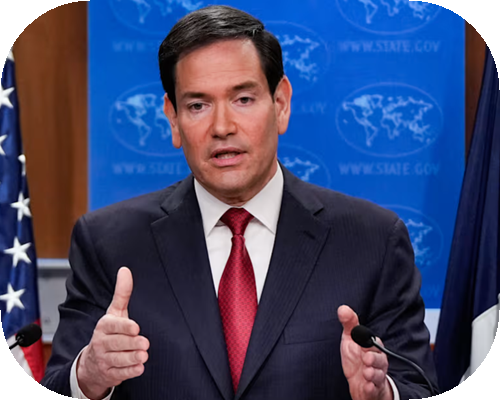
Secretary of State Marco Rubio speaks during a press conference. AP Photo
President Donald Trump’s plan for the United States to administer Venezuela following Nicolás Maduro’s ouster will play out in three primary phases, Secretary of State Marco Rubio said.
Speaking with reporters on Capitol Hill on Jan. 7, Rubio described the initial step as a stabilization effort followed by a second phase focused on recovery. The plan will ultimately conclude with a transition of power, he said.
Rubio’s comments followed a closed-door briefing to the U.S. Senate. Lawmakers and media have raised numerous questions about this interim plan for Venezuela in the days since U.S. forces conducted an early morning raid to capture Maduro and bring him to the United States to face narcotics trafficking and terrorism-related charges.
At the moment, Maduro’s deputy and political ally, Delcy Rodríguez, is serving as interim leader in Venezuela. Trump has indicated he’s willing to work with Rodríguez, so long as she remains cooperative with his administration’s efforts.





Stabilization Phase Includes Oil Transfers
Laying out the three-fold plan, Rubio said, “Step one is the stabilization of the country. We don’t want it descending into chaos.”
In this first phase, the secretary said the United States will continue to exercise control over access to Venezuela’s oil resources. Last month, Trump declared a blockade of oil tankers coming to and from Venezuela.
Since December, the U.S. government has seized four tankers, including the two most recent seizures taking place earlier on Wednesday.
“As you’ve seen today, two more ships were seized,” Rubio said.


“We are in the midst right now, and in fact, about to execute on a deal to take all the oil they have, oil that is stuck in Venezuela. They can’t move it because of our quarantine and because it’s sanctioned.”
Trump said on Tuesday that the United States will receive 30 million to 50 million barrels of Venezuelan oil in the near future.
Rubio told reporters on Wednesday that this Venezuelan oil would be sold at market rates, with the proceeds managed “in such a way that we will control how it is dispersed in a way that benefits the Venezuelan people, not corruption, not the regime.”
Outside Business, Internal Reconciliation in Phase 2
Rubio said the second step for post-Maduro Venezuela will be known as the recovery phase.
“And that is ensuring that American, Western, and other companies have access to the Venezuela market in a way that’s fair,” he added.
Along with opening Venezuela to foreign business enterprises, Rubio said the recovery phase of the process will see the creation of a reconciliation process within Venezuelan society. He said this process will allow opposition elements to “be amnestied and released from prisons or brought back to the country and begin to rebuild civil society.”
In December, Venezuelan opposition figure Maria Corina Machado defied a travel ban, escaping the South American country and appearing in Norway hours after her daughter accepted a Nobel Peace Prize on her behalf. Machado has since praised the U.S. operation to capture Maduro and reiterated a vow to return to Venezuela.


In separate remarks to the press on Wednesday, White House press secretary Karoline Leavitt said, “We obviously have maximum leverage over the interim authorities in Venezuela right now.”
Leavitt said Vice President JD Vance, Rubio, and others on Trump’s national security team remain in communication with Venezuela’s interim leadership.
Questions Surround Transition Timeline
As he spoke with reporters, Rubio did not lay out a precise timeline for each of the phases or the final transition of power in Venezuela.
“Obviously, this will be a process of transition. In the end, it will be up to the Venezuelan people to transform their country,” he said.
Venezuela’s constitution requires an election within 30 days in the event its president becomes “permanently unavailable” to serve. However, the Venezuelan Supreme Court has declared Maduro’s absence “temporary,” avoiding the 30-day election window.
In an interview with ABC News on Sunday, Rubio was asked how soon new elections might be held in Venezuela. Declining to offer a specific timeline, he said “there’s a lot of work to be done.”
Senate Minority Leader Chuck Schumer (D-N.Y.) criticized the Trump administration’s closed-door briefing, calling it a way to avoid a public discussion on the situation in Venezuela. The Wednesday briefing didn’t yield sufficient answers, he said.
“We need answers to these questions, and we need them made publicly,” Schumer said.
Rubio and Secretary of War Pete Hegseth provided a second closed-door briefing to members of the House of Representatives on Wednesday.
Following this second briefing, Rep. Gregory Meeks (D-N.Y.) told reporters that Democrats raised questions about the potential timeline for new elections in Venezuela but said “there’s no answer to that.”
Meeks raised further concerns that third-party actors, including left-wing guerrilla movements like the Fuerzas Armadas Revolucionarias de Colombia (FARC) and Ejército de Liberación Nacional (ELN), could add to the chaos during a transitional period.
“The ELN is still there, the FARC is still there. They’re in the bushes somewhere, hiding. And as long as you have instability, that then opens a door for them to try to take advantage,” Meeks said.
Rubio rebuffed the criticism from Democrats.
“We’ve gone into great detail with them about the planning. We’ve described it to them,” he said. “In fact, it’s not just winging it. It’s not just saying or speculating it’s going to happen. It’s already happening, like the oil arrangement that we’ve made.”
The Associated Press contributed to this report.